
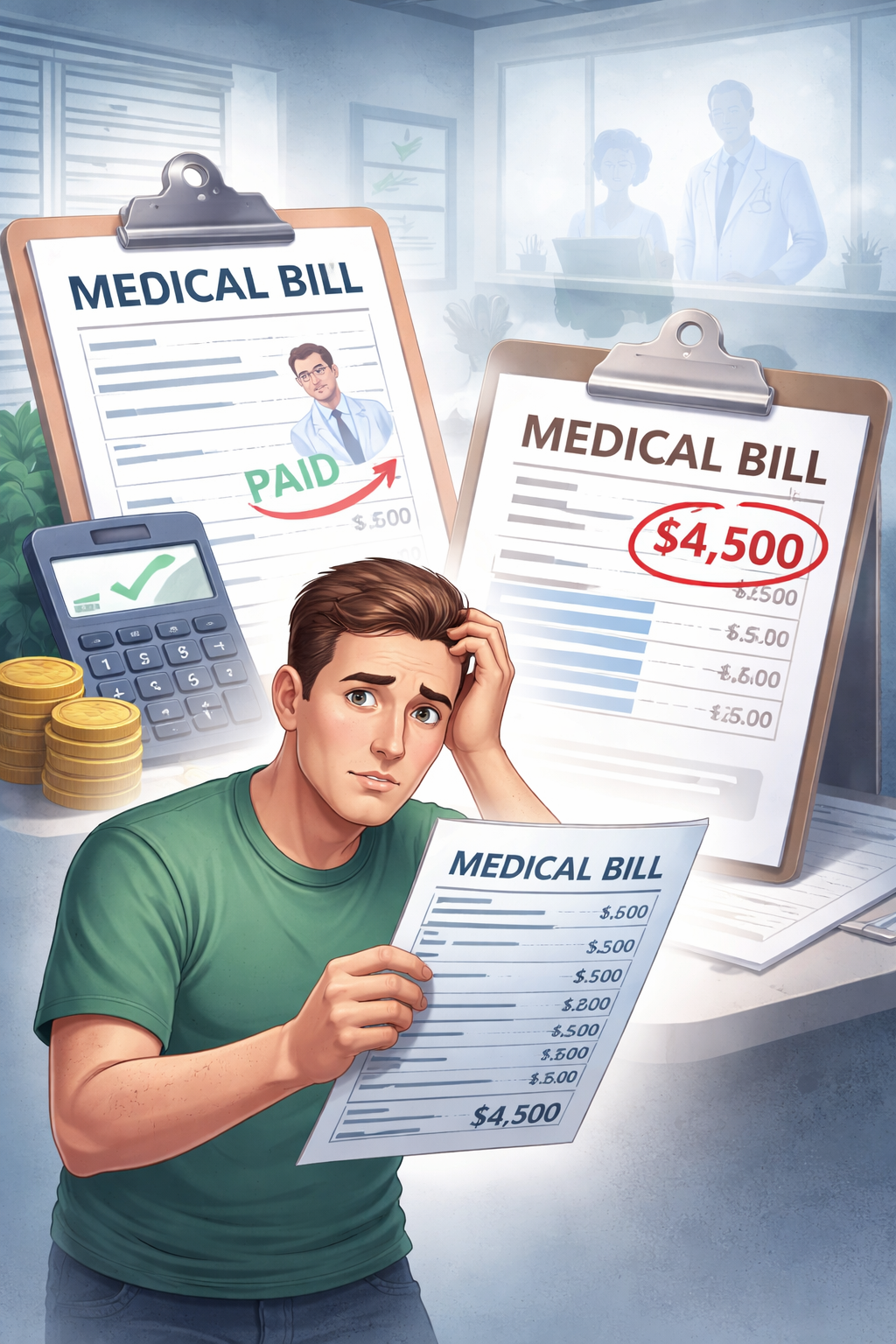
Insurance paid claim but provider billing full amount to patient was the last thing I expected to see after checking the account again. I had already looked at the insurance explanation of benefits, saw the claim had been processed, and assumed the numbers would settle on their own. Instead, the provider statement showed the full original charge as if the insurance payment had never happened. The amount was so high that it did not feel like a small delay. It felt like the account had skipped an entire layer of correction.
What made it worse was how ordinary the bill looked. There was no warning, no note saying the balance was temporary, no clear sign that the account was still being updated. Just a due date, a large balance, and the quiet impression that I was expected to pay it. That is what makes this kind of billing problem so risky: the bill looks final long before the account is actually accurate.
Before getting lost in phone calls, it helps to understand the broader billing logic behind these errors. This hub is the closest starting point because it explains how consumer billing problems form and why they often keep moving even when the numbers are wrong.
Why this happens even after insurance already paid
Insurance paid claim but provider billing full amount to patient usually does not mean the insurance failed to do its job. In many situations, the insurance side did exactly what it was supposed to do. The breakdown happens after that, when the provider’s billing ledger fails to absorb the insurance outcome correctly.
A medical bill usually moves through several stages. First, the provider creates the original charge. Then the claim is sent to insurance. Then the insurer decides the allowed amount, pays its share, and assigns the patient share. After that, the provider should post the insurance payment, apply any contractual adjustment, remove any amount that cannot legally be billed to the patient under the network agreement, and leave only the correct patient responsibility. If one of those middle steps fails, the provider statement can still show the full charge.
The insurance payment alone does not fix the bill. The provider ledger must also apply the right adjustment logic.
That is why insurance paid claim but provider billing full amount to patient is often a provider-side posting or adjustment problem rather than a true claim appeal issue. The claim may already be resolved. The bill is wrong because the provider account is not reflecting that resolution.
The exact points where the workflow can break
There is not just one version of this problem. Insurance paid claim but provider billing full amount to patient can happen through several different workflow failures, and knowing which one you have matters because the fix changes depending on the breakdown.
Main breakdown paths to check:
- Contractual adjustment missing: insurance payment posted, but the write-off tied to the network contract never hit the account.
- Allowed amount mismatch: the provider ledger still shows billed charges instead of recalculating from the insurer’s allowed amount.
- Out-of-network flag error: the provider or insurer classified the visit differently than expected, keeping the balance artificially high.
- Corrected claim delay: the first claim version is still driving the bill while a corrected claim is pending in the background.
- Secondary insurance hold: the provider left the full balance in place while waiting for another payer, even though the first payer already processed the claim.
- Portal display lag: the internal account may be partly updated, but the patient-facing portal is still showing the pre-adjustment amount.
- Manual review queue: the account was kicked out for human review, so the final patient balance never generated before the statement cycle.
The most common version is the first one: insurance paid, but the contract reduction never posted. In that situation, the system recognizes money came in from insurance, yet still behaves as if the patient could be billed for the unreduced difference. That is how a processed claim turns into a statement that looks inflated.
How to tell which version you are dealing with
If you want to solve insurance paid claim but provider billing full amount to patient quickly, do not begin with a general complaint that the bill is too high. Start by comparing the provider bill against the insurance explanation of benefits line by line.
Use this self-check to identify the problem type:
- If the EOB shows an allowed amount far below the original charge, but the bill still uses the original charge, the contractual adjustment or allowed-amount logic likely did not post.
- If the EOB shows the patient responsibility clearly, but the provider bill is still much higher, the provider ledger is probably still stuck on the pre-adjudication balance.
- If the EOB says the claim was reprocessed or corrected, but the provider bill looks unchanged, the provider may still be billing off the earlier claim version.
- If the insurer processed the claim as in-network, but the provider bill looks like out-of-network pricing, the network classification needs to be reviewed.
- If there is another insurance on file, the provider may be holding the full amount while waiting for the next payer to respond.
- If the provider says payment posted but the portal still looks wrong, the issue may be a display lag rather than a final ledger error.
This comparison is the fastest way to stop guessing. When patients skip this step, they often waste time calling the wrong department or arguing about a number without understanding which system actually produced it.
Why front-line billing staff often give confusing answers
One frustrating part of insurance paid claim but provider billing full amount to patient is that different people can look at the same account and give different explanations. That usually happens because they are not all seeing the same layer of the workflow.
One representative may see that insurance paid and assume the bill is now accurate. Another may see that a review flag is still active. Another may only see the patient-facing balance, not the underlying contract adjustment status. In some provider systems, payment posting, contractual write-offs, secondary billing, and portal display updates are all handled in separate modules. So the account can be half-correct internally and still look completely wrong on the screen the patient sees.
Confusing answers do not always mean bad intent. Sometimes they mean the system itself is fragmented.
That is why you need specific questions, not broad complaints. If you only say the bill looks wrong, you may get a generic answer. If you ask whether the contractual adjustment, allowed amount, and final patient responsibility were posted to the ledger, you are much more likely to move the account toward a real review.
What to say when you call the provider
When dealing with insurance paid claim but provider billing full amount to patient, the language you use matters. A vague call often ends with “please allow more time.” A precise call has a better chance of getting the account routed correctly.
Ask the provider billing office to review whether the insurance payment posted, whether the contractual adjustment was applied, whether the allowed amount on the EOB matches the ledger, and whether the current statement was generated before final patient responsibility was calculated. Ask for an itemized statement. Ask whether the account is on hold while the review is pending. Ask whether a corrected claim, rebill, or coordination-of-benefits issue is still open.
Do not ask only why the bill is high. Ask whether the account still reflects the original billed charge instead of the post-insurance amount.
If the provider confirms money posted but the balance still looks too high, this related article can help you understand the overlap with payment-display issues:
Detailed situation branches patients commonly fall into
Insurance paid claim but provider billing full amount to patient is easier to fix when you know which branch your situation fits into. Here are the most common real-world patterns.
Branch 1: Insurance paid, but provider never applied the contract discount
This is the classic inflated-balance problem. The EOB shows the insurer paid and reduced the charge under the network agreement, but the provider statement still looks like self-pay pricing. This usually needs a provider-side ledger correction.
Branch 2: Insurance processed the claim, but the visit was marked under the wrong network status
Here the disagreement is not just about posting. It may be about whether the claim should be treated as in-network or out-of-network. That can dramatically change what the patient owes.
Branch 3: A corrected claim exists, but the provider bill still follows the old claim version
You may hear that the claim was adjusted or reprocessed, yet the bill still looks untouched. In this branch, the billing office may need to rebalance the account after the corrected claim data finishes loading.
Branch 4: The provider is waiting on secondary insurance, but sent a statement too early
The full charge may appear because the first payer has processed the claim, while the provider is still waiting for another payer. The balance on the bill may not represent the final patient share at all.
Branch 5: The portal is wrong, but the internal ledger is partly fixed
This is less common but still important. A rep may tell you the adjustment is in progress or already posted, while the online balance still looks unchanged. In that situation, ask for an emailed or mailed account detail rather than relying only on the portal.
What not to do while trying to fix it
The worst move in insurance paid claim but provider billing full amount to patient is paying the full amount immediately just to stop the stress. Once the account is paid, the problem can turn into a refund fight instead of a billing correction, and refunds are often slower, harder to trace, and easier for providers to delay.
Another mistake is doing nothing because you assume the provider will catch the error later. Many billing systems continue aging balances even when the account is under informal review. Statements can keep generating. Calls can begin. Internal delinquency codes can build in the background. The account may not freeze unless someone places a real hold on it.
Silence does not protect your account. A documented review request and a hold request do.
How this turns into a collections problem if you wait too long
Insurance paid claim but provider billing full amount to patient becomes much more serious once time starts working against you. Even a wrong balance can move through statement cycles, aging thresholds, internal collection queues, or outside collection referral rules if the account is still technically open and unpaid in the provider’s system.
That is why this is not only a billing math problem. It is also a timing problem. If you wait for the provider to fix it eventually, the account can continue following a workflow designed for valid unpaid balances. A provider note that says “under review” is not always enough. You want to know whether a real hold is in place.
If you want to understand how disputed or inaccurate balances can still keep moving, this article is the best next read:
That matters here because patients often believe a complaint automatically freezes the account. In many systems, it does not.
What your practical rights look like here
This is not legal advice, but from a practical billing standpoint, you generally have the right to ask for an itemized bill, a corrected statement, and an explanation of how the insurance payment, allowed amount, adjustment, and final patient responsibility were applied. If the provider bill plainly conflicts with the EOB, you are not being unreasonable by demanding a review before paying.
For broader federal information on patient protections and medical bill rights, use this official source from CMS: CMS medical bill rights.
The core issue is simple: if the insurer processed the claim, the provider should not be treating the original full charge as the automatic patient obligation without reconciling the account first.
FAQ
Can a provider send me a bill for the full amount even after insurance paid?
Yes, it can happen, but that does not mean the bill is correct. Often the statement was generated before the contractual adjustment or final patient share was properly posted.
Is this the same as an insurance denial?
No. Insurance paid claim but provider billing full amount to patient is often a provider-ledger issue after the claim was already processed.
Who should I call first?
Usually the provider billing office first, because the provider controls the patient-facing statement and the account ledger.
What documents should I have ready?
Have the provider bill, the EOB, claim dates, and any notice showing whether the claim was corrected, reprocessed, or pending secondary insurance.
What if the balance gets even worse after they “adjust” it?
That can happen when a billing adjustment is reversed, reloaded incorrectly, or tied to a corrected claim that changed the account math. If that sounds close to your situation, read this next:
Key Takeaways
- Insurance paid claim but provider billing full amount to patient is usually a provider billing-system problem, not a pure claim appeal problem.
- The most common failure is that the insurance payment posted, but the contractual adjustment or allowed-amount logic did not.
- The bill can look final even when the ledger is still incomplete or wrong.
- You should compare the EOB and the provider statement line by line before making calls.
- Ask specifically about contractual adjustment, allowed amount, final patient responsibility, and whether the account is on hold.
- Do not pay the full amount just to make the problem disappear.
- If the account is not held, a wrong balance can still move toward collections.
The hardest part about insurance paid claim but provider billing full amount to patient is that it makes the wrong number feel official. The statement arrives cleanly. The due date looks real. The balance sits there long enough that you begin to wonder whether the insurer paperwork somehow meant less than you thought. But a medical statement can be polished and still be wrong. A patient portal can look final while the ledger behind it is unfinished.
So the next step should be immediate and specific: compare the EOB to the provider bill, call the provider billing office, ask whether the insurance payment, contractual adjustment, and final patient responsibility were actually posted, request an itemized statement, and ask for a hold while the account is reviewed. Do not let a paid claim turn into a patient debt simply because the provider ledger failed to catch up.