
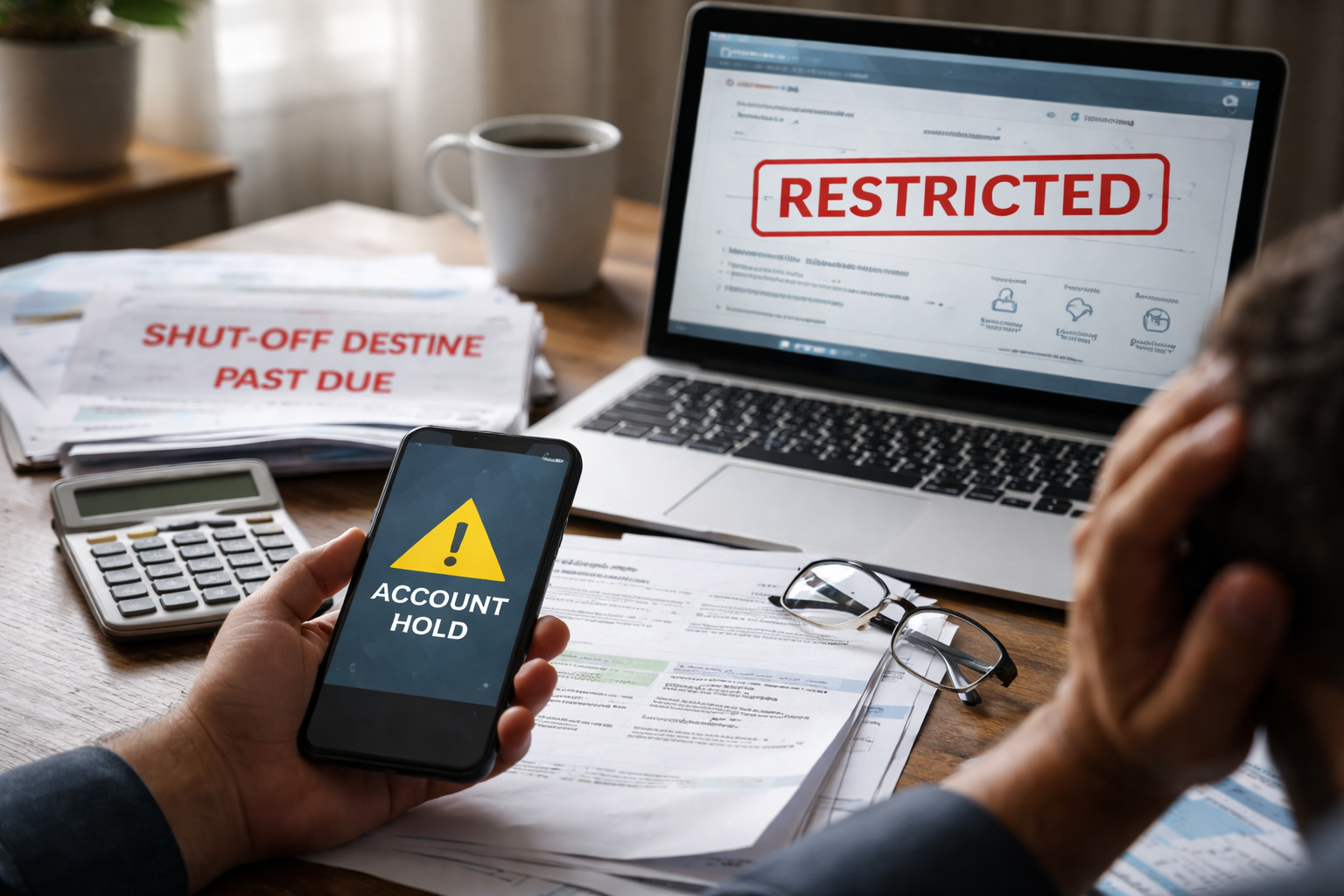
Utility Account Placed on Administrative Hold After Billing Dispute was the phrase the agent repeated, like it was routine. I had called thinking I’d get a simple correction—one wrong charge, one quick adjustment. Instead, the portal showed “Restricted,” my online options disappeared, and the rep told me they couldn’t change anything “until the hold clears.” That was the moment it clicked: I wasn’t dealing with a normal bill anymore. I was dealing with a workflow.
The weird part was the contradiction. My bank showed the last payment cleared. My statement showed a credit pending. But the account banner stayed the same. When Utility Account Placed on Administrative Hold After Billing Dispute appears, you can be fully paid and still be frozen. If that’s your situation, this guide is built to help you map your exact case, avoid the mistakes that extend holds, and get to a clean resolution without turning it into a bigger fight.
If you want the “why” behind payment posting and credits first, this is the closest hub-level explainer on the site and it will make the rest of this article easier to follow:
In many Utility Account Placed on Administrative Hold After Billing Dispute situations, the hold is caused by how payments/adjustments are allocated internally—not by your intent or behavior.
Why This Hold Happens in Real Systems
Most utilities use rule-based billing platforms: a customer ledger, a dispute module, and a collections module. The minute a dispute is filed, the account may be assigned a “status” that limits what can happen while the review is open. Utility Account Placed on Administrative Hold After Billing Dispute usually appears when the system tries to prevent one module from making changes that would contradict another module.
Common internal triggers include:
- Adjustment pending threshold: a credit or correction is queued but not finalized, so the ledger is temporarily locked.
- Collections pause mismatch: the dispute module pauses some actions, but the collections timer is still running in the background.
- Meter or usage review flag: disputed consumption triggers a usage audit, which freezes billing edits until verification is complete.
- Identity/authorization gate: if the dispute involves a name mismatch, address change, or third-party payment, the system may require verification.
- Multiple dispute records: if you filed more than one dispute or reopened a closed one, layered flags can keep the hold active even after one issue is fixed.
Utility Account Placed on Administrative Hold After Billing Dispute is often a containment setting, not a verdict. The goal is to protect reconciliation and audit trails while the account is in review.
Find Your Exact Scenario
How to use this box: Pick the closest case below, then follow the “What to ask” and “What to do today” steps. Utility Account Placed on Administrative Hold After Billing Dispute resolves faster when your request matches the internal queue you’re actually in.
Case A — Paid in full, portal still says “Restricted”
What it usually means: Your payment posted, but the dispute record is still open or the ledger is locked waiting for an adjustment batch to finalize.
What to ask: “Is the dispute status Open / Pending Review / Approved / Closed? What is the dispute case number and the reason code?”
What to do today: Request a written note (email or letter) confirming: (1) payment posted date, (2) hold reason, (3) expected release timeline.
Case B — You received a partial credit, but the remaining balance is disputed
What it usually means: The utility applied an adjustment to one line item, but the remaining charge continues to age. Some systems hold the account until the entire dispute package is closed.
What to ask: “Which line items were credited? Which items remain ‘in dispute’ and are they excluded from late fees/disconnection?”
What to do today: Pay the undisputed portion (if any) and get confirmation the disputed portion is coded to prevent collections action.
Case C — Autopay failed or got blocked after the dispute
What it usually means: Autopay is often disabled automatically during restricted status to prevent posting errors or accidental overpayment during review.
What to ask: “Is autopay suspended due to hold status? Will it reactivate automatically when the hold clears?”
What to do today: Make a manual payment for the undisputed amount and store proof of payment. If you’re also seeing bank confirmation issues, compare your case here.
Case D — Service is threatened or limited even though you paid
What it usually means: Either the collections timer wasn’t properly paused, or the system still sees a delinquent bucket despite posted payment.
What to ask: “Is there an active disconnection order? Is the account coded as ‘protected during dispute’?”
What to do today: Escalate to a supervisor with a concise timeline and request an immediate disconnection pause while review is verified.
Case E — You moved, changed names, or updated bank info recently
What it usually means: Account changes can trigger an identity verification step when a dispute is active. Some utilities freeze edits to avoid “wrong person” adjustments.
What to ask: “Is the hold due to identity verification, address validation, or account ownership review?”
What to do today: Provide only what’s requested (ID verification method, proof of residence if needed) and get the hold reason documented.
Case F — You filed multiple disputes, reopened one, or used multiple channels
What it usually means: Duplicate tickets create layered flags. Even if one closes, another may keep Utility Account Placed on Administrative Hold After Billing Dispute active.
What to ask: “How many dispute records are open on my account? Can we consolidate them?”
What to do today: Ask them to merge cases and confirm which case number controls the hold release.
Case G — You received a collections notice while the dispute is pending
What it usually means: Either the dispute wasn’t coded correctly, or collections was triggered by a separate balance bucket (older charges, fees, or a different service address).
What to ask: “Is the collections action tied to the disputed invoice, or to a separate charge bucket?”
What to do today: Escalate immediately and request written confirmation that the disputed amount is coded as disputed and protected from collections while investigated.
If your situation includes service restriction even though you paid, use this related guide for comparison and language you can reuse on the phone:
What the Utility Is Doing Behind the Scenes
When Utility Account Placed on Administrative Hold After Billing Dispute appears, there’s usually a workflow queue assigned to your account. Typical steps look like this:
- Intake: the dispute is logged with a category and a reason code (duplicate charge, meter reading, estimated usage, late fee dispute, allocation mismatch).
- System protection: the account status changes to prevent conflicting actions (credit issuance, plan changes, transfers, closures).
- Evidence check: the utility verifies meter data, service dates, payment posting timestamps, and ledger allocations.
- Decision step: adjust, partially adjust, deny, or request more information.
- Reconciliation: the ledger is updated and the account is re-aged (this is where holds sometimes “stick”).
- Release: the hold is removed or converted to a different status (sometimes “monitoring” or “review closed”).
The sticky part is reconciliation. That’s why you can see “paid” and still have Utility Account Placed on Administrative Hold After Billing Dispute. The system may wait for nightly or weekly batching to finalize credits, reverse fees, or rebuild the aging bucket.
A Self-Check Checklist Before You Call
To make your call productive, collect these items first. This isn’t busywork—this is the set of facts utilities use to unlock the hold.
- The disputed invoice number(s) and service period dates
- Proof of payment (bank confirmation, screenshot, confirmation ID)
- Your portal history showing “Restricted” or “Hold” status
- The exact amount you dispute vs. the amount you agree is owed
- Any prior case numbers (including web chat tickets or email threads)
When you can state the timeline cleanly, the hold stops being a story and becomes a task.
The Script That Gets the Hold Explained
When you reach a human, keep it short. You’re trying to get internal labels, not vent. You can say:
“My account shows Utility Account Placed on Administrative Hold After Billing Dispute. I need the dispute case number, the reason code, and confirmation of whether disconnection/collections is paused. What date is the hold scheduled to release, and what condition triggers release?”
Then ask these follow-ups, one at a time:
- “Is the hold for billing review, meter/usage review, compliance verification, or collections containment?”
- “How many dispute records are open on the account?”
- “Is autopay disabled due to status, and does it restart automatically?”
- “Can you email a note summarizing the hold and timeline?”
Written confirmation is the lever. Utility Account Placed on Administrative Hold After Billing Dispute becomes much easier to resolve when the utility commits to a stated reason and date.
Do This If the Hold Blocks Payment Posting or Cutoff Timing
Sometimes the hold doesn’t just freeze edits—it creates timing problems. A payment made after a cutoff time can post the next business day, while the dispute queue remains open, and the system briefly shows delinquency. That’s how people get late fee notices during a dispute.
If your payment timing is part of the confusion, this guide helps you align your timeline with how posting actually works:
In Utility Account Placed on Administrative Hold After Billing Dispute cases, ask specifically: “What is the posting date recognized by the utility ledger, not my bank?”
Consumer-Safe Escalation Without Overheating the Case
If your first call doesn’t produce a case number, reason code, and timeline, your next step is escalation—but clean escalation. That means you keep the same facts and simply route them higher.
- Ask for a supervisor or the billing disputes unit.
- Request a written summary note that your dispute is active.
- Confirm disconnection is paused while the dispute is pending (if applicable).
- Ask whether the case requires documents and where to upload them.
If the situation starts drifting toward collections or the utility keeps giving vague answers, use this step-by-step escalation roadmap (it’s designed to keep the process orderly):
Escalation works best when your request is specific: reason code + timeline + written confirmation.
Official Consumer Protection Guidance
For a plain-English, official framework on resolving billing and service problems with a provider, review the Federal Trade Commission guidance on
solving problems with a business (returns, refunds, and other resolutions)
This helps you keep your dispute factual, request a supervisor correctly, and document the outcome without escalating the situation unnecessarily.
Mistakes That Extend Administrative Holds
- Opening new disputes for the same charge: creates duplicate records that keep the hold alive.
- Refusing to pay undisputed amounts: can trigger a separate delinquency bucket.
- Assuming the hold pauses everything: some systems still send automated notices unless correctly coded.
- Threatening legal action on the first call: can route your case to a slower channel without adding clarity.
- Filing a chargeback immediately: may complicate utility billing workflows and prolong reconciliation.
Utility Account Placed on Administrative Hold After Billing Dispute often clears once the account returns to a single, consistent narrative in the system: one dispute record, one ledger balance, one resolution step.
FAQ
Is Utility Account Placed on Administrative Hold After Billing Dispute the same as being delinquent?
No. It’s a status flag indicating controlled review. You can be current and still have the hold.
Can my utility shut off service during a dispute?
Many utilities pause disconnection during valid disputes, but you must confirm your account is coded correctly and get it documented.
What if my bank shows payment but the utility says it didn’t post?
Ask for the ledger posting date recognized by the utility and compare it to cutoff policies and allocation logic.
How long do holds usually last?
Often 7–30 days, but layered disputes or meter investigations can take longer.
What’s the fastest way to get the hold explained?
Ask for the dispute case number, reason code, and the release condition in writing.
Key Takeaways
- Utility Account Placed on Administrative Hold After Billing Dispute is usually a workflow containment flag.
- The fastest path is: case number + reason code + written timeline.
- Pay undisputed amounts to avoid secondary delinquency buckets.
- Avoid duplicate disputes; consolidate records when possible.
- Use escalation only when you’re missing internal labels or a clear release condition.
The first time I heard Utility Account Placed on Administrative Hold After Billing Dispute, I treated it like a generic excuse. It wasn’t. It was a system state. Once I asked for the case number, the reason code, and the release condition, the conversation changed. The agent stopped repeating policy lines and started reading actual notes.
Here’s what you should do right now: pull your timeline, call, and request three items—(1) dispute case number and reason code, (2) written confirmation that disconnection/collections is paused if your dispute is active, and (3) the exact condition and date the hold is scheduled to clear. Do not leave the call without a documented next step. Utility Account Placed on Administrative Hold After Billing Dispute ends when the system has one clean record to close—help them close it.