
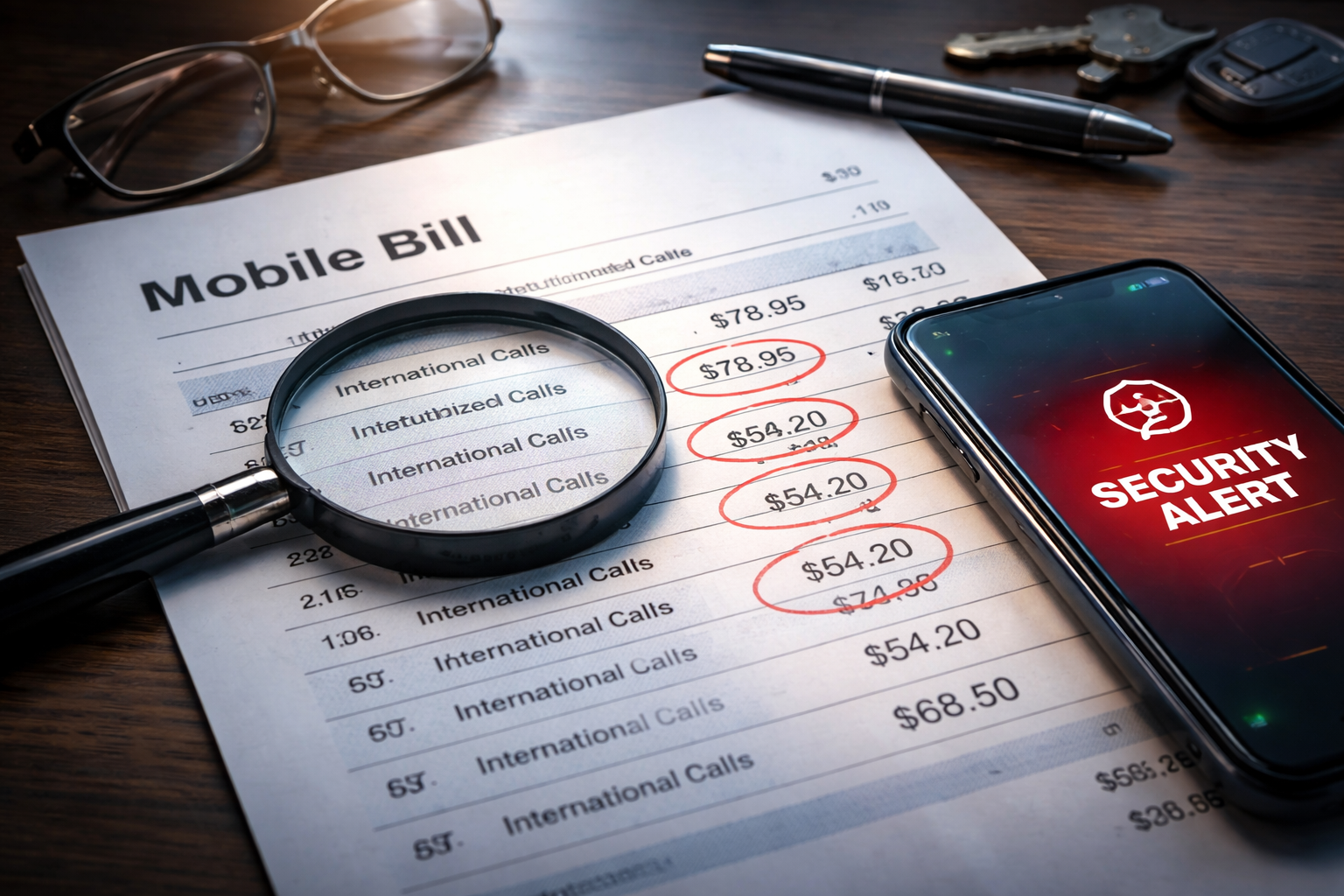
Unauthorized international calls mobile bill — I saw it while doing the most boring task: checking my carrier app to confirm autopay didn’t fail. The balance looked inflated, so I tapped into the call details expecting a simple mistake. Instead, there were international numbers I didn’t recognize, spaced out through the night like someone had been “using” my phone while it sat on my nightstand.
I didn’t feel dramatic. I felt alert. Because once you see charges tied to places you’ve never called, you’re no longer dealing with a bill — you’re dealing with an account-security event. And the real risk isn’t just the amount. It’s that the same path can stay open and keep generating charges until you close it.
If you’re here because this happened to you, the goal is simple: stop repeat calls, preserve dispute leverage, and push the carrier into a real investigation rather than a polite shrug. A confirmed unauthorized international calls mobile bill is one of those problems where “waiting to see what happens” is the most expensive choice.
Start With a 3-Minute Reality Check (So You Don’t Dispute the Wrong Thing)
Before you call anyone, do a fast verification so you can describe the problem cleanly:
Quick Self-Check (Answer Yes/No):
1) Was anyone else holding your phone during those times (kids, spouse, coworker)?
2) Are the “international” numbers actually saved contacts shown in a different format?
3) Do you have Wi-Fi Calling enabled, and did you recently travel or change SIM/eSIM?
4) Did you install any “free” calling, VPN, keyboard, flashlight, or launcher apps recently?
5) Did you receive any “your SIM was updated / your number was ported” texts or emails?
If you can’t confidently explain the calls, treat it as unauthorized until proven otherwise.
This is not about blaming yourself. It’s about choosing the correct lane. A carrier will respond differently if you report “my bill is wrong” versus “my account was used without authorization.” Your case gets traction faster when you frame it as unauthorized international calls mobile bill plus immediate security controls.
The 4 Core Causes (Detailed Case Split You Can Match to Your Situation)
Signs: password reset emails you didn’t request, new devices listed, profile changes, call forwarding added, paperless billing toggled, new “authorized user.”
Why it happens: reused passwords, weak PIN, email compromise, leaked credentials.
Best move: lock account + change PIN + request a fraud note + verify no forwarding features are active.Case B — SIM Swap / Number Port-Out Attempt
Signs: sudden “No Service,” SIM/eSIM changed, your phone stops receiving calls/texts, carrier says “a new SIM was activated.”
Why it happens: criminals move your number to another SIM to generate calls or intercept verification codes.
Best move: call carrier fraud department, add a port freeze/port-out PIN, confirm the SIM history and activation timestamps.Case C — Device/App Abuse (Permissions or Malware)
Signs: battery drain, unknown apps, pop-ups, call permission granted to weird apps, accessibility services enabled unexpectedly.
Why it happens: some apps abuse call permissions or trigger dial actions; others hide as “system tools.”
Best move: remove suspicious apps, review call permissions, run a reputable mobile security scan, and reset network settings if needed.
Case D — “Not Really International” Billing Confusion (But Still Disputable)
Signs: calls show as international because of routing, voicemail access numbers, international conferencing bridges, or mis-rated numbers.
Why it happens: number formatting and routing can misclassify calls, especially with Wi-Fi Calling or carrier-side rating errors.
Best move: request a rating review and itemized explanation for the exact dialed digits and routing path.
Most people guess. Don’t. Match your facts to the buckets above, then take the steps for that bucket. That alone makes your unauthorized international calls mobile bill dispute sound like it came from someone who has handled it before.
What the Provider Usually Thinks (So You Can Counter It)
Carriers are built to assume that if the SIM authenticated the network, the usage was “yours.” That’s not personal — it’s how telecom systems operate. But you can push them from “billing question” to “fraud investigation” by providing the right signals.
What They Check Internally:
• SIM/eSIM activation history (date/time, store/online channel)
• Device identifiers tied to the line (IMEI changes)
• Location indicators (tower / region patterns)
• Account access logs (new device login, IP patterns)
• Feature changes (international dialing enabled, call forwarding, number transfer requests)
Your job is to force these checks to happen, not to “argue” about the amount.
When you report unauthorized international calls mobile bill, ask explicitly for: “a fraud case number,” “a billing investigation,” and “a block on international calling until resolved.” Those are operational steps — not opinions.
Your Rights
You don’t need to cite laws like a courtroom. You need to communicate like a consumer who knows the process. Keep it factual. Keep it consistent.
- You have the right to request an itemized explanation of charges.
- You have the right to dispute charges you did not authorize and request an investigation.
- You have the right to add account-level security controls (port freeze, PIN, blocks) to prevent repeat loss.
For a clear overview of phone-bill structure and dispute basics, this FCC consumer guide is a solid reference:
Use the FCC page as your confidence anchor, not as a threat. Your tone should be calm: you are reporting unauthorized usage and requesting the standard investigation steps.
Do This Today: The 60-Minute Action Plan
This is the fastest path that preserves leverage and stops repeat charges.
• Ask the carrier to place an international calling block (temporary or permanent).
• Confirm call forwarding is OFF on your line.
• Change your carrier account password + account PIN immediately.Step 2 — Create a Paper Trail (10 minutes)
• Screenshot the call log (dates, times, numbers, amounts).
• Screenshot your plan details (international calling settings if shown).
• Write down: when you discovered it, what you did first, and any alerts you received.Step 3 — Open a Fraud Investigation (20 minutes)
Call the fraud department (not just billing) and say:
“I am formally disputing unauthorized international calling charges and requesting an investigation and reversal.”
Ask for a case number and the exact timeline for results.
Step 4 — Lock the Weak Link (20 minutes)
• If email is tied to the carrier login, change your email password too.
• Enable two-factor authentication where possible.
• Review authorized users and remove anything unfamiliar.
Handled this way, a unauthorized international calls mobile bill is no longer “my bill is high.” It becomes “my line was used without authorization; here are the controls I’ve applied and the evidence.” That difference matters.
Script That Works (Use This Verbatim)
When you call, avoid long stories. Use a short, repeatable script:
Phone Script:
“Hi. I’m calling about international calls on my line that I did not make. I’m formally disputing the charges as unauthorized. I need an investigation opened, an international calling block placed, and a case number. Please also check whether my SIM/eSIM or device on the line changed recently, and whether any account features like call forwarding were modified.”
If the agent tries to keep it vague, calmly repeat: “I need a fraud case number and investigation timeline.” This is how you keep a unauthorized international calls mobile bill from becoming an endless loop of transfers.
Evidence Checklist (This Is What Wins Refunds)
Refund outcomes often hinge on whether you can show “I noticed quickly” and “I locked it down.”
Collect These:
• Screenshots of the call detail list and total charges
• Your phone’s location proof if relevant (calendar events, work shift times, travel receipts)
• Any carrier alerts (SIM change, password reset, login warnings)
• A short written timeline (discovered → called → blocked → case number)
• Confirmation of international block and port-out protection
Keep the focus on facts. A clean evidence packet makes a unauthorized international calls mobile bill easier to reverse because it gives the carrier something to “approve” internally.
What Not to Do (These Mistakes Quietly Kill Your Leverage)
- Don’t wait for the next billing cycle “to see if it fixes itself.”
- Don’t rant or accuse an agent personally; keep it procedural.
- Don’t ignore security while disputing; repeat charges undermine your story.
- Don’t accept partial answers like “international calls are valid if they show on the log.” Ask for the fraud investigation anyway.
One common trap: people pay the full amount to “avoid late fees” and never formally dispute. If you must pay to keep service active, still open the dispute and ask what portion can be held during investigation. For unauthorized international calls mobile bill problems, process beats emotion.
Prevent It From Happening Again (Fast Hardening Checklist)
Once this is resolved, keep the door closed.
- Keep international calling blocked by default (enable only when needed).
- Add a port-out freeze or port-out PIN to your line.
- Use a unique password for your carrier login (not reused anywhere).
- Audit your apps monthly: remove anything you don’t truly use.
- Check your carrier account for new authorized users and feature changes.
Most repeat incidents happen because the original weak point stays open.
Recommended Reading (Related Fix Guides)
If you want to strengthen your overall telecom dispute playbook, these are the most relevant on this site:
Use this when the carrier agrees it’s wrong, but stalls on adjusting the total.
Best if your account shows international activity tied to travel, towers, or roaming rating issues.
FAQ
How fast should I report this?
Same day if possible. The sooner you report and lock the account, the stronger your investigation outcome tends to be.
What if the carrier says the calls “originated from my SIM,” so it’s my responsibility?
That’s a common first response. Repeat the request for a fraud investigation, SIM/eSIM history review, and feature audit (call forwarding, port activity). Ask for a case number and timeline.
Should I factory reset my phone?
Not immediately. First preserve screenshots and account evidence. Remove suspicious apps and lock your carrier account. If the device is clearly compromised, then consider a reset after backing up essentials.
Can I keep service on while disputing?
Often yes. Ask whether the disputed portion can be separated during investigation and what minimum payment keeps the line active.
What if the calls were made by someone on my family plan?
Still document and request itemized detail. If it wasn’t authorized by the account holder, you can still ask for a review and prevention measures (blocks, permissions, controls).
Key Takeaways
- unauthorized international calls mobile bill is a security event, not just a high bill.
- Block international calling first, then open a fraud investigation with a case number.
- Match your situation to the case split (login takeover, SIM swap, device/app, rating confusion).
- Evidence + timeline wins more refunds than anger.
- Prevent repeats with port-out protection and default blocks.
When this happened to me, the biggest shift was realizing the “call log” is not the same thing as “authorization.” A log can show what the system recorded. It cannot prove you approved it. That’s why a unauthorized international calls mobile bill must be handled like a controlled dispute with security actions attached.
Do this today: call the carrier’s fraud department, request an international calling block, reset your carrier password and PIN, and open an investigation with a case number. Those steps stop the leak and force a real review. If you take only one thing from this page, let it be this: unauthorized international calls mobile bill gets easier to fix when you act immediately and document everything once — cleanly, calmly, and fast.