
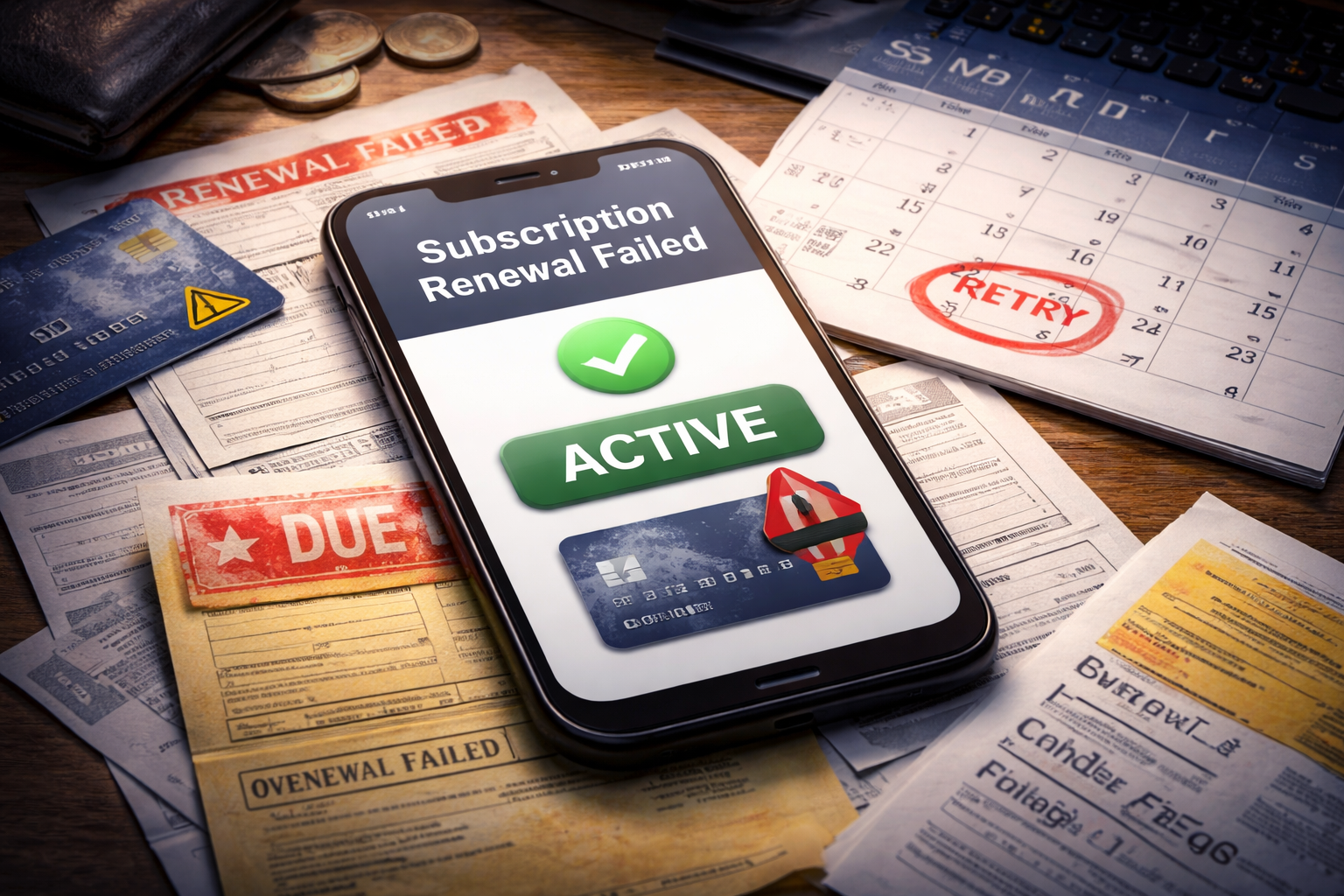
Subscription shows active after failed renewal but user still charged on retry cycle was not something I expected to deal with twice in the same week. The first sign looked small: a failed renewal notice that made it seem like the subscription had simply not gone through. I assumed the account would either lock, downgrade, or cancel on its own. Instead, the service stayed active, nothing looked urgent, and the account page gave me just enough reassurance to move on.
Then the charge appeared later anyway. Not at the same moment. Not in a way that made sense. It showed up after I had already treated the failed payment like the end of the story. That is the trap with this kind of billing problem: the failed renewal is often not the real event. The real event is the retry cycle that keeps running after the account still looks active.
If that is where you are right now, the problem is probably not a random glitch. It is usually a billing design issue involving grace access, retry scheduling, payment authorization timing, and account-state mismatch. That is why subscription shows active after failed renewal but user still charged on retry cycle keeps catching people off guard. The page says one thing, the billing engine does another, and the customer only finds out when money moves.
To understand how these billing breakdowns start across consumer accounts, this broader hub can help frame the issue before you deal with the specific subscription problem below.
Why This Problem Feels So Misleading
subscription shows active after failed renewal but user still charged on retry cycle feels deceptive because the customer sees two messages at once without realizing it. One message is visible: the payment failed, so the user thinks the billing event is over. The other message is hidden inside the system: the service remains in an active or semi-active state while retry logic continues in the background.
That gap matters. Many subscription companies do not shut access off immediately after a failed renewal. They often leave the account active for a short period because they want to preserve continuity, reduce churn, and recover the payment automatically. From the company’s perspective, this is retention logic. From the customer’s perspective, it looks like the failed payment did not matter, or worse, that the service is somehow being provided without a successful charge.
The account can look stable while the billing system is still actively trying to collect money.
That is the central reason subscription shows active after failed renewal but user still charged on retry cycle becomes such a nasty surprise. The customer reads the visible screen. The company relies on the invisible schedule.
What Usually Happens Behind the Scenes
In a typical setup, the subscription engine does not treat a failed renewal as a final stop. It treats it as an interruption to be corrected. That means several different system actions may happen after the first failure:
- The invoice remains open instead of closed
- The account stays active during a grace period
- A retry scheduler sets one or more future payment attempts
- The payment processor may create new authorizations on later dates
- The customer may receive no clear notice beyond the original failure
This is why subscription shows active after failed renewal but user still charged on retry cycle is usually not a contradiction. It is a sequence. The failure happens first. The retry succeeds later. By the time the customer notices, the system has already treated the later successful attempt as valid recovery.
Sometimes the account is marked “active” because access has not been cut off yet. Sometimes it is marked “current” because the interface updates more slowly than the payment processor. Sometimes it says “renewal issue” in one part of the dashboard and “active plan” in another. When different system layers update at different speeds, users are left guessing which status actually controls the money.
The Most Common Branches of This Billing Loop
Branch 1: Failed Renewal, Then Silent Retry Success
The original renewal attempt fails because of insufficient funds, an expired card, a bank block, or a temporary network issue. The service remains active. A second attempt succeeds a day or two later. The customer sees only the later charge and assumes the company charged without permission.
Branch 2: Active Access During Grace Period
The account stays usable after the failed payment, so the user assumes everything is fine or that the platform forgave the failed charge. In reality, the company is simply keeping access open while trying again in the background.
Branch 3: Manual Update Triggers a Retry
The user updates the card after the failed attempt, thinking they are just fixing the account for the future. The platform immediately retries the unpaid renewal balance and charges the card right away.
Branch 4: Pending Charge Confusion
A failed attempt creates an authorization issue or temporary hold. Later, a successful retry posts as an actual charge. The user thinks they were charged twice, but one was pending and one posted. In other situations, both actually post.
Branch 5: Multiple Retry Windows
The system retries at 24 hours, then 72 hours, then seven days. If the customer does nothing, the platform may continue making attempts longer than expected.
Branch 6: Cancellation Happens Too Late
The customer cancels after the failed renewal but before noticing that a retry had already been queued. The later charge still posts, and support argues that the retry was already in motion before cancellation was completed.
Those branches matter because they require different proof and different arguments. If subscription shows active after failed renewal but user still charged on retry cycle happened to you, your next step depends on which branch you are in.
How To Tell Which Version You Are Dealing With
Start by checking four things at the same time, not one by one:
- The exact timestamp of the failed renewal notice
- The account status shown in your subscription dashboard
- The date and time of the later posted charge
- Any email or app notice showing retry, grace period, or updated payment method
If the later charge happened after you updated your card, your issue may be an unpaid balance recovery rather than a new renewal. If the charge appeared after you canceled, the question becomes whether the cancellation was processed before the retry instruction was finalized. If the account never lost access, then the company will often claim the plan remained active and collectible the whole time.
The difference between a new billing cycle and a recovered failed cycle is one of the most important distinctions in the entire dispute.
That is where many customers lose the argument. They complain that the company “charged again,” while the company responds that it only completed an earlier failed renewal. If you do not separate those two possibilities, support can dismiss the complaint faster than you expect.
What Companies Rely On When They Defend The Charge
When subscription shows active after failed renewal but user still charged on retry cycle leads to a dispute, the company usually leans on a few predictable points:
- The subscription terms allow retry attempts after failed payments
- The service remained available during the grace window
- The unpaid renewal balance was still owed
- The payment method on file was still valid for collection
- The account was not fully canceled before the successful retry
That does not automatically mean the company is right. It means the company has a system narrative ready before you even contact support. If the platform failed to disclose retries clearly, mislabeled the account status, ignored a timely cancellation, or posted duplicate attempts, then the situation changes. But you need records, not just frustration.
For broader subscription charging problems that can overlap with this issue, this related page may help you compare patterns.
What You Should Do Right Now
If subscription shows active after failed renewal but user still charged on retry cycle is happening now, move in a specific order:
- Take screenshots of the current subscription status, billing history, and cancellation page if available
- Check whether the charge is pending or fully posted
- Look for any email mentioning retry attempts, grace period, or past-due renewal
- Cancel the subscription manually if it is still active
- Remove or replace the stored payment method if the platform allows it
- Contact support and ask whether the charge was a new renewal or a recovered failed renewal
- Request the exact timestamp of cancellation and the exact timestamp of the charge event
You need the platform to identify the charge type in writing. Without that, you are arguing against a system label you cannot see.
If support confirms that the charge was tied to the earlier failed cycle, then ask whether access was preserved during the grace period, whether retries were disclosed, and whether cancellation was completed before the retry succeeded. If support gives vague answers, keep the conversation in writing and avoid phone-only discussions when possible.
Mistakes That Make The Situation Worse
Several common mistakes turn a fixable problem into a messy one:
- Assuming a failed renewal automatically cancels the service
- Waiting days before checking whether the charge posted
- Deleting the app without canceling the plan
- Updating the payment method without reviewing unpaid balance status
- Calling support before taking screenshots
- Focusing only on the amount instead of the billing sequence
One of the worst mistakes is treating the dashboard status as the full truth. The visible account page is often only one layer of the billing environment. Payment processors, invoice ledgers, and retry schedulers may all be operating on timelines the customer never sees. That is why subscription shows active after failed renewal but user still charged on retry cycle can feel irrational when it is actually the result of several internal systems not speaking clearly to the user.
If The Charge Hit After You Thought You Had Canceled
This is the most frustrating branch. You saw a failed renewal, you thought the issue was over, and maybe you even canceled later. Then the money still came out. In this version, the key issue is timing. You need to find out whether:
- The cancellation request was submitted before the successful retry
- The cancellation was merely requested but not fully processed
- The account remained active until the end of the period despite the cancellation action
- The platform had already queued the retry before you canceled
If your cancellation screen said the service would remain active until the end of the current term, the company may argue that billing recovery was still permitted during that period. If your cancellation was supposed to take effect immediately and the charge came after that point, your refund argument is stronger.
This related post can help if the problem grows into a canceled-but-still-billed situation.
Key Takeaways
- Failed renewal does not always end the subscription process
- Active status can continue while retry billing is still running
- The later charge may be a recovered failed renewal, not a new cycle
- Cancellation timing matters more than many customers realize
- Screenshots, timestamps, and written support answers are critical
FAQ
Why did my subscription stay active after the renewal failed?
Many services use a grace period that keeps access active while they retry the payment.
Is the later charge always unauthorized?
Not always. It may be an authorized retry under the subscription terms, but that depends on the timing, disclosures, and whether cancellation was already effective.
Why does this feel like a double charge sometimes?
Because one payment event may appear as a failed attempt or pending authorization while another later event posts successfully. In some situations, duplicate successful retries can happen too.
Can I dispute the charge with my bank?
Possibly, but it is usually better to first determine whether the platform treated the charge as recovery of a previously failed renewal. Your evidence matters.
What is the first thing I should save?
Save the account status, billing page, support chat, and the timing of the failed renewal notice and later charge.
What To Do Before Another Retry Goes Through
Subscription shows active after failed renewal but user still charged on retry cycle does not usually stop on its own just because you noticed it. If the account is still open, the payment method is still on file, and the platform still considers the renewal collectible, you may be only one retry window away from another billing event.
So do not treat this like a small annoyance. Log in now. Confirm whether the account is still active. Cancel it manually if needed. Check whether there is an unpaid invoice still attached to the plan. Remove the stored card where possible. Then contact support and force the billing sequence into writing.
The goal is not just to complain about the charge. The goal is to stop the next retry before it happens.
If the matter escalates and support stops being useful, this step-by-step dispute page is the best next read before you move further.
For general consumer guidance on financial products and payment problems, you can also review information from the Consumer Financial Protection Bureau.
Subscription shows active after failed renewal but user still charged on retry cycle is frustrating precisely because it does not look urgent until the later charge lands. But once you understand the pattern, the situation becomes more manageable. You are not looking at a mystery anymore. You are looking at a sequence: failed renewal, continued active status, retry scheduling, later collection. Once you see the sequence clearly, you can challenge it correctly and shut it down faster.