
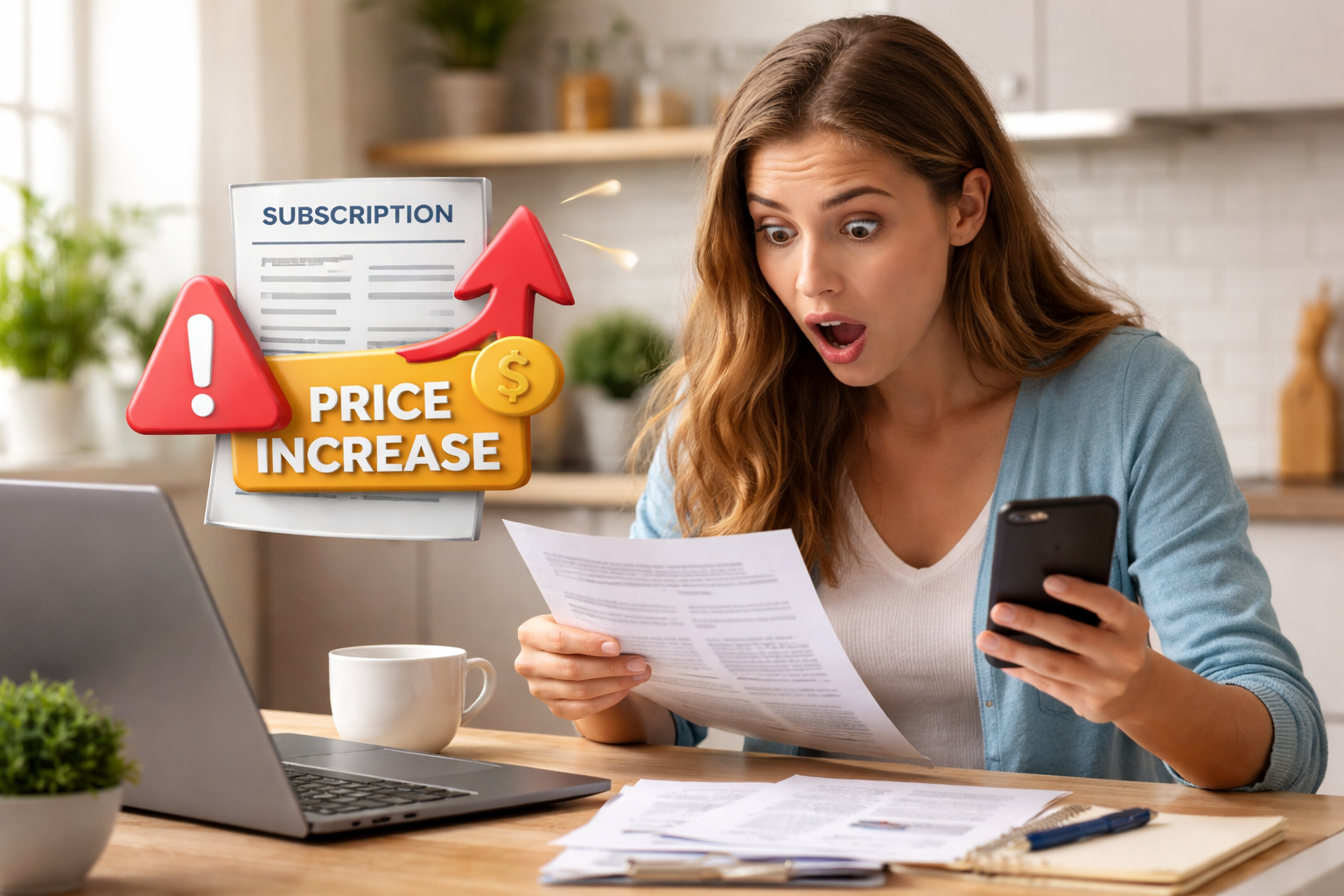
Subscription price increased without notice was the exact phrase I searched the moment I saw the new renewal amount. I wasn’t hunting for a loophole. I just wanted an explanation that matched what I’d agreed to. The original price was familiar — it had been the same for months. Then one morning, I opened my card activity and the number was different. Not “a little tax.” Not “a one-time fee.” Just a higher monthly charge that looked like it had always been that way.
I scrolled through my inbox expecting a clear email: “Your price is changing.” Nothing. I checked spam. Nothing. I opened the app, thinking maybe there was a banner I clicked past. Nothing obvious. And that’s the unnerving part when a subscription price increased without notice: it makes you second-guess yourself before you even start fixing it. If you’re here, you probably want a clean path: confirm what happened, lock down proof, and get the price reversed or refunded without turning your life into a customer-service project.
Before you do anything else, anchor yourself with a broader subscription billing playbook. If your issue overlaps with credits/refunds, multiple charges, or cancellation confusion, this hub helps you spot the fastest route:
What “No Notice” Really Looks Like in Real Life
People assume “notice” means a clear email with a subject line like “Price Increase.” In practice, when a subscription price increased without notice, companies often point to one of these:
• A line in the terms that says prices may change
• A dashboard message you had to log in to see
• A “product update” email that included pricing in the middle
• A renewal receipt sent after the charge posted
• A help-center page with new pricing, but no direct alert
Your job isn’t to prove they never updated anything on earth. Your job is to show you didn’t receive a clear, timely, reasonable alert tied to your actual account renewal. That difference matters when you ask for an adjustment or when you escalate to a card dispute.
Why a Subscription Price Increased Without Notice Happens (System Triggers)
When a subscription price increased without notice, it usually comes from predictable system changes. Here are the most common triggers — and how to recognize each one fast:
1) Promotional pricing expired
You signed up on a discounted rate (intro offer, student pricing, “first 3 months,” bundle discount). The system flips you to standard pricing at renewal.
2) Plan migration (legacy tier retired)
A “Basic” plan quietly disappears. Accounts are moved to a new tier that includes features you never asked for.
3) Annual-to-monthly conversion confusion
You thought you paid monthly; the company treats you as annual divided by 12, then changes the annual price and your “monthly” rises.
4) Add-on toggled on
Extra storage, premium support, extra seats, HD streaming, family-sharing, device protection. Sometimes it’s one accidental click; sometimes it’s a default change during an update.
5) Taxes and “regulatory recovery” fees
This can be legitimate, but it still must be disclosed clearly. And it should be identifiable as a separate line item.
6) Billing platform change
A company switches payment processors or merges brands. Your plan name changes, your price changes, and the “notice” is buried in a migration announcement.
The fix starts with correctly naming the trigger. That’s how you get a refund decision in minutes instead of weeks.
Find Your Exact Version in 90 Seconds
Use the boxes below like a quick self-check. When a subscription price increased without notice, your leverage depends on which box matches your reality.
Signs: You can find “intro” pricing in the old receipt. The new charge matches the public “standard price.”
Best move: Ask for a one-time courtesy refund and restoration for one cycle, then decide to keep or cancel.
What to collect: Original receipt + screenshot of current pricing + your renewal charge date/time.
Win condition: They refund the difference or give a credit immediately.
Signs: Your plan name changed, features changed, and the new price is tied to a different tier than you chose.
Best move: Request rollback to your prior tier or to the nearest equivalent price point.
What to collect: Screenshot of your plan history (if visible) + old confirmation email showing plan tier.
Win condition: They restore your old tier or grandfather pricing.
Signs: Your base plan price is unchanged, but your monthly total rose. Account shows add-ons like “premium,” “extra storage,” “additional device,” “seat.”
Best move: Remove add-on, then request refund for add-on months billed without informed consent.
What to collect: Screenshot of add-on page + billing breakdown (even if it’s “included”).
Win condition: They reverse add-on charges and confirm add-ons are off.
Signs: Increase is small and inconsistent month-to-month; no clear itemization; “tax included” changes.
Best move: Ask for an itemized breakdown and the jurisdiction basis; request reversal if they can’t explain it clearly.
What to collect: Statement screenshots for 2–3 months showing the drift.
Win condition: Itemized fee appears clearly or the drift is corrected.
Signs: You only learned about the increase from a receipt that arrived after the charge posted.
Best move: Ask for refund due to lack of advance disclosure; request confirmation of cancellation date if leaving.
What to collect: Timestamped email + charge posting time in your card activity.
Win condition: Refund or credit issued quickly as “one-time exception.”
Signs: You have a cancel/downgrade confirmation, yet the renewal increased or didn’t reflect the change.
Best move: Treat this as a processing error and request immediate correction plus refund for the mismatch.
What to collect: Confirmation screenshot + account status page showing current tier.
Win condition: Refund + corrected subscription state.
Pick the case that matches you, then follow the steps for that case. If you try generic support scripts, you’ll often get generic answers.
Provider and Bank Reality: What They Look At When You Complain
When you say a subscription price increased without notice, providers usually run through a checklist on their side:
• Was the new price posted publicly?
• Did the user “agree” to updated terms (even via a login prompt)?
• Is there an internal record of a message banner shown?
• Is the user within a refund window (often 7–30 days)?
• Has the user used the service after the renewal date?
Banks/issuers often look at different signals:
• Was the amount materially different from what was authorized?
• Did you attempt resolution with the merchant first?
• Do you have documentation (old receipt, screenshots)?
• Is it recurring billing (not a one-time purchase)?
That’s why you build a small proof packet first. It’s not overkill — it’s the fastest way to get “yes.”
Your Rights: Recurring Charges Must Be Clearly Disclosed
If your subscription price increased without notice, one of the clearest official explanations of how automatic renewals and recurring billing should work comes from the Federal Trade Commission’s consumer guidance:
The FTC explains how companies must clearly disclose recurring prices and renewal terms before charging you — and how they can’t rely on buried terms alone when a subscription renews at a higher price.
Fix It Fast: The Exact Message That Works Better Than “You Raised My Price”
When a subscription price increased without notice, vague complaints get vague replies. Use a structured message:
Copy/Paste Template
“Hi — my subscription renewed at a higher price than the one I agreed to. My subscription price increased without notice. I did not receive clear advance disclosure tied to my account renewal. Please (1) explain the exact reason for the increase, (2) restore the prior price or comparable grandfather rate, and (3) refund/credit the difference for this renewal. I can provide the original receipt and screenshots if needed.”
Key detail: you’re not asking them “if” they notified you. You’re asking for the “exact reason,” which forces specificity.
If They Refuse: Escalation Ladder That Doesn’t Backfire
If a subscription price increased without notice and frontline support won’t help, don’t jump straight to “chargeback” in your first reply. Do this instead:
1) Ask for a supervisor or billing specialist
2) Ask them to cite where the advance notice was delivered (email subject line, in-app banner date, account notice path)
3) Request a one-time exception refund if they insist “terms allow it”
4) If still refused, proceed to card issuer dispute with your proof packet
Why this works: you give them a clean off-ramp to refund you without admitting wrongdoing.
If your case is tangled with cancellation or “I stopped it but it billed anyway,” this is the closest internal reference on your site:
Proof Packet Checklist (This Makes You Hard to Ignore)
Build this in 5 minutes:
• Screenshot: renewal charge in card activity (date/time/amount)
• Screenshot: current plan page showing new price
• Receipt: original signup confirmation showing old price
• Screenshot: account page showing plan tier (if visible)
• If relevant: screenshot of add-ons page
When you present this cleanly, you turn a “complaint” into a “billing exception request.”
Mistakes That Make Refunds Less Likely
When a subscription price increased without notice, these are the errors that quietly kill your leverage:
• Waiting multiple renewals before complaining
• Using only phone calls with no written record
• Canceling before capturing the plan/price screen
• Calling it “fraud” when it’s a pricing dispute (you can lose credibility)
• Accepting a “partial credit” without written confirmation of future pricing
Most people lose refunds because they delay, not because they’re wrong.
FAQ
How do I prove my subscription price increased without notice?
Use your original receipt + current plan pricing screenshot + the renewal charge timestamp. Proof is about clarity and timing.
Should I cancel first or dispute first?
Capture evidence first. Then contact the provider. If unresolved quickly, escalate. Canceling too early can erase what you need to prove.
What if they claim the notice was in the terms?
Terms can allow price changes, but the question becomes whether disclosure was clear and reasonably delivered before renewal.
Is a small increase worth disputing?
Yes if it’s recurring. Small monthly increases compound, and recurring disputes are easiest to fix early.
What if I’m also seeing double charges?
Treat that separately as duplicate billing. Use this internal guide for that scenario:
Key Takeaways
• When a subscription price increased without notice, it usually ties to promo expiry, plan migration, or add-ons.
• Build a proof packet before you cancel or argue.
• Ask for the exact reason + rollback pricing + refund difference — in writing.
• Escalate carefully; don’t lead with threats.
• Act within the first billing cycle for best results.
Next Step: What to Do Right Now
If your subscription price increased without notice, do these three actions today:
1) Screenshot the charge and your current plan price.
2) Send the structured message to billing support in writing.
3) Set a 48-hour decision point: if no meaningful fix, escalate to your card issuer with your proof packet.
You’re not “overreacting.” You’re preventing a recurring increase from silently draining your account. You don’t need to argue for hours. You need to document, request a precise correction, and escalate if they won’t fix it.
And if your situation starts to blend into “I canceled but it still billed,” or “my refund was approved but never arrived,” keep moving with targeted guides rather than guessing:
If you noticed it today, treat today as your start line. Document. Message. Escalate. Don’t let another renewal pass while you’re still trying to get someone to read your first ticket.