
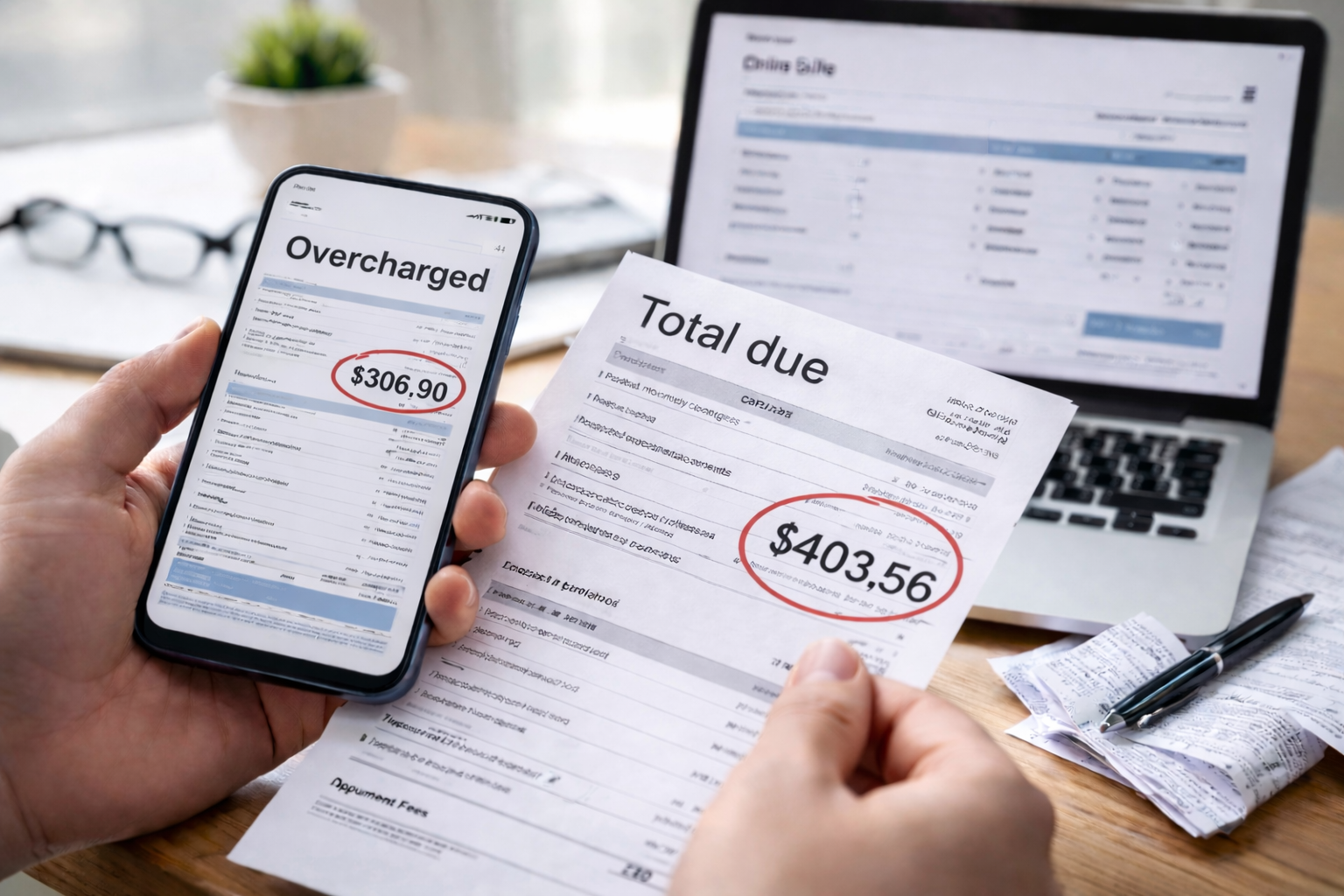
Mobile bill overcharged — I saw the total first, and for a second I assumed I’d clicked the wrong month. Same carrier. Same plan. Same phone. But the number was higher enough that it didn’t feel like “taxes went up.” It felt like something slipped in.
The 10-Minute Reality Check (Before You Contact Anyone)
When mobile bill overcharged happens, the first win is clarity. Do this before you chat or call, so you don’t get stuck in “we can’t see what you mean” loops.
- Download the bill PDF (not just the app summary).
- Circle the change: “This line wasn’t here last month,” or “This line doubled.”
- Check the billing period (mid-cycle plan changes can create pro-rated weirdness).
- Check each line/number on the account (family plans hide the issue under one line).
- Look for the “one-time charge” section (setup fees, activation, SIM, device swap).
Don’t start with “my bill is too high.” Start with “this charge is wrong.” That one change usually cuts the dispute time in half.
Why This Happens (In Plain Real Life, Not a Lecture)
If you’re thinking “I didn’t change anything,” you might still be right. The most common mobile bill overcharged situations are boring system stuff, not dramatic fraud:
- Promo credit didn’t apply (trade-in, BYOD, autopay, paperless billing).
- Plan “optimization” or feature add-on that got toggled (insurance, hotspot, international day pass).
- Device installment or upgrade timing (one installment posted twice, or a payoff didn’t stick).
- Partial month / proration after a plan change or line change.
- Third-party billing (apps/services charged through your carrier billing).
It’s not “your fault” for missing it. Bills are designed to be skimmed. Your job is to isolate the smallest provable error.
How the Provider Thinks (So You Can Speak Their Language)
Carriers and billing systems don’t treat this as “fair vs unfair.” They treat it as: “Is the charge valid per the account settings and the billing system record?” When mobile bill overcharged hits, your leverage comes from documentation and precision:
- They can see plan history, add-on toggles, and usage logs.
- They will prioritize disputes that reference the exact date/charge name.
- They are more likely to credit when the error is clearly theirs (promo missing, duplicate line item, canceled feature still billed).
- They may offer a “courtesy credit” if it’s messy but reasonable—especially if you caught it quickly.
What you want is a correction + credit, not a long debate.
Your Rights in Practice
You don’t need threats to win a billing fix. In the U.S., you can:
- Request an itemized explanation of every unfamiliar charge.
- Dispute incorrect charges and request a credit or rebill.
- Escalate to a supervisor or billing specialist if the first rep can’t trace it.
- File a formal complaint with a regulator if the carrier won’t correct clear errors.
If you want an authoritative next-step option (especially when you’re getting ignored), the FCC complaint path is straightforward for telecom billing issues.
Use this when: you have a clear billing error, you’ve already contacted the carrier, and you want a formal paper trail. Keep your tone factual and attach the bill PDF and screenshots.
Case Split: Find Your Exact Situation
Use this block like a mirror. Pick the one that matches what you’re seeing. Most mobile bill overcharged fixes come from one of these branches:
A) The total jumped, but usage looks normal
Likely causes: promo credit missing, autopay discount removed, plan price changed, taxes/fees recalculated, or a new add-on.
Action: Compare last month’s “Credits/Discounts” section line-by-line. Screenshot the missing credit.
B) One line on a family plan is the culprit
Likely causes: a kid’s line added an add-on, hotspot pass, insurance, or third-party charge; or one line hit data overage on a limited plan.
Action: Ask for a per-line breakdown and the date/time the add-on was enabled.
C) A “one-time charge” appeared
Likely causes: activation fee, upgrade fee, SIM fee, restocking charge, device swap, or a late fee.
Action: If this wasn’t disclosed, request a waiver and ask them to cite where you agreed to it.
D) Device payments look wrong
Likely causes: installment posted twice, payoff not applied, trade-in credit delayed, or plan/device mismatch after an upgrade.
Action: Gather the original financing agreement email and the payoff confirmation (if any). Ask for a “billing correction” ticket number.
E) You see charges you don’t recognize (apps/services)
Likely causes: third-party billing through carrier, accidental subscription purchase, or someone on the account approved a charge.
Action: Request “carrier billing” or “third-party charges” history and ask them to block third-party billing going forward.
F) Travel/roaming related confusion
Likely causes: day pass toggled, roaming rates, or international add-ons applied unexpectedly.
Action: If this is the main issue, use a roaming-specific playbook so you don’t miss the key proofs.
The Script That Gets Results (Copy/Paste)
When mobile bill overcharged is the issue, use a short script that forces clarity and a trackable outcome:
Hi — I’m contacting you about a billing error on my most recent statement. The charge I’m disputing is: [exact charge name] for [$X], dated [date], on line [line/number]. Last month, this charge was [absent / $Y]. I’m requesting: (1) an explanation of why it appears, and (2) a correction/credit if it’s not valid. Please provide a ticket number for this dispute.
Always ask for a ticket number. If the rep can’t give one, ask what reference ID they can provide for the notes.
If They Say “It’s Valid” (How to Escalate Without Burning Time)
Sometimes the first response is a wall. If mobile bill overcharged is real and you have the line-item proof, escalate in a controlled way:
- Step 1: Ask them to read back the account notes and confirm the disputed line item.
- Step 2: Ask for a supervisor or billing specialist, not “a different rep.”
- Step 3: Request a “billing investigation” or “rebill” (carriers use different names, but those words help).
- Step 4: If you’re being bounced, move to a written channel (secure message, email confirmation, or complaint path).
You’re not asking for a favor; you’re asking for the account to match its own rules.
What NOT To Do (These Mistakes Cost Money)
- Don’t ignore it for “one more month.” Small errors become “normal” after multiple cycles.
- Don’t cancel the line mid-dispute unless you’ve saved the bill PDF and your chat/call records.
- Don’t argue the entire bill. Pick the clearest wrong charge first; win that, then handle the rest.
- Don’t assume it’s fraud instantly. If mobile bill overcharged is from promos/proration, fraud talk just slows you down.
- Don’t lose the paper trail. Screenshot everything: bill, chat transcript, confirmation IDs.
Key Takeaways
- mobile bill overcharged is usually a specific line-item error, not a mystery total.
- Download the PDF and isolate the exact charge before contacting support.
- Ask for a ticket/reference number and keep screenshots.
- Escalate to a billing specialist if the first rep can’t trace the charge.
- Use a formal complaint path only after you’ve made a clear, documented attempt with the carrier.
Related Reads (Internal Links)
If your mobile bill overcharged situation matches one of these patterns, these guides go deeper and can save you time:
1) Roaming charges dispute (travel-related overcharges)
If your bill spike happened right after travel, this one helps you gather the right proof and dispute the right line items.
2) Subscription charged twice (duplicate billing pattern)
If you see a “same charge twice” pattern—especially add-ons or services—this shows a clean dispute structure that works across industries.
3) Internet service canceled but still billed (service status vs billing mismatch)
If your line was supposed to be changed, paused, or removed—but billing kept going—this teaches the “prove the status change” method.
FAQ
- How fast should I dispute an overcharge?
As soon as you can identify the exact charge. The earlier you dispute, the more likely you get a clean credit instead of a “we’ll watch it next month” answer. - What if the carrier says the promo credit “will apply next month”?
Ask them to confirm in writing (chat transcript or email), and ask whether the missing credit will be backdated. If it won’t, request a one-time credit now. - Should I pay the bill while disputing?
If you can, pay the undisputed portion to avoid late fees or service interruption. Then keep the dispute focused on the incorrect line item. If you’re unsure, ask the carrier whether a partial payment will affect service. - What proof matters most?
The bill PDF, a screenshot of the exact disputed charge, the previous month’s bill showing the difference, and any confirmation messages (plan change, promo, payoff, trade-in). - What if I suspect third-party charges?
Ask for the third-party billing history and request a block going forward. Dispute the specific third-party line items rather than the whole statement.
Ending (What I’d Do Today, In Order)
By the time I finished the PDF comparison, it wasn’t “a high bill” anymore—it was one charge with a name, a date, and a dollar amount. That’s when the conversation changed. When you can point to one wrong line item, you stop sounding emotional and start sounding accurate. And accuracy is what gets credits approved.
Here’s what to do right now if mobile bill overcharged is staring at you: download the PDF, highlight the exact charge, screenshot last month’s version, then contact support with the script above and request a ticket/reference number. If they can’t trace it or won’t correct it, escalate to a billing specialist and move the dispute into writing. You don’t have to “eat” an incorrect bill—there’s a clean process to fix it, and you can start it today.