
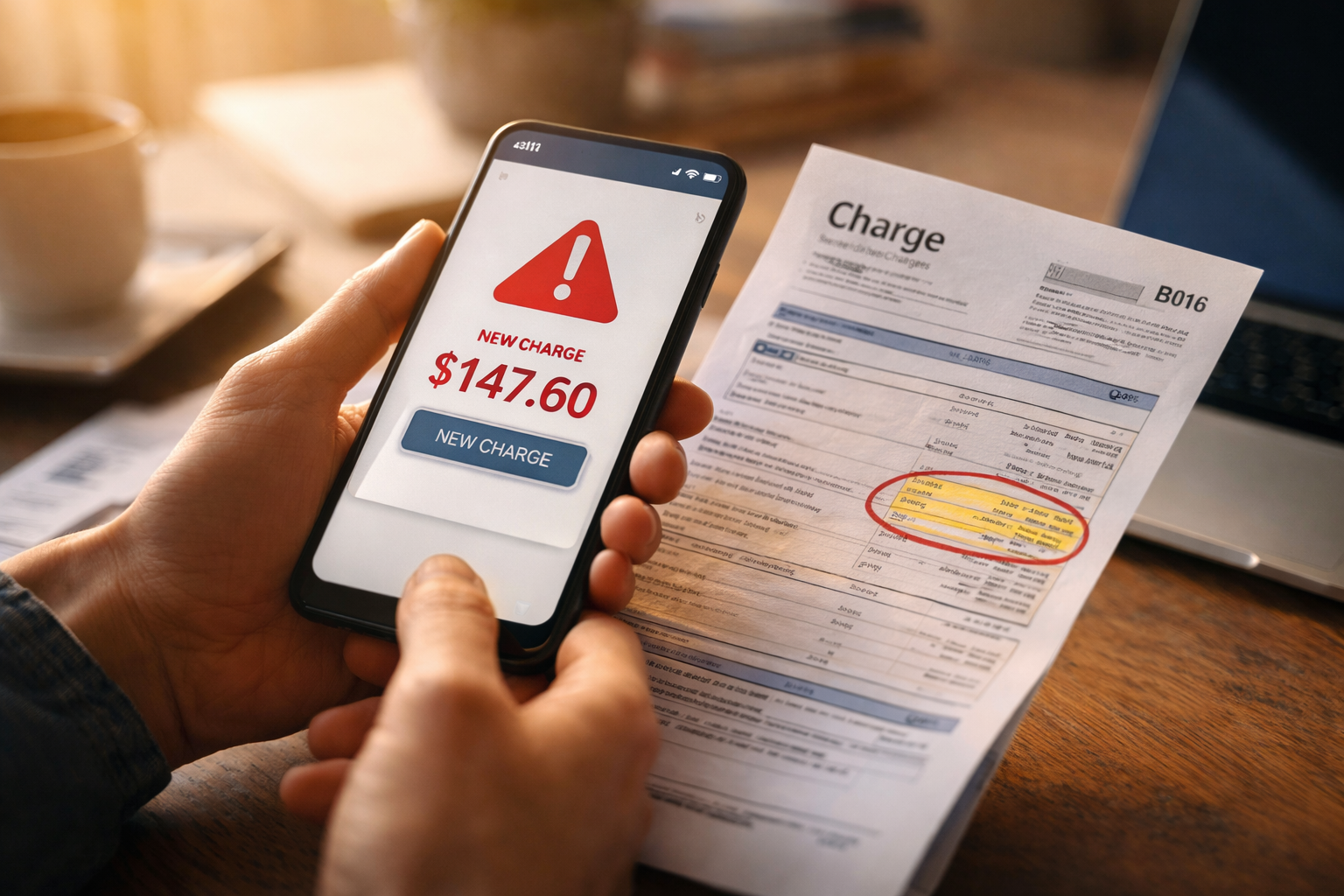
Mobile bill cancellation date dispute — I noticed it in the most normal way: I opened my carrier app to make sure the line was closed before the next autopay draft. I had the confirmation message. I had the “your service is canceled” email. So I was expecting a calm, boring screen with a zero balance.
Instead, there was a new charge with a date that didn’t match reality. A charge that started after the day I canceled. I didn’t get dramatic. I got focused. Because the longer a billing system “believes” its own timeline, the more departments it touches—billing, collections, and sometimes even your credit profile. If you’re here for a mobile bill cancellation date dispute, you want the quickest path to make the record match the truth.
Key Takeaways (Read This First)
- A mobile bill cancellation date dispute is usually a timestamp problem (what you were told vs. what the billing ledger recorded).
- Your goal is not a “courtesy credit.” Your goal is a corrected event log and corrected final invoice.
- Most wins happen when you present: confirmation proof, device/plan status, and a written dispute request.
- Act fast: the best window is before the charge ages into the next statement cycle.
- If you switched carriers, the port-out timeline is often your strongest evidence.
The 2-Minute Self-Check That Prevents a Bad Call
Before you call, do this once. It keeps you from getting trapped in “policy talk” that doesn’t fit your account.
- Find your cancellation confirmation (email, SMS, chat transcript, or ticket number).
- Screenshot your account page showing the charge date and description.
- Check whether the line shows “inactive/terminated” and the termination date shown in the portal.
- Look for plan components that survive cancellation (device installments, protection plans, add-ons).
- If you ported out, confirm the port completion timestamp in the new provider’s email or activation record.
When you have these five items, you can drive the conversation instead of reacting to it.
Why This Happens (Without the Lecture)
Most carriers don’t “cancel your bill.” They cancel your service, and then the billing system reconciles later. That gap is where a mobile bill cancellation date dispute lives.
Typical internal triggers:
- Cancellation requested near a billing cutoff (system queues it).
- Agent schedules cancellation but back-dates or mis-dates the event.
- Port-out completed after the ledger already assumed another cycle.
- Usage posted late (roaming, international, or delayed network reporting).
- Device installment or protection plan stayed active and generated a “final” charge.
The key: your cancellation proof must connect to the ledger record. That’s how you win a mobile bill cancellation date dispute cleanly.
Case Branch Box — Identify Your Exact Dispute Type
Pick the line that matches your situation:
A) You have a confirmation, but charges posted after that date.
Best outcome odds. You’re disputing an incorrect termination timestamp.
B) Autopay drafted after cancellation.
Your focus is reversing the payment and correcting the final invoice, not “turning off autopay.”
C) You ported your number out and still got billed.
Strong leverage. Port completion is often treated as service termination.
D) They charged a full month instead of prorating.
Could be error or policy. First verify the plan’s proration rules and state rules.
E) A device installment or protection plan kept billing.
You may have a valid remaining balance, but you still dispute the service portion and dates.
F) Roaming/international usage posted after you canceled.
Delayed posting is common. Dispute requires usage detail and timestamp reconciliation.
G) Early termination fee appeared even though contract ended.
You’re disputing contract end date classification and eligibility.
Now use the section below that matches your branch. This is how a mobile bill cancellation date dispute becomes a solvable checklist, not a vague complaint.
Branch A — Confirmed Cancellation, Charges After the Date
If your mobile bill cancellation date dispute is “I canceled on X, but you billed me after X,” don’t ask for a favor. Ask for a correction.
- Say: “Please review the account event log and correct the termination timestamp to match my confirmation.”
- Provide: screenshot of confirmation + the charge screen.
- Ask for: corrected final invoice and a written resolution note.
What to request if the first agent stalls:
- “Billing investigation” or “back-office review.”
- “Supervisor can open a formal dispute ticket.”
- “Please send me the dispute case number by email.”
Do not accept “We can’t change it” without a ticket number. If the ledger is wrong, it can be corrected. That’s the point of a mobile bill cancellation date dispute.
Branch B — Autopay Drafted After Cancellation
This one feels insulting because the money is already gone. But autopay disputes are often reversible quickly if you document them correctly.
- First call billing and ask for a “payment reversal request.”
- Ask whether the payment is still pending or already settled.
- If pending, request immediate cancellation of the draft.
- If settled, request refund to original payment method and a corrected invoice.
Important: Don’t just remove your card immediately. If you remove it too early, some carriers auto-route balances to collections workflows faster because they can’t reattempt payment. Handle the mobile bill cancellation date dispute first, then remove payment methods after written confirmation.
Branch C — Ported Your Number Out, Still Billed
If you switched carriers, your port-out proof is often your cleanest weapon.
- Gather: port completion email, new carrier activation time, and the old carrier’s final bill.
- Tell billing: “My number port completed on X. Billing after X is inaccurate.”
- Request: recalculation of final charges through the port completion time.
What carriers may argue:
- “Porting doesn’t cancel the account.”
- “You needed to call to close it.”
How to respond without drama:
- “Even if an account workflow remained open, service was no longer provided after port completion.”
- “Please remove service charges after the termination event.”
In a mobile bill cancellation date dispute, separating “account open” from “service provided” is a powerful distinction.
Branch D — Full Month Charged (Proration Fight)
This branch is tricky because sometimes it’s policy, not error. Still, you can win if the policy was misapplied or not disclosed.
- Check the plan terms for proration language.
- Check if your state has specific billing disclosure requirements.
- Ask billing to explain the calculation line-by-line.
If the agent cannot explain the math, request a supervisor review. “I’m disputing the calculation and the effective cancellation date used.” That keeps the discussion inside your mobile bill cancellation date dispute instead of drifting into generic policy statements.
Branch E — Device Installments or Protection Plan Kept Billing
You can have two realities at once:
- You may still owe a device installment balance.
- You may not owe service charges after cancellation.
What to do:
- Ask for a breakdown separating service, device, and add-ons.
- Dispute only the lines tied to the wrong date.
- Request cancellation/refund of add-ons that continued after termination (if applicable).
Precision wins. A narrow, evidence-backed mobile bill cancellation date dispute is harder to deny than a broad “everything is wrong.”
Branch F — Roaming/International Charges Posted After Cancellation
These charges can post late because networks report usage after the fact. That doesn’t automatically make them valid.
- Ask for detailed usage records with timestamps.
- Compare those timestamps to your cancellation confirmation.
- If timestamps are after termination, dispute as inaccurate posting.
If they can’t provide usage detail, don’t accept a denial. Lack of documentation should strengthen your mobile bill cancellation date dispute, not weaken it.
Branch G — Early Termination Fee That Shouldn’t Exist
If you were out of contract or eligible for waiver, demand the basis for the fee.
- Ask: contract end date and the waiver policy applied.
- Provide: proof of contract completion, upgrade eligibility, or waiver promise.
- Request: fee removal and updated final bill.
Do not pay an ETF you believe is wrong without filing a dispute ticket first. That’s how a mobile bill cancellation date dispute becomes “paid and closed,” which is harder to reopen.
The Phone Script That Gets You Past the First “No”
Use this structure. Keep it calm. Read it like a checklist.
- “I’m calling about a mobile bill cancellation date dispute. My cancellation confirmation shows X date.”
- “The bill shows charges after X date. I’m requesting an event log review and correction.”
- “I can provide screenshots and the confirmation number.”
- “Please open a formal billing dispute ticket and give me the case number.”
- “When should I expect the corrected invoice, and will you email confirmation?”
Notice what’s missing: blame, sarcasm, threats. You’re forcing procedure, which is what resolves a mobile bill cancellation date dispute.
What Not To Do (These Mistakes Create Collections Risk)
- Don’t ignore the bill while “waiting to see.”
- Don’t rack up late fees while arguing about the date.
- Don’t close your payment method as your first move.
- Don’t accept “policy” without a written calculation or event log explanation.
- Don’t let it drift into the next statement cycle without a dispute ticket.
One Authoritative Reference (Use It If You Escalate)
If the charge touched a credit card or bank debit, understanding dispute rights helps you escalate cleanly.
This is not for arguing with the agent; it’s for understanding the investigation expectation and documentation mindset you should follow.
Recommended Reading (Internal Links)
If your mobile bill cancellation date dispute overlaps with these scenarios, these are the most relevant three pages from your site:
1) Subscription canceled but still billed — same “termination vs billing ledger” pattern, different industry.
2) Internet service canceled still billed — useful for escalation language and billing ticket strategy.
3) Mobile bill overcharged — helps if the carrier reclassifies your dispute as a general overcharge.
This article is not a duplicate of those pages because it focuses specifically on the cancellation date timestamp conflict and branch-based resolution paths.
FAQ
How long does a mobile bill cancellation date dispute take?
Simple timestamp corrections can resolve within days. Complex cases can take one to two billing cycles.
Should I pay while disputing?
If you’re worried about late fees or collections workflows, consider paying the undisputed portion and marking the remainder disputed.
Will this hurt my credit?
Usually no unless it becomes delinquent and escalates into collections reporting. Open a dispute ticket early.
Can I file a chargeback?
Yes, but it’s best used after you attempt carrier resolution and you have documentation showing the date error.
What proof matters most?
Cancellation confirmation, screenshots, port-out timestamps, and written notes confirming the corrected termination date.
What if the carrier says they can’t change the date?
Ask for a billing investigation ticket and written denial reason. Dates in event logs can be corrected when they’re wrong.
Is this the same as “canceled but still billed”?
The pattern is similar, but mobile bill cancellation date dispute is narrower and typically hinges on specific termination timestamps.
Mobile bill cancellation date dispute — The part that stayed with me wasn’t the charge itself. It was how confidently it sat there, like the system’s version of the timeline mattered more than what actually happened. And that’s exactly why you handle this like a record-correction problem, not a “customer service rant.”
Do it today: gather proof, classify your branch, call billing (not general support), request an event log review, and get a dispute ticket number in writing. Your goal is simple: make the official timeline match the real one. If you do those steps, a mobile bill cancellation date dispute becomes one of the more fixable billing problems—not because the system is kind, but because documentation forces it to be accurate.