
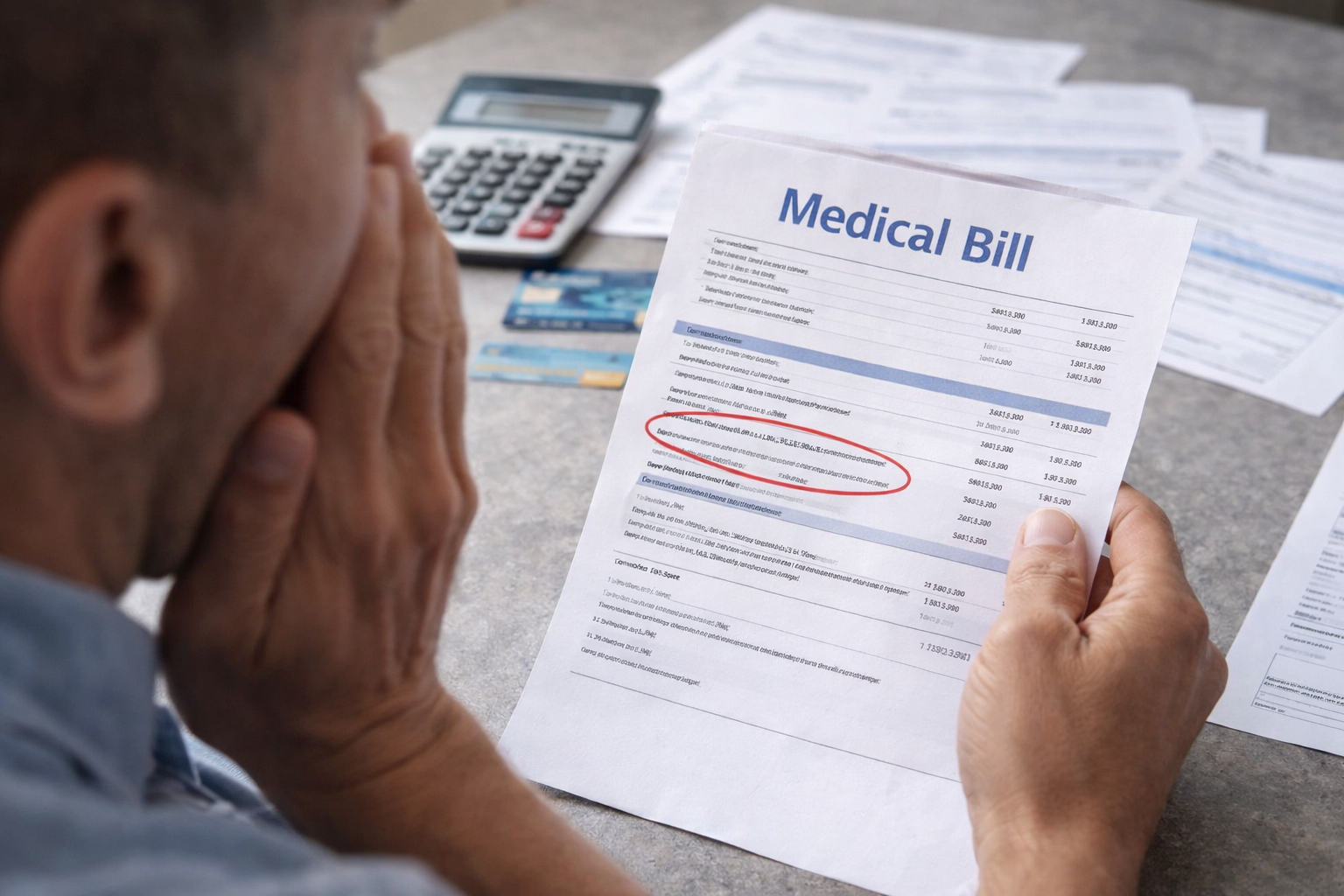
Medical Bill Charged for Service Never Received was the exact phrase I typed the moment I looked down at the statement and saw a line item that did not belong there. The date matched my appointment. The hospital name was right. The account number was mine. But the service itself was wrong. It was not a vague number or a confusing abbreviation. It was a specific charge for something that never happened during that visit. That is the moment this kind of billing problem becomes real, because the paperwork looks official even when the charge is not.
Medical Bill Charged for Service Never Received situations are especially stressful because they force you to argue with a system that already sounds certain. The statement arrives with codes, balances, due dates, and warning language. Everything about it is designed to look final. But many of these cases start with a very ordinary breakdown inside a provider’s billing workflow: a planned service that was never performed, a chart that was not updated correctly, a code that stayed on the account after a change, or a charge entered by one department and never reconciled by another. If you do not challenge that mismatch early, the billing system may keep treating the charge as valid simply because it was entered once and never removed.
If you want the bigger system view first, this guide explains how billing disputes usually get detected and escalated inside consumer billing systems.
What this usually looks like on the bill
A Medical Bill Charged for Service Never Received does not always appear in an obvious way. Sometimes the charge is written out clearly enough that you spot it immediately. Other times it hides behind a code description, a bundled service label, or a provider entry that sounds generic unless you compare it carefully against what actually happened during the visit.
Common versions include a procedure that was discussed but never done, imaging that was ordered but then canceled, a specialist consultation that never happened, supplies that were not used, or duplicate entries that make it look like two separate services took place when only one did. In emergency room and hospital settings, this can also happen when care moved quickly and multiple departments documented pieces of the visit at different times.
Quick self-check box
- Does the bill list a test, scan, injection, consult, or treatment you never received?
- Was a service planned, mentioned, or prepared, but then canceled?
- Did you leave before a step of care happened, yet the bill still includes it?
- Does the provider name or department on the bill not match who actually treated you?
- Does the statement show multiple charges that seem to describe the same visit event?
If one or more of those apply, a Medical Bill Charged for Service Never Received is a realistic possibility rather than a misunderstanding.
How this happens inside the system
A Medical Bill Charged for Service Never Received often starts long before the final patient statement is created. In many U.S. provider systems, the visit flows through several separate layers: scheduling, registration, clinical charting, charge entry, coding, insurance claim preparation, and patient billing. A mistake in any one of those layers can survive long enough to appear on the final bill.
One common pattern is the planned-but-canceled service. A doctor orders a test. Staff prepare for it. The order enters the chart. Then the plan changes. Maybe symptoms improve. Maybe the patient declines. Maybe the doctor decides the test is unnecessary. But if the order or related charge line is not removed correctly, the billing side may still treat it as completed.
Another pattern is incomplete chart closure. Clinical staff may document parts of the encounter at different times. A coder later reviews the chart and interprets it for billing. If the final documentation is unclear, the coder may assign a charge based on a note that does not fully reflect what happened.
A third pattern involves imported charge data. Large health systems often use connected software platforms. When one system sends a service entry into another system, the receiving side may generate a billable line item even if the clinical event was not finalized correctly. That is one reason a Medical Bill Charged for Service Never Received can look surprisingly polished on the statement.
The most common case branches
Not every Medical Bill Charged for Service Never Received case is the same. The fastest way to resolve it depends on how the bad charge entered the account.
Case Branch Box
Case 1: Planned but canceled
You were told a test, scan, procedure, or consult might happen, but it never actually took place. This usually points to an order or charge entry that stayed on the account after the plan changed.
Case 2: Documentation mismatch
The provider’s chart language may have suggested a service happened even though the real encounter was more limited. This usually requires a coding or documentation review.
Case 3: Duplicate workflow charge
One part of the system billed for the service and another part created a second line item tied to the same event. This can happen with facility and professional billing running separately.
Case 4: Insurance-driven confusion
An insurer processed or denied a claim line, and that claim activity made the patient statement look like a real service occurred even though the underlying charge was wrong from the start.
Case 5: Vendor or outside billing office error
The provider outsourced charge posting or patient statements, and the third-party billing office relied on incomplete encounter data.
Each branch matters because the person who answers the phone may not be the team that can actually fix it. A front-line billing representative can note the dispute, but a coding team, patient financial services unit, or provider office may need to correct the source record.
What providers usually do after you complain
When you report a Medical Bill Charged for Service Never Received, the provider usually does not remove it immediately on the first call. Instead, the account often enters an internal review path. That review can sound vague, but it normally includes several concrete checks.
The billing office may first confirm the line item, service date, and account number. Then it may compare the patient statement to the insurance claim, if one exists. After that, the dispute may be routed to coding review, charge review, or the department that originally created the entry. In some systems, the provider’s office also has to confirm that the service was not actually rendered.
This matters because a Medical Bill Charged for Service Never Received is often treated as a source-data problem, not just a payment problem. The provider is not only deciding whether you should pay it. The provider is deciding whether the service should exist on the account at all.
If the service cannot be supported by documentation, the proper outcome is usually a correction or adjustment, not a negotiation over whether you should pay part of it.
What you should ask for right away
If you find a Medical Bill Charged for Service Never Received, do not start with a general complaint. Be specific. Ask for the itemized bill. Ask for the exact date of service. Ask for the billing code or description tied to the disputed line. Ask which department posted it. Ask whether the line was billed to insurance. Ask for a formal review of the charge based on the fact that the service was never received.
The more specific your language is, the harder it is for the dispute to be handled like a routine call. You want the provider to understand that this is not just “I do not understand my bill.” This is “this listed service did not occur.” That framing usually moves the issue into a more serious review track.
You should also ask whether the account can be placed on temporary hold while the investigation is pending. A Medical Bill Charged for Service Never Received should not continue moving normally through reminder notices if the provider is actively reviewing whether the charge is valid.
What not to say and what not to do
A Medical Bill Charged for Service Never Received can get harder to fix if you respond the wrong way. The biggest mistake is paying first because the due date feels urgent. Once money is applied, the conversation can shift from removing an invalid charge to requesting a refund, and refund workflows often move slower.
The second mistake is arguing only in broad terms. Saying “this bill seems wrong” is weaker than saying “the statement includes a service I never received, and I need the documentation supporting that charge.”
The third mistake is waiting too long because you assume it will correct itself. Most billing systems do not reverse disputed charges automatically just because the patient does nothing. Silence usually helps the charge age into the account, and aging balances can create bigger pressure later.
The fourth mistake is focusing only on insurance. Insurance may be involved, but a Medical Bill Charged for Service Never Received often starts at the provider level. If the provider’s source charge is wrong, that issue has to be challenged there.
If the wrong charge appears after insurance activity
Sometimes a Medical Bill Charged for Service Never Received becomes visible only after insurance has processed the claim. Patients then assume the insurer approved something real. That is not always true. Insurance processing does not prove the service happened. It only proves a claim line was submitted and then adjudicated in some way.
If your statement got more confusing after insurance paid or denied part of it, this related guide can help you separate provider billing from insurance coordination problems.
In this branch, ask two separate questions: first, whether the service was actually rendered; second, whether the claim line tied to that service can be corrected or retracted. Those are different steps, and mixing them together often slows the process down.
If the bill is moving toward collections
A Medical Bill Charged for Service Never Received becomes more urgent when late notices start arriving or the statement language changes from routine billing to final warning language. At that point, the problem is no longer only about accuracy. It is also about timing.
If the provider is still reviewing the charge, ask whether the account is coded in dispute and whether collection activity is paused. If they cannot confirm that, ask for the dispute to be documented again and request written confirmation if available.
This is where many patients lose control of the situation: they assume the first phone call protected them, but the account keeps moving. If you are seeing signs that the balance may escalate, you need to press for status, not just make the initial complaint.
If the situation is already close to that stage, read this next so you do not get caught reacting too late.
A practical step-by-step path
Here is the most practical way to handle a Medical Bill Charged for Service Never Received without letting the issue drift.
- Get the itemized statement, not just the summary bill.
- Mark the exact disputed line item.
- Write down why that service did not occur.
- Call the billing office and ask for a formal charge review.
- Ask which team now owns the review.
- Ask whether the account is on hold during the review.
- Record the date, time, and name of the representative.
- Follow up if you do not receive movement within a reasonable period.
A Medical Bill Charged for Service Never Received is easier to fix when you keep the issue narrow and factual. You do not need to explain your whole medical history. You need to establish that the billed service did not happen and that the provider must verify the charge before expecting payment.
Official consumer guidance
For official consumer information related to medical debt and billing issues, see the federal consumer guidance below.
Consumer Financial Protection Bureau – Medical Debt
Key Takeaways
- Medical Bill Charged for Service Never Received is a distinct billing problem, not just a general high-balance complaint.
- The charge often comes from planned-but-canceled care, coding mismatches, duplicate workflow entries, or bad source data.
- The right first move is to request an itemized bill and challenge the exact line item.
- Do not assume insurance processing proves the service really happened.
- Do not pay the disputed charge first just to stop the pressure.
- Ask whether the account is in dispute status and whether escalation is paused.
FAQ
Can a hospital bill me for something that was ordered but never done?
It can appear that way on a statement, but if the service was never actually performed, the charge should be reviewed and corrected rather than simply accepted as valid.
What if the billing office says they need time to investigate?
That is common. Ask who is reviewing it, what was documented on the account, and whether billing or collection activity is paused while the review is pending.
Does insurance approval mean I have to pay it?
No. Insurance activity does not automatically prove the service occurred. A Medical Bill Charged for Service Never Received can still be disputed even if a claim line was submitted or processed.
Should I dispute by phone or in writing?
Start fast by phone if needed, but keep records and be specific about the exact service line you are disputing. Clear documentation helps if the matter drags on.
Medical Bill Charged for Service Never Received is one of those problems that can look small on paper and become expensive if you treat it casually. The line item may be only one entry on a long statement, but it can affect the balance, trigger follow-up notices, and make you second-guess your own memory because the system sounds so confident. Do not let the formality of the bill talk you into assuming the charge must be real.
Medical Bill Charged for Service Never Received should be challenged immediately, directly, and specifically. Request the itemized bill, identify the exact service that did not happen, ask for a formal charge review, and confirm the account is being handled as a dispute before the balance moves further through the billing cycle. That is the action to take now, and it is the safest way to stop a bad charge from turning into a bigger account problem.