
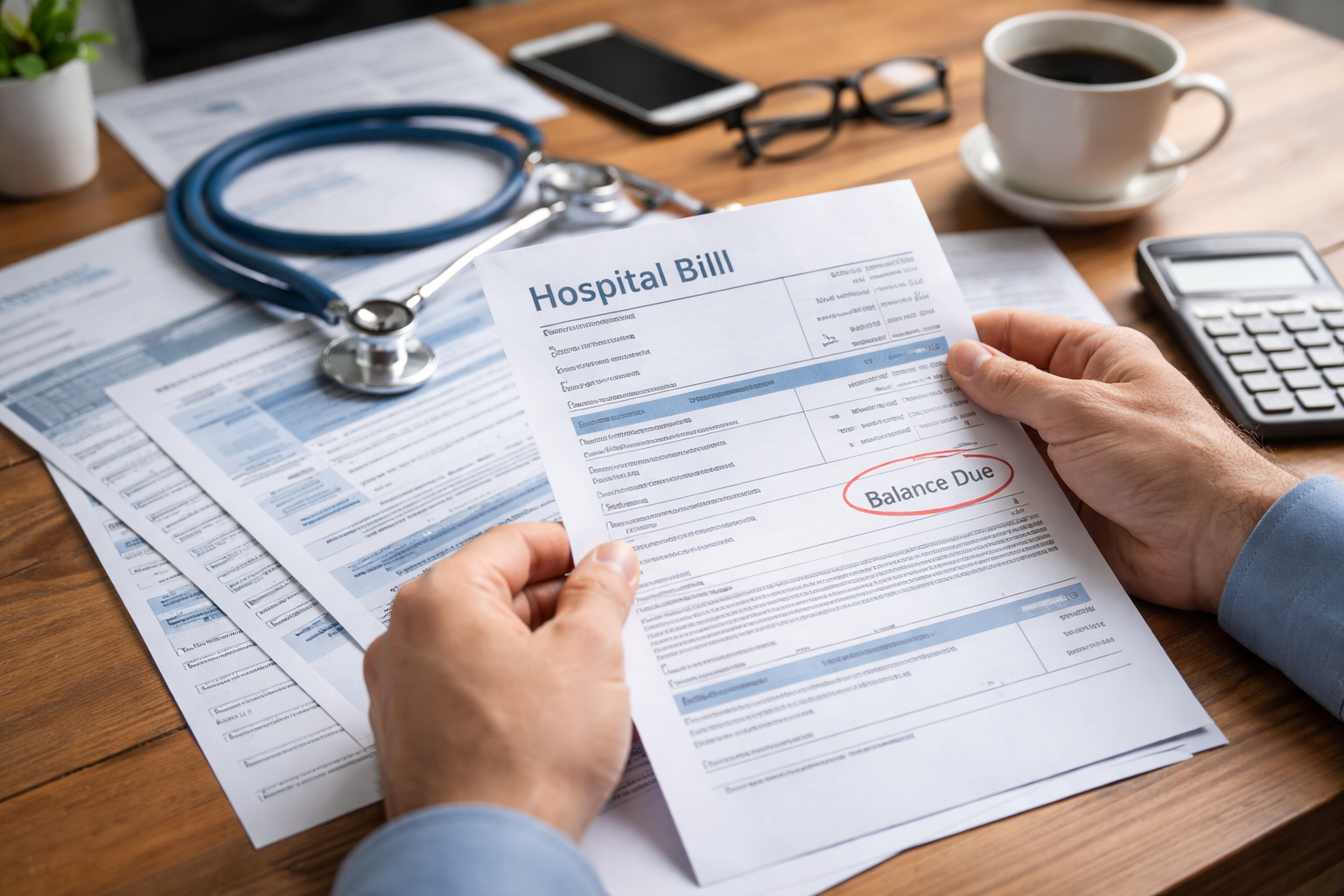
Hospital Still Billing After Insurance Paid — I noticed it in the most boring, ordinary way: the same balance showed up again, like nothing had happened. I had already logged into my insurance portal and seen the claim marked as processed. The provider name matched. The service date matched. The payment amount was right there.
Then the hospital statement arrived with a due date that felt too close for comfort. No plain-English explanation. No “this is pending.” Just a balance and a payment coupon. That’s when Hospital Still Billing After Insurance Paid stops being a confusing billing glitch and starts feeling like a time-sensitive financial trap.
If you’re dealing with Hospital Still Billing After Insurance Paid, don’t assume you did something wrong. And don’t assume the hospital is automatically “double charging” either. Most of the time, the issue is the gap between (1) an insurance payment being issued and (2) that payment being properly allocated, adjusted, and reflected on the hospital’s patient ledger.
Before you call anyone, it helps to understand how payments and adjustments are applied inside billing systems. This hub-style breakdown will make the next steps much faster.
The Fast Reality Check (2 minutes)
When Hospital Still Billing After Insurance Paid happens, you want to answer two questions immediately:
- Did the insurer actually pay the provider? (not just “processed”)
- Did the provider apply that payment to the correct account/visit?
Open your insurance portal and look for language like “paid,” “payment issued,” or “payment date.” Then look at your hospital statement for the account number, visit/encounter number, and service date range.
Many Hospital Still Billing After Insurance Paid situations are not about whether money moved — they’re about where the money landed.
Why Hospital Still Billing After Insurance Paid Happens in Real Systems
Hospital Still Billing After Insurance Paid is common because hospital billing is not a single “invoice.” It’s a ledger with multiple moving parts: charges, insurance payments, contractual adjustments, patient responsibility, and sometimes secondary billing.
A hospital can receive an insurance payment and still generate a statement that looks wrong because:
- statement generation runs on a schedule (batch cycles) before posting finishes
- payment arrives in a “suspense” or “unapplied cash” queue waiting for matching
- adjustments (contractual write-offs) aren’t applied yet
- your payment was applied to a different encounter or guarantor account
So yes, Hospital Still Billing After Insurance Paid can be a real error — but it can also be a timing problem that looks like an error.
Identify Your Exact Scenario
Use this like a choose-your-path checklist. Read the case that matches your statement and what you see online. Hospital Still Billing After Insurance Paid is solvable faster when you pick the right lane.
Case A — “Insurance paid” is real, but the hospital balance is unchanged
Usually a posting delay, unapplied cash queue, or mismatch to the wrong visit.
Case B — The statement shows a “patient responsibility” amount that seems too high
Often missing contractual adjustment, duplicate charge line, or wrong plan order.
Case C — The insurer paid, but the hospital says “no payment received”
Payment may be in transit, routed to the wrong lockbox, or credited to a different entity (facility vs physician group).
Case D — There are multiple bills for the same date
Could be separate billing entities (facility, radiology, anesthesia, pathology). Not all are “the hospital.”
Case E — The claim was “reprocessed” or “adjusted” after payment
The account may temporarily show Hospital Still Billing After Insurance Paid while the ledger rebuilds.
Case F — Secondary insurance is involved
The provider may bill you while waiting for secondary, or the system may be holding adjustments until COB finishes.
Case A: Payment Posting Delay or Unapplied Cash
If Hospital Still Billing After Insurance Paid appears and your insurer shows a payment date, the first thing to request is a “ledger look” (not a generic explanation).
Ask the billing office:
- “Is the insurance payment posted to my encounter number, or is it sitting as unapplied cash?”
- “Can you confirm the posting date and the amount posted to this visit?”
- “Is there a contractual adjustment still pending?”
What you’re listening for is whether the payment is in a holding bucket. Hospitals often receive payments in bulk files, and matching can lag behind statement cycles.
If they confirm unapplied cash, request a timeline: “When will it be allocated and when will the next statement reflect it?” Then ask them to note the account so automated late notices pause while they finish posting.
In this case, Hospital Still Billing After Insurance Paid is usually resolved without a formal dispute — but you should still get a reference number for the call.
Case B: Missing Contractual Adjustment (The “Allowed Amount” Problem)
Sometimes Hospital Still Billing After Insurance Paid is not really about payment; it’s about the adjustment that should have reduced the billed charges down to the insurer’s allowed amount.
Here’s how this shows up:
- insurance paid an amount that looks correct
- but the statement still reflects the original billed charge total
- your “patient responsibility” looks inflated
What to ask for:
- “Can you verify the contracted/allowed amount for this CPT/charge set?”
- “Is the contractual write-off posted? If not, what is blocking it?”
- “Can I get an itemized statement that shows charges, payments, and adjustments line-by-line?”
When the adjustment is missing, the account can look like Hospital Still Billing After Insurance Paid even if the insurer did everything correctly.
If they can’t explain the adjustment gap clearly, move to escalation rather than repeating the same frontline call loop.
Case C: “We Never Got Paid” Even Though Insurance Shows Paid
This is one of the most stressful versions of Hospital Still Billing After Insurance Paid because it sounds like someone is lying. Usually it’s not. It’s routing.
Common causes:
- payment sent to an old address/lockbox on file
- payment credited to a different provider entity (hospital vs contracted physician group)
- patient name mismatch or account number mismatch prevents auto-posting
- EFT/check issued but returned, reissued, or delayed
What to request from insurance (without turning this into an insurance-appeal article):
- payment method (EFT vs check)
- trace number or check number
- payee name and remittance address used
Then give those details to the hospital and ask them to search by trace/check number. If Hospital Still Billing After Insurance Paid continues after they have trace details, request a supervisor review of remittance matching.
Case D: Multiple Bills for One Visit (Not Always Duplicate Billing)
Hospital Still Billing After Insurance Paid gets confusing when you see “the same date” but multiple statements. Many visits produce separate billing streams.
Examples:
- facility bill (the hospital)
- professional bill (physician group)
- anesthesia group bill
- radiology interpretation bill
- pathology/lab bill
It can look like Hospital Still Billing After Insurance Paid when it’s actually a different billing entity that your insurer paid differently.
Action step: match each statement to a different “billing provider name” and tax ID if shown. If the hospital is billing you for the facility portion, but the physician group is still unpaid, you should not pay the wrong statement “just to be safe.” You want each bill tied to the correct payer and ledger.
Case E: Reprocessing, Refunds, and Ledger Rebuilds
Some accounts briefly show Hospital Still Billing After Insurance Paid when a claim is reprocessed. The hospital system may temporarily remove prior adjustments and reapply them after the new remittance posts.
Signs you’re in this lane:
- your insurer portal shows “adjusted” or “reprocessed”
- your statement shows odd negative lines or “reversal” lines
- you received a corrected statement recently
What to ask the hospital:
- “Is this account in a reprocessing cycle?”
- “Was a payment or adjustment reversed and reposted?”
- “Can you confirm the expected final patient responsibility after reprocessing completes?”
If they confirm reprocessing, request a temporary hold on late notices until the rebuild completes. Hospital Still Billing After Insurance Paid should not be treated as delinquency while the system is rebalancing.
Case F: Secondary Insurance or Coordination of Benefits
If there is any secondary coverage involved, Hospital Still Billing After Insurance Paid can show up because the provider may be waiting for the secondary payer to finalize, or the system may be holding the final patient balance until COB rules are satisfied.
Fast checks:
- Does the statement mention “pending secondary”?
- Does your portal show “patient responsibility” that might actually be sent to secondary?
- Did your employer or plan change recently (even mid-year)?
What to ask the billing office:
- “Do you have my primary and secondary in the correct order?”
- “Is secondary billed already, or is the claim stuck in COB verification?”
Wrong payer order can keep Hospital Still Billing After Insurance Paid alive for months unless someone fixes the insurance order on the account.
The Exact Script That Gets Better Answers (Copy/Paste)
When Hospital Still Billing After Insurance Paid is happening, vague questions produce vague answers. Use this:
Script:
“Hi — I’m calling because Hospital Still Billing After Insurance Paid is showing on my statement. I’m not disputing the visit itself. I need a ledger review for this specific encounter. Can you confirm whether the insurance payment is posted to this encounter number, whether any contractual adjustment is pending, and whether any unapplied cash exists for my account? If something is pending, can you place a note to pause late notices while posting completes?”
This wording keeps the conversation in the billing-system lane instead of turning into a generic back-and-forth.
What Not to Do (These Mistakes Create New Problems)
- Don’t pay the full balance “just in case.” You can end up chasing refunds for months.
- Don’t ignore the bill. Even if you’re right, automation can keep sending late notices.
- Don’t open five separate tickets with five different reps. You want one clear escalation path and a reference number.
- Don’t mix bills from different entities. Facility vs professional billing matters.
The goal is to stop Hospital Still Billing After Insurance Paid from turning into a delinquency storyline.
Escalation Path When Frontline Support Stalls
If you’re getting circular answers and Hospital Still Billing After Insurance Paid is still unresolved after a reasonable posting window, escalate through a structured billing dispute process. This is not about being aggressive — it’s about getting routed to the team that can actually correct ledger allocation.
Use this mid-article helper if your calls aren’t moving the account.
Escalation typically triggers a supervisor-level review of: encounter mapping, remittance matching, adjustment posting, and any hold codes that block statement suppression.
Consumer Rights (Keep It Simple and Safe)
You have the right to ask for an itemized bill, to dispute inaccuracies, and to request clarity about why a balance exists. If the issue involves unexpected out-of-network billing protections, official federal information is available through CMS’s medical bill rights resource:
CMS: Medical bill rights (No Surprises Act)
This isn’t about “winning an argument.” It’s about making sure Hospital Still Billing After Insurance Paid doesn’t remain unresolved due to silence or confusion.
Key Takeaways
- Hospital Still Billing After Insurance Paid often comes from posting delays or unapplied cash queues.
- Missing contractual adjustments can make the balance look wrong even when insurance paid correctly.
- Multiple bills can be separate entities, not duplicate billing.
- A clear ledger-review script gets better answers than generic questions.
- Escalation is for routing to the team that can actually fix allocation and adjustments.
FAQ
Why am I seeing Hospital Still Billing After Insurance Paid when my portal shows the claim processed?
“Processed” can appear before the payment is fully posted on the provider’s ledger. Hospital Still Billing After Insurance Paid can show up while the payment is matched, allocated, and adjusted internally.
How long should I wait before escalating?
Posting timelines vary, but if you’re seeing repeated statements or late notices and Hospital Still Billing After Insurance Paid hasn’t changed after you’ve confirmed payment details, escalation is reasonable.
Should I request an itemized bill?
Yes. Itemization helps confirm whether the correct encounter was billed and whether adjustments are missing. It’s especially helpful when Hospital Still Billing After Insurance Paid seems tied to inflated “patient responsibility.”
What if the hospital says they never received payment?
Ask your insurer for a trace/check number and the payee details used. Many Hospital Still Billing After Insurance Paid cases are routing or entity-matching problems.
Will ignoring the statement hurt me?
It can. Automated systems can keep generating late notices while a correction is pending. Hospital Still Billing After Insurance Paid is best handled with documented calls and a clear timeline.
What To Do Right Now (Make This Move Today)
If Hospital Still Billing After Insurance Paid is on your statement today, do this in order:
- Step 1: Confirm the claim shows a payment date (not just “processed”).
- Step 2: Call billing and request a ledger review for the specific encounter number.
- Step 3: Ask whether the payment is unapplied cash, misapplied to another visit, or missing a contractual adjustment.
- Step 4: Request a note to pause late notices while posting completes.
- Step 5: If the answer is vague, escalate using a structured dispute path.
And if any notice mentions collections risk, don’t wait. This is the next guide to read before the situation escalates beyond routine corrections.
Final Thoughts
Hospital Still Billing After Insurance Paid feels personal because it lands on you as a deadline, not as a system status. You did the responsible thing by checking insurance. You expected the bill to shrink or disappear. Instead, you got another statement that looks like the first one.
Most of the time, Hospital Still Billing After Insurance Paid is a ledger problem: posting delays, unapplied cash, missing contractual adjustments, or mismatched encounters. When you treat it like a system workflow — and you ask for a ledger review with specifics — the issue becomes much easier to correct.
Today, take the fast reality check, use the script, and get a reference number. If the balance still doesn’t change, escalate with structure rather than repeating the same call. That’s how you stop Hospital Still Billing After Insurance Paid from turning into late notices, avoidable stress, or a collections surprise.