
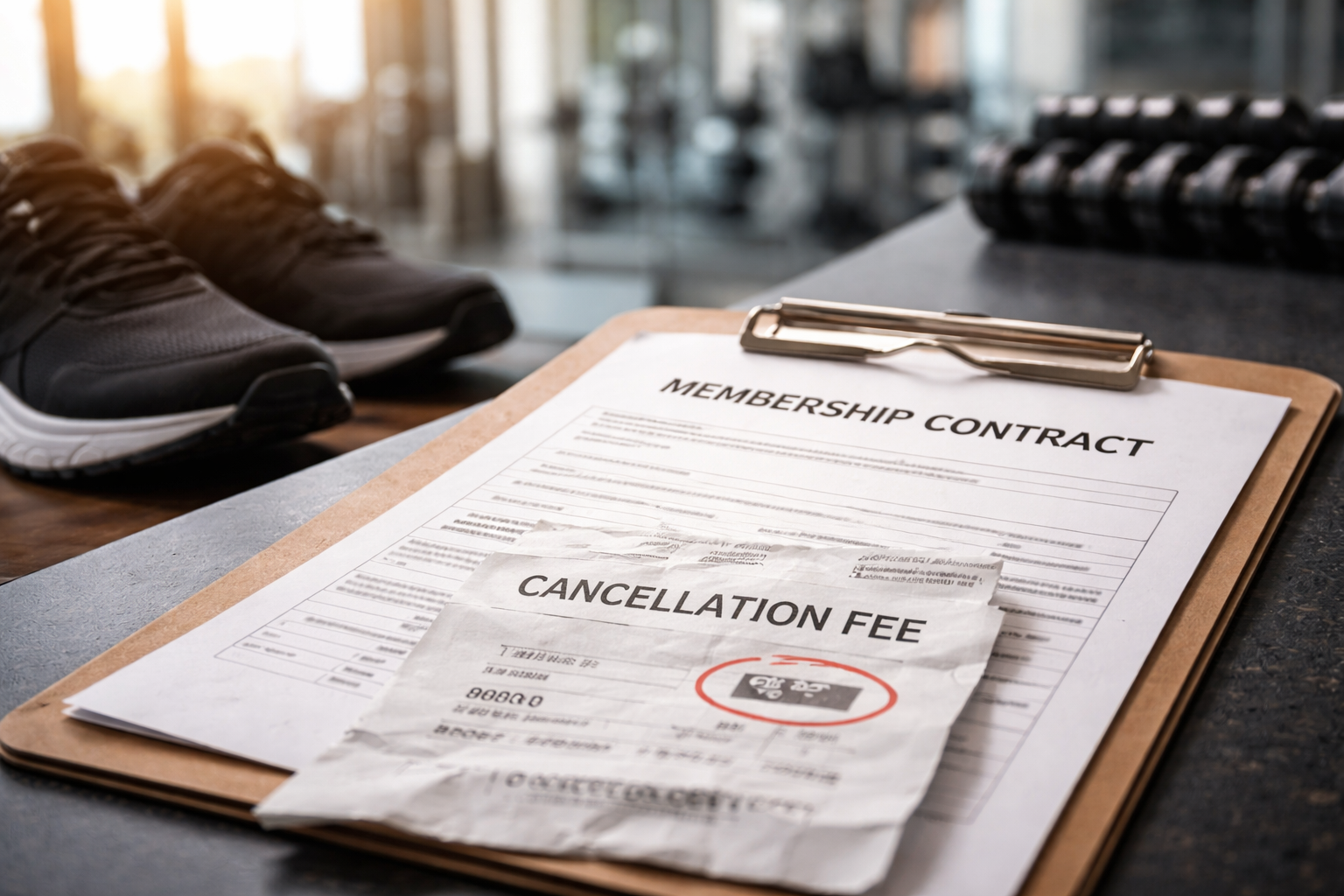
Gym Membership Cancellation Fee Charged After Contract Ended was the phrase I ended up searching after opening my bank app and seeing a charge that made no sense. The contract term was over. I was not actively using the gym anymore. In my mind, the relationship had already ended. Then a cancellation fee appeared anyway, as if I had just broken an active agreement. The worst part was not even the amount at first. It was the feeling that the system was treating an expired contract like it was still alive.
That kind of charge catches people off guard because it shows up after they think the hard part is already over. Many consumers assume that when the term ends, the account ends too. But gyms often do not run their memberships that way. A contract can expire while the billing profile stays open, the payment authorization stays active, and the account quietly rolls into a different status behind the scenes. That is where Gym Membership Cancellation Fee Charged After Contract Ended problems usually begin, and that is why this issue feels so unfair when it lands on a statement.
If you want to understand how billing systems internally treat account disputes after a charge posts, this related guide helps explain the logic companies use once an account is challenged.
Why This Charge Shows Up
In many gyms, the contract term and the billing relationship are not the same thing. That is the first point most consumers do not see until there is already a problem. A 12-month or 18-month contract may only describe the minimum commitment period. Once that period ends, the membership may not automatically terminate. Instead, the account often moves into a renewal, month-to-month, or continuation status.
That matters because Gym Membership Cancellation Fee Charged After Contract Ended situations often happen when a member acts based on the contract date, while the gym’s billing software acts based on account status. The person thinks, “My contract ended, so I am done.” The billing system thinks, “This membership continued, and now a termination event happened outside the approved window.” Those two interpretations create the charge.
Some gyms also separate local club operations from billing administration. The front desk may see that your term ended. The billing vendor may still see an active payment profile. When those systems are not aligned, the fee can be generated automatically without anyone at the gym manually deciding to charge it.
Where Consumers Usually Misread the Timeline
Gym Membership Cancellation Fee Charged After Contract Ended disputes often come from one timeline problem: the member is tracking one date, but the billing platform is tracking another. The contract end date is only one date. The system may also track a renewal date, a notice deadline, a billing cutoff date, and a cancellation effective date.
That means all of the following can be true at the same time:
- your minimum contract term ended,
- your account remained open,
- your payment method stayed authorized,
- your cancellation request was logged after the system’s internal cutoff.
Once that happens, the gym may argue that the fee was triggered by late termination rather than by the original contract itself. This is why people feel blindsided. They are looking at the end of the term, while the billing software is looking at the rules around how the account exits the system.
The Most Common Account Paths
Not every Gym Membership Cancellation Fee Charged After Contract Ended problem follows the same path. The charge may look identical on the statement, but the internal reason can be completely different. Figuring out which path matches your situation is what makes the dispute stronger.
Path 1: The term ended, but the membership auto-continued.
This is one of the most common patterns. The contract reached the end of its required term, but the membership rolled into month-to-month status. When the member later requested cancellation, the billing system treated it as a termination event subject to a fee.
What to check: Look for language like automatic renewal, month-to-month continuation, recurring membership after initial term, or ongoing dues unless canceled in writing.
Path 2: The cancellation request missed the notice window.
Some gyms require a notice period before the next draft or before the account can fully close. Even if the contract term ended, a late request can still trigger a final charge or cancellation fee if the request landed outside the required notice period.
What to check: Look for language mentioning 10-day, 30-day, or next-billing-cycle notice. Search emails, portal messages, and cancellation forms for timestamps.
Path 3: A freeze or hold was mistaken for a cancellation.
Members often freeze a gym account because they are traveling, injured, moving, or temporarily not using the club. But a freeze usually pauses access, not the legal or billing relationship. When the freeze ends, the system may restore the account and later assess a fee when the member tries to shut it down for good.
What to check: Review whether you signed a freeze request, a medical hold, or a temporary suspension rather than a true closure request.
Path 4: The club changed ownership or billing vendors.
Sometimes Gym Membership Cancellation Fee Charged After Contract Ended appears after an account migration. During ownership or platform changes, old status notes, cancellation records, and contract history can be transferred incompletely. The new system may interpret an old account as active and assess a fee when it sees a closure request.
What to check: Think back to whether the gym rebranded, changed names, merged, or started using a new billing company.
Path 5: The cancellation was requested verbally, but not recorded properly.
A member may have told staff in person, by phone, or at the desk that they wanted the account closed. But many gyms require a web form, certified mail, in-club signature, or billing-department submission. If the conversation happened but the system never recorded it, the account may have kept running until a fee appeared.
What to check: Search for written confirmation, email replies, portal screenshots, signed forms, or any proof that the request was actually logged.
How Gyms See It Internally
From the consumer side, this feels like a simple question: did the contract end or not? From the gym side, the issue is often broken into several internal fields. Staff and billing vendors may review contract term, service access, payment authorization, account lifecycle status, and cancellation method separately. That is why a Gym Membership Cancellation Fee Charged After Contract Ended dispute can sound obvious to the member but still take time to unwind internally.
Many gyms do not manually create these fees one by one. The platform does it automatically when certain conditions are met. If the account is coded as renewable, the cancellation arrives after cutoff, and the payment profile remains valid, the system may generate the fee with almost no human judgment involved.
That also explains why the first employee you speak with may sound unhelpful. The desk staff may not have authority to reverse charges generated by a third-party billing processor. The real decision may sit with a corporate billing team or outside collections-style membership vendor.
If you want to see how companies process the movement of charges, payments, and corrections after they enter a billing system, this related article can help fill in that part of the puzzle.
What Makes Your Dispute Strong
If you are dealing with Gym Membership Cancellation Fee Charged After Contract Ended, the strongest dispute is not emotional. It is chronological. You want to rebuild the account timeline in a way the billing department cannot easily ignore.
Start with these items:
- the original contract or membership agreement,
- the date the minimum term ended,
- the exact date you tried to cancel,
- proof of how you tried to cancel,
- the date the fee posted,
- any notice emails or account messages sent before the charge.
The goal is to show one of two things clearly. Either the account should have already been closed when the fee was assessed, or the gym failed to properly disclose that a continuation status or notice period would trigger additional charges. Once the timeline becomes concrete, many vague gym explanations start falling apart.
What To Do Based On Your Situation
If you have the contract and it shows the term clearly ended:
Write to the gym’s billing department and state that the term ended on the documented date. Ask them to identify the exact contract clause that authorized the cancellation fee after expiration. Request that they provide the renewal or continuation language they relied on.
If you canceled verbally but have no written proof:
Still document the interaction. State when you visited or called, who you spoke with if known, and what you were told. Then ask the company whether there is any note history or staff log showing your request. Even if they deny it, you create a record that your cancellation effort started earlier than the fee.
If the gym says the account rolled month-to-month:
Request the exact provision that converted the account. Ask whether notice of that rollover was ever sent to you. A lot of disputes become much easier when the company cannot prove that the continuation terms were actually disclosed in a usable way.
If the fee is already in collections or headed there:
Do not ignore it. Send a written dispute immediately to the gym and the collector if one is involved. State that you dispute the underlying validity of the fee and that the contract term had already ended. Delay makes these cases harder, especially once internal notes start describing the balance as uncontested.
Mistakes That Hurt Fast
Gym Membership Cancellation Fee Charged After Contract Ended disputes often get worse because people react in ways that feel satisfying in the moment but weaken the paper trail. One common mistake is immediately blocking the card or bank draft without first documenting the dispute. Another is arguing with the front desk repeatedly but never sending a written demand to billing. A third is assuming that because the fee is unfair, it will obviously be removed on its own.
The better move is to create a clean record. Ask for written confirmation. Ask what status the account was in on the day the fee was generated. Ask what clause authorized it. Ask whether the account was shown as expired, renewed, frozen, or active. Those questions force the company to define its position instead of hiding behind vague membership language.
Key Takeaways
- Gym Membership Cancellation Fee Charged After Contract Ended usually happens because the contract term ended but the billing account did not fully close.
- Auto-renewal, notice windows, freezes, and bad recordkeeping are the most common triggers.
- The strongest disputes focus on timeline evidence, not general complaints.
- Front desk staff may not control the charge if a third-party billing company generated it.
- Fast written action reduces the chance that the fee grows or gets escalated.
FAQ
Can a gym keep charging after the contract term ends?
Yes, if the membership agreement allowed the account to continue beyond the minimum term. That is why the contract end date alone does not always end billing.
Is Gym Membership Cancellation Fee Charged After Contract Ended always legal?
No. It depends on the contract language, disclosure, timing, and whether the gym can show that the account remained active under valid terms after the original period ended.
What if I already stopped using the gym?
Stopping use does not automatically end the membership. Gyms usually rely on the cancellation procedure, not attendance history.
Should I dispute it with my bank right away?
You may have that option, but first gather the contract, cancellation record, and billing timeline. A rushed payment reversal without documentation can complicate the dispute.
Recommended Reading
If your next concern is how to push the dispute forward once the company starts resisting, this article is the best follow-up because it breaks down escalation in a structured way.
For general official consumer guidance on disputing charges, the Federal Trade Commission provides a useful overview here: FTC guidance on disputing charges.
Gym Membership Cancellation Fee Charged After Contract Ended feels especially frustrating because it appears after people think they already fulfilled the deal. That is exactly why these disputes require precision. You are not just arguing about a fee. You are challenging the billing system’s assumption that your account was still in a status that allowed one.
So do not wait and do not rely on one phone call. Gather the contract, pin down the date the term ended, identify how and when you tried to cancel, and demand written proof for the fee. If the gym cannot clearly connect that charge to a valid continuation clause or a properly disclosed notice rule, press the dispute in writing immediately. That is the fastest way to stop the charge from becoming a larger and more expensive problem.