
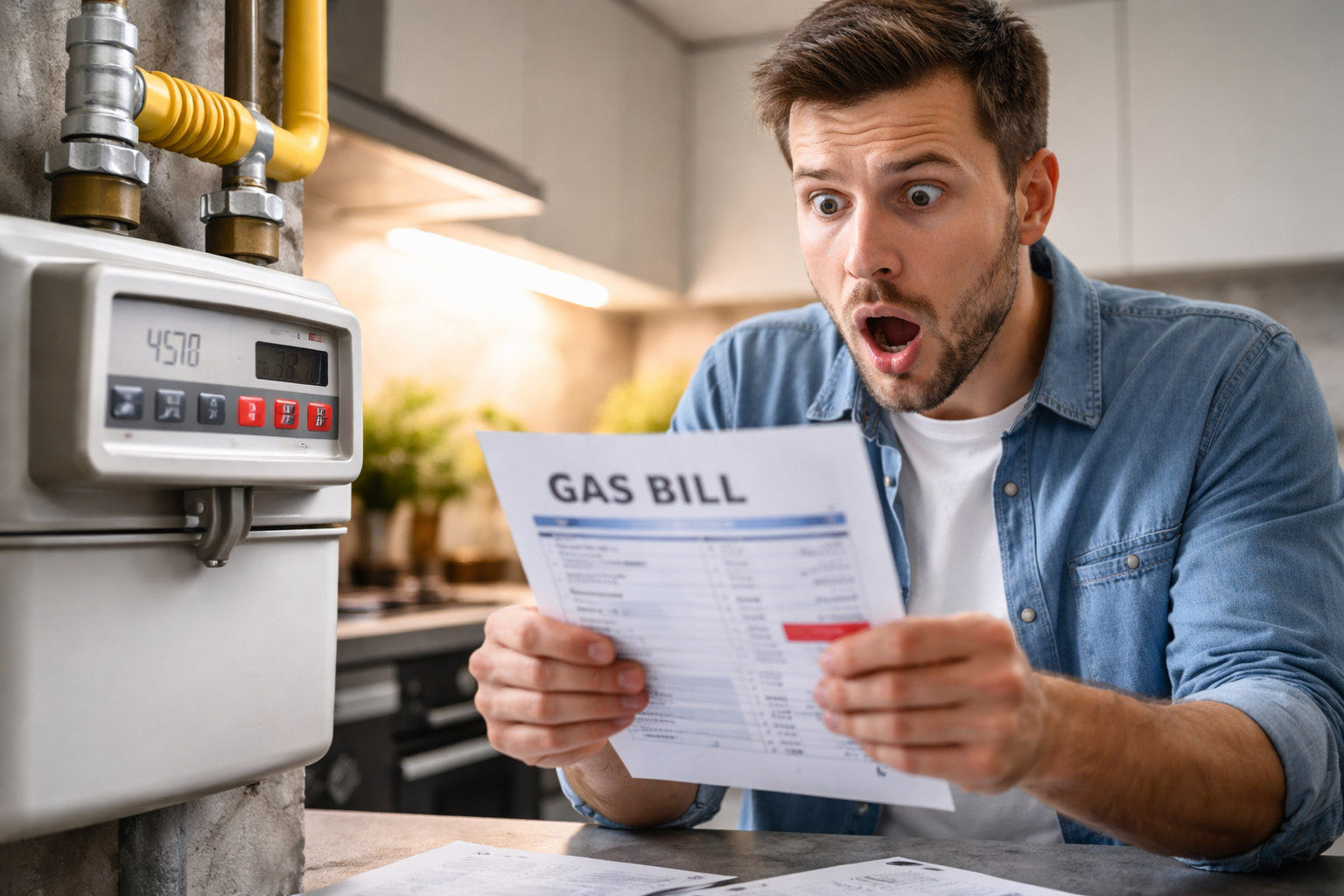
Gas bill unusually high — that exact phrase was the first thing I typed after I opened my utility app and felt my stomach drop. The number didn’t look “a little off.” It looked like someone added a zero. I stared at it long enough to convince myself the screen would refresh and fix itself. It didn’t.
I’m not dramatic with bills. I pay, I move on. But this time I opened the PDF statement, scrolled to the usage chart, and the dates didn’t match what my brain remembered. Same routine. Same house. Same thermostat habits. Yet gas bill unusually high was suddenly my whole evening.
First 10 Minutes: Do These Checks Before You Call
- Confirm the service address on the bill matches your home (not a prior address).
- Look for “Estimated” vs “Actual” meter read on the statement.
- Compare billing days: 28 days vs 35+ days can inflate totals even when daily use is normal.
- Find your rate line: “Cost per therm” or supply/delivery rate. A rate jump can mimic higher usage.
- Check for fees: late fee, reconnect fee, “budget billing true-up,” or deposit applied.
If you do nothing else tonight, screenshot the bill page that shows “Estimated/Actual,” usage, and billing dates. That screenshot is the difference between a 3-minute fix and a 3-week loop.
Why a Gas Bill Spikes When Your Habits Didn’t Change
When gas bill unusually high shows up, it’s usually not “mystery usage.” It’s one of a few repeat patterns. Here’s how they present in real life:
- Estimated reads catching up: several months of estimates, then one actual read that “trues up” the gap.
- Long billing cycle: more days billed, same daily usage, bigger total.
- Rate increase / seasonal pricing / supplier change: usage looks similar, total cost jumps anyway.
- Leak or failing appliance: usage rises quietly, often with no obvious smell.
- Meter or account error: wrong meter number, misread digits, or usage assigned incorrectly.
Utility Company Perspective: What Their System “Assumes”
This matters because it explains why you can feel stuck when gas bill unusually high and the first agent says, “The bill is correct.” Most billing systems follow a default script:
- If the meter read is estimated, the system assumes it will be corrected later (not immediately).
- If the read is actual, the system assumes the meter is accurate unless you request a test or investigation.
- If you’re on budget billing, the system expects a “true-up” eventually—sometimes as a painful surprise.
- If you’re past due, the system pushes payment first and “review later.”
You’re not asking them to “be nice.” You’re asking them to follow their own investigation steps and document them.
Your Rights (Practical, Not Legal Advice)
Rules vary by state and provider, but in the U.S. there’s a common theme: you can request details and you can dispute a charge. If gas bill unusually high, your goal is to create a clean record that forces a real review.
- You can request itemization (read dates, read type, meter number, usage history).
- You can request a re-check of the read and whether it was estimated.
- You can request a meter accuracy test (sometimes free within certain limits, sometimes a fee if it passes).
- You can escalate beyond frontline support when the numbers don’t reconcile.
If the provider stalls or you can’t find your state’s complaint path, this federal resource helps you locate the right consumer office by state:
The Self-Apply Checklist (Use This to Diagnose Your Case)
Read each line and mark Yes or No. This is how you stop guessing and start narrowing down the real cause of gas bill unusually high.
- Billing days: Is this bill covering more days than usual? (Yes/No)
- Read type: Does it say “Estimated” anywhere? (Yes/No)
- Usage: Are therms significantly higher than the same month last year? (Yes/No)
- Rate: Is the cost per therm higher than last bill? (Yes/No)
- Budget billing: Are you on level pay/budget plan with a true-up? (Yes/No)
- House changes: New heater/water heater, more people, colder weather, longer showers? (Yes/No)
- Appliance red flags: Pilot light issues, furnace running longer, hot water inconsistent? (Yes/No)
- Move-in/out: Did you recently move or transfer service? (Yes/No)
If you answer “Yes” to Estimated + True-up OR Estimated + Long billing cycle, you likely have a billing mechanics issue—not a usage behavior issue.
Case Block: Pick Your Situation and Follow the Exact Steps
Case A: The bill says “Estimated” or “E” for meter read
- Take a photo of your gas meter today (include the full meter face + digits).
- Call/chat and say: “My bill is based on an estimated read. I have a current meter photo. Please open a review and re-bill using an actual read.”
- Ask for: ticket number, the read date they used, and the reason it was estimated.
- If they won’t adjust immediately, request: “Please schedule an actual meter read and note that the estimated bill is disputed.”
Case B: The read is “Actual,” but the therms don’t make sense
- Compare last 12 months usage (most bills show a chart). Screenshot it.
- Ask them to confirm the meter number on your account matches your physical meter.
- Ask: “Can you confirm this read was captured on-site and not estimated?”
- Request a meter accuracy test and ask what happens if it fails (credit/back-bill rules).
Case C: Usage looks normal, but the total cost jumped
- Find the line showing rate per therm (supply and delivery may be separate).
- Ask if you were switched to a different plan, rider, or supplier.
- Ask for a written explanation of the rate change and effective date.
- If you’re on a third-party supplier and didn’t intend to be, ask how to revert to the default utility supply (rules vary).
Case D: You suspect a leak or failing appliance
- Prioritize safety: if you smell gas or feel unwell, leave the area and contact emergency services and/or the utility emergency line.
- Even without smell: check if the furnace is short-cycling or running longer than normal.
- Stop “guessing” and document: thermostat settings, run-time, any maintenance changes.
- Ask the utility what documentation helps for a “high bill investigation” and whether they offer a usage review.
Exactly What to Say (Scripts That Get You Past the Loop)
When gas bill unusually high, your tone matters less than your structure. Use short, specific sentences:
- “I’m disputing this bill amount due to a suspected billing/reading error. Please note the account and open a review.”
- “Was this read estimated or actual? What is the read date and the prior read date?”
- “Please confirm the meter number on my account matches my physical meter.”
- “If you can’t adjust today, please escalate to the billing investigation team and provide a ticket number.”
Never accept “it’s correct” without asking “based on what read type and what dates?”
Proof Pack: What to Collect So You Win the Dispute
Think of this as your “one-page file” that makes your case easy to approve:
- Bill PDF + screenshots of usage chart and read type
- Photo of meter with date/time (phone metadata helps)
- Last 2–3 bills for comparison
- Notes: billing days, thermostat settings, any home changes
- Ticket numbers + agent names + dates of contact
If gas bill unusually high and you later escalate, this proof pack prevents the classic reset: “Can you explain again from the beginning?”
Mistakes That Make High Bills Harder to Fix
- Paying in full without noting a dispute (you may lose urgency and leverage in the process).
- Calling with no facts (no read type, no dates, no meter photo).
- Arguing about feelings instead of the math (billing days, estimated reads, rate changes).
- Assuming “no smell = no issue” (appliance inefficiency can raise usage without obvious odor).
- Waiting past the due date without a ticket number or dispute note.
The best time to act is the same day you notice the spike—before it becomes “last month’s issue.”
Related Reads (Internal Links)
These are the closest matches on billingdisputehelp.com. They help you handle adjacent scenarios without repeating the same steps.
If your issue is “unusually high” across utilities and you want a comparison framework:
If you think the meter read itself is wrong (digits, read date, mismatch):
If the “unusually high” problem may be leak-related and you want documentation tactics:
Duplicate-risk note: This post overlaps lightly in structure with your “unusually high” electricity/water articles, but it is designed to be gas-specific (therms, furnace/water heater behavior, estimated-read catch-up patterns, and meter/account matching). It should index as a separate intent if you keep the examples and scripts gas-only.
Key Takeaways
- Don’t guess. Confirm billing days, read type (estimated vs actual), and rate changes first.
- Document fast. Meter photo + usage chart screenshot makes the dispute actionable.
- Ask for a ticket number. It stops the “start over” cycle.
- Choose the right case path. Estimated read, actual read mismatch, rate increase, or appliance/leak.
- Escalate cleanly. Facts + dates + proof pack beat emotion every time.
FAQ
- Q: If my gas bill unusually high because of an estimated read, will they fix it automatically?
A: Sometimes it corrects on the next actual read, but that can take weeks. If the amount is extreme, open a ticket now and provide a meter photo so the correction doesn’t drag out. - Q: Should I pay the full bill while disputing it?
A: Policies vary. The safest move is to contact the provider immediately, ask them to note the bill as disputed, and request their specific “disputed bill” instructions (including due date impact). Keep everything documented. - Q: What if usage is truly higher and not a billing error?
A: Then the checklist still helps: you’ll usually find a cause (long billing cycle, colder spell, appliance running longer, water heater issue). The key is proving which bucket you’re in before you accept the charge. - Q: Can a supplier switch raise my gas charges?
A: Yes. If the rate per therm changed noticeably while usage stayed similar, ask whether your supply source changed and request a written explanation of the rate and effective date. - Q: When is a meter test worth it?
A: If the read is “Actual,” the usage is wildly out of pattern, and the meter/account match checks out, a meter test becomes a logical next step—especially if the provider offers a low-cost or limited-free testing policy.
Closing: What I Did Next (And What You Should Do Tonight)
After the shock wore off, the fix wasn’t magic—it was sequence. I stopped rereading the total and started collecting proof: read type, billing days, rate line, and one clear meter photo. Once I had that, the conversation changed. The agent wasn’t deciding whether my frustration was “reasonable.” They were reacting to a file that forced a billing review.
Right now, if gas bill unusually high for you, do this in order: (1) screenshot the read type/usage/dates, (2) take a meter photo, (3) call or chat and open a dispute ticket using the scripts above, and (4) ask for the next concrete step (actual read scheduling, re-bill timeline, or investigation team escalation). Don’t wait for the next bill—tonight is when you lock in the paper trail that protects you.