
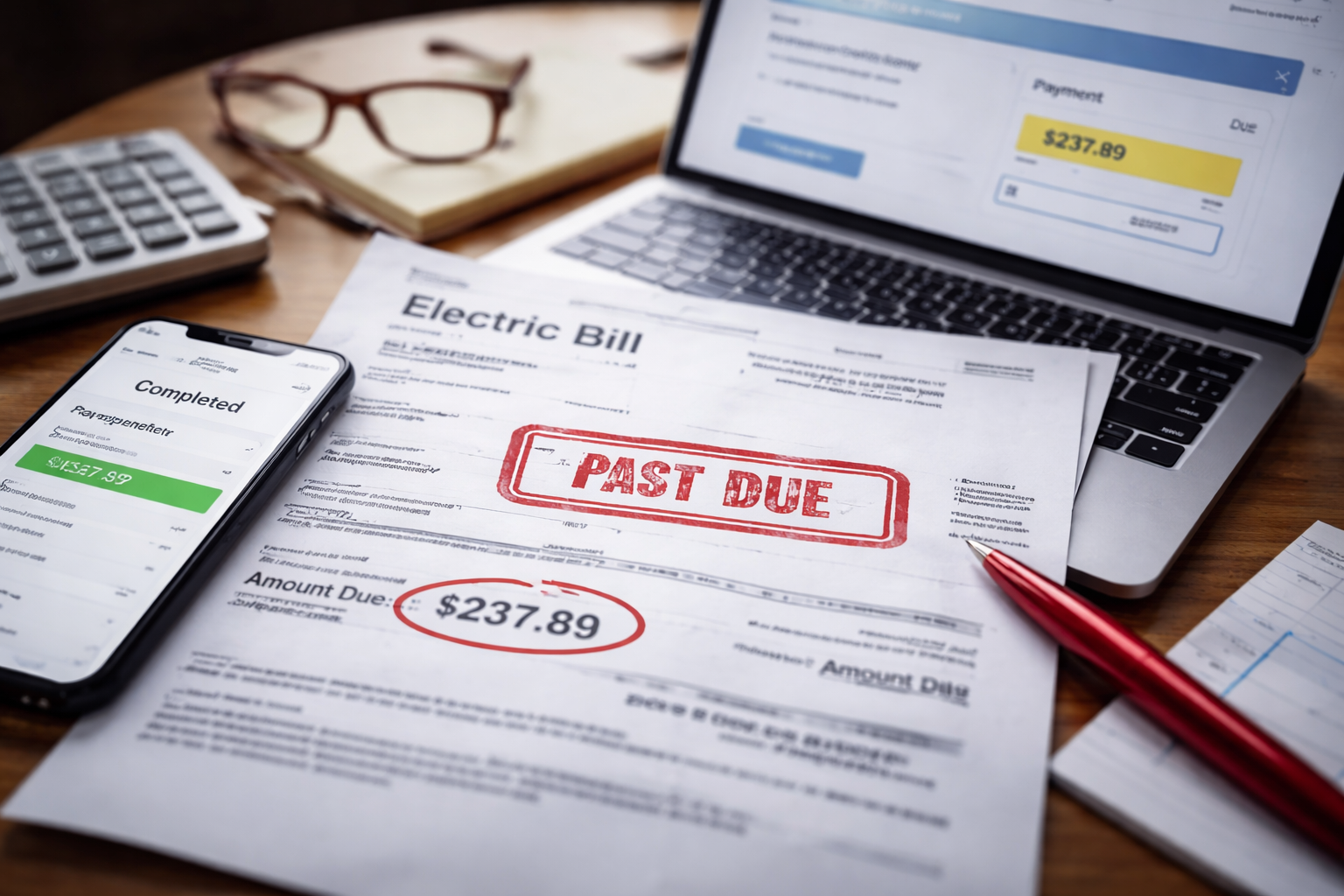
Electric bill payment not credited — that’s the exact phrase I typed the second I saw the balance still sitting there like I hadn’t paid anything. The payment confirmation email was in my inbox. My bank showed the money moved. But the utility portal acted like it never happened.
I didn’t spiral. I just felt that tight, practical concern: late fees, a shutoff notice, or an “unpaid” flag that creates a chain of problems. If you’re here, you’re not looking for a lecture. You want your payment credited and your account protected—without accidentally making it worse.
Quick “Do This First” Checklist (3 Minutes)
Before you call anyone, do this fast. It turns electric bill payment not credited from a confusing portal issue into a trackable fix.
- Screenshot #1: Your payment confirmation (date/time, amount, confirmation number, account number).
- Screenshot #2: Bank/credit card transaction page showing Pending vs Posted.
- Screenshot #3: Utility portal balance page (showing the unpaid amount).
- Check #4: Payment method used (utility portal, bank bill pay, autopay, Apple Pay/Google Pay, third-party vendor).
- Check #5: Due date and any shutoff/late fee language on your bill.
The goal is not to “argue.” The goal is to prove the payment, lock in account protection, and get a reference number.
Why This Happens (Without the Textbook Talk)
Most electric bill payment not credited situations happen because payments don’t travel in a straight line. Your bank is one system. The payment processor is another. The utility’s billing system is often separate from the portal you see. When timing or identifiers don’t match perfectly, your money can move while the credit doesn’t post where you expect.
- Batch posting delays: Payments post in daily batches, especially after weekends/holidays.
- Pending vs posted confusion: The utility may not credit “pending” transactions.
- Wrong account mapping: One digit off in the account number or a saved profile for an old address.
- Bank bill pay routing: The bank may send it as a check or electronic remittance with a reference the utility must match.
- Third-party vendor lag: You paid through a vendor link, not directly inside the utility’s core system.
The Timeline That Prevents “Panic-Paying Twice”
When electric bill payment not credited happens close to a due date, people do the most expensive thing: they pay again “just in case.” Don’t do that until you’ve identified which timing bucket you’re in:
- Card payment: sometimes instant, sometimes 24–48 hours depending on the vendor.
- ACH transfer: commonly 1–3 business days to post (longer around holidays).
- Bank bill pay: can be electronic or mailed check; “sent” is not the same as “received and posted.”
If your bank shows Posted and the portal still shows unpaid, treat it as “research ticket” time—not “wait and hope” time.
Provider View: What the Utility Checks First
Utilities usually classify electric bill payment not credited as a back-office matching problem. The front-line rep may not see your payment immediately. That’s why you want to ask for the right action instead of telling a long story.
- They check whether a payment exists in the payment processor feed.
- They check whether it matched your account number/service address.
- They check whether it is sitting in “unapplied cash” or a suspense queue.
- They check whether your account is flagged for a move-in/out or account merge that delays posting.
When you use process language (ticket, research, trace, reference number), your issue becomes trackable.
Your Rights (Practical, Not Dramatic)
Rules vary by state and by utility, but in most U.S. cases you can reasonably request:
(1) a formal billing review,
(2) the expected posting timeline for your payment, and
(3) written confirmation that your account is marked “under review” so late fees or shutoff actions are paused while the issue is investigated.
If you want a credible, regulator-level explanation of how utility consumer protections work in practice, this official state resource is a solid starting point:
Why this matters:
You are not escalating emotionally or making threats.
You are simply following the standard consumer-protection framework utilities already operate under, especially when a documented payment exists but has not been properly credited.
Case Branching (Long Block): Pick Your Exact Situation
Use this block like a decision tree. Most electric bill payment not credited cases fall into one of these. Pick the box that matches you and follow only that path.
Case A: Bank/Card shows “Pending”
- Take screenshots now (pending status can change).
- Set a reminder to re-check the portal next business day morning and afternoon.
- Do not pay again yet. Pending transactions can drop off and re-post.
Case B: Bank/Card shows “Posted,” portal still shows unpaid
- Call or chat the utility and request a payment research ticket.
- Ask for late-fee protection or an account note while the ticket is open.
- Get a reference number and a follow-up date.
Case C: You used Bank Bill Pay
- Confirm whether the bank sent it electronically or by mailed check.
- Ask the bank for a trace number (electronic) or a check image (mailed).
- Verify the payee details and account number the bank used.
Case D: Payment went to the wrong utility account (old address / wrong account number)
- Tell the utility: “I need a payment reallocation to the correct account.”
- Provide proof + both account numbers (old and new, if applicable).
- Ask how long reallocation takes and request fee protection during the transfer.
Case E: You paid through a third-party vendor / guest payment link
- Find the vendor receipt/transaction ID (not just the utility email).
- When you contact the utility, lead with the vendor ID and the amount/date.
- Request confirmation of the vendor posting window and a research ticket if it’s past that window.
Case F: You’re near shutoff / urgent notice
- Tell them you need your account placed in protected status while they research the payment.
- Ask what minimum action prevents disconnection while they investigate (varies by provider).
- Get the agent name/ID (if available) and a reference number.
What to Say (Short Script That Works)
If electric bill payment not credited is happening right now, read this verbatim. Keep it administrative.
- Opening: “Hi, I made a payment on [date/time]. My bank shows it [posted/pending], but my online account still shows a balance.”
- Proof: “I have the confirmation number and a screenshot of the transaction.”
- Request: “Can you open a payment research ticket and confirm the expected posting timeline?”
- Protection: “Please note my account to prevent late fees or disconnection activity while this is investigated.”
- Close: “What is the reference number, and when should I follow up if it doesn’t post?”
Always end with a reference number. It converts a vague conversation into a trackable process.
Proof Pack (5 Screenshots That Make Support Move Faster)
When electric bill payment not credited drags on, it’s usually because the evidence is scattered. Build a “proof pack” once:
- Utility portal page showing balance due
- Payment confirmation page/email showing confirmation number
- Bank/card transaction page showing status (pending/posted) and amount
- Utility account page showing your account number (or bill header with account ID)
- Device date/time visible (helps establish timing if needed)
Mistakes That Make This Worse (Avoid These)
- Panic-paying again: The fastest route to overpayment and refund delays.
- Calling with no proof: If you can’t show it, they can’t route it.
- Using vague language: Say “posted at my bank” and “payment research ticket,” not “your system is broken.”
- Ignoring the due date: Even if it’s a posting glitch, you must protect the account from auto-fees.
- Starting over every time: Each contact should add a record, not restart the story.
The goal is a clean timeline: proof → ticket → protection → follow-up → resolution.
Escalation Ladder (Use Only If the First Contact Stalls)
If electric bill payment not credited is still unresolved after the normal posting window:
- Day 1: Open a payment research ticket. Get a reference number.
- Day 2: Ask for the billing/research team or a supervisor. Provide the proof pack.
- Day 3: Send a short written follow-up (email/contact form) attaching proof and referencing the ticket number.
Keep the tone calm and factual. The system responds to documentation and identifiers, not intensity.
Self-Check: Apply This to Your Situation (Don’t Skip)
Use this checklist to “map” your case in under two minutes. If you can answer these, you can resolve electric bill payment not credited faster.
- Did my bank show Pending or Posted?
- Did I pay inside the utility portal, via bank bill pay, autopay, or a third party?
- Do I have a confirmation number that includes my account number?
- Is there any chance I paid a saved/old account (old address, old profile)?
- How close am I to the due date or any shutoff language?
If you can’t answer one of these, your first step is not a phone call—it’s collecting proof.
Related Reads (Internal Links)
These are closely related and can prevent common “double-problem” scenarios (overpay, duplicate charges, and confusion between billing vs payment posting). Use them if your case overlaps.
Why it helps: Same core issue (payment moved, portal doesn’t reflect it) with a clean documentation-and-ticket approach you can copy.
Why it helps: If you’re tempted to “pay again,” read this first—duplicate transactions are a common side effect of panic-fixing.
Why it helps: Sometimes a missing credit shows up as an “unusually high” balance. This helps you separate usage problems from system/billing problems.
FAQ
- How long should I wait before I worry?
If your bank shows Pending, waiting until it posts (often next business day) can be normal. If it shows Posted and the portal is still unchanged, open a research ticket the same day. - Should I cancel the payment and re-pay?
Usually no. Cancellations can create returned-payment labels or confusion. Only consider cancellation if the bank confirms it never posted and the utility confirms they have no record of it. - Can the utility charge late fees while the payment is “missing”?
Some systems auto-apply fees. That’s why you request an account note and fee protection once a research ticket is open. - What if I paid the wrong account number?
Report it immediately and request a reallocation/transfer. Provide proof and both account identifiers if you have them. The faster you report it, the easier it usually is to correct internally. - Will this hurt my credit?
Utility billing and credit reporting practices vary, but the risk usually increases if it becomes delinquent and gets sent to collections. That’s why your priority is account protection (documentation + ticket) before the due date passes.
Key Takeaways
- Don’t panic-pay twice. Confirm pending vs posted before you do anything.
- Build a proof pack once. Screenshots turn confusion into a fast fix.
- Use the right words: “payment research ticket,” “reference number,” “fee protection.”
- Protect the account first, then fix the posting. That prevents late fees and shutoff stress.
- Escalate with documentation, not emotion. Every contact should add a record.
What to Do Right Now (Read This Once, Then Act)
If electric bill payment not credited is what brought you here, do not spend another hour refreshing the portal. Open your bank transaction page and your utility portal side-by-side, capture the screenshots, and contact the utility using the short script above.
Your goal today is simple: get a payment research ticket, get a reference number, and get your account noted for protection while they locate and post the payment. When you handle it this way, electric bill payment not credited stops being a stressful mystery and becomes a straightforward admin task with a paper trail—fast.