
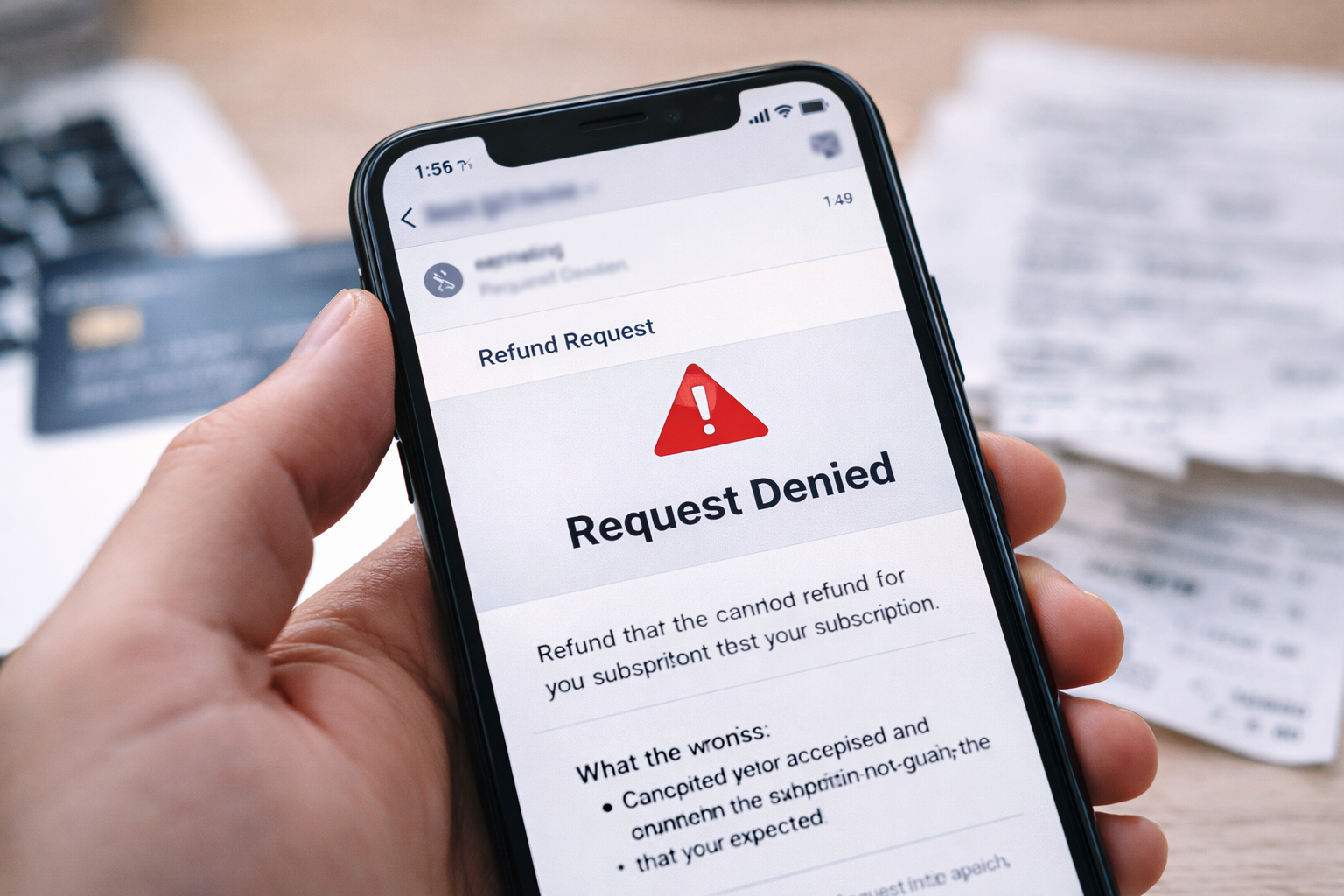
Subscription refund denied was the last thing I expected after doing what most people think is “the right way.” I canceled, I followed the prompts, and I even took a screenshot because I’ve learned that subscriptions can be slippery. When the email came back—short, automated, and final—it felt like the system was telling me my timeline didn’t matter.
It wasn’t dramatic. It was just stubbornly unfair: I wasn’t asking for a favor—I was asking for a correction. When a refund is denied, the problem is rarely your emotions. It’s the path you choose next and how clean your proof is.
If your situation includes duplicate charges (which often triggers a denial because the provider “sees it as valid”), read this next. It helps you separate a refund request from a billing error claim.
Why Refunds Get Denied (The System, Not the Story)
In most disputes, subscription refund denied happens for one of three reasons: policy windows, account mismatch, or billing classification. Providers and payment processors don’t evaluate “fairness.” They evaluate rules.
- Policy window: You canceled after a cutoff (you may still have a different remedy).
- Account mismatch: You canceled one account but were billed on another (common with multiple emails).
- Classification: The provider treats it as “digital access used” rather than “service not delivered.”
Your leverage increases the moment you turn “I canceled” into “Here is the timeline and proof.”
The One Thing That Changes Outcomes: A Clean Timeline
When subscription refund denied hits, most people immediately send a long message. That usually fails because support agents can’t verify anything quickly. Instead, build a timeline that fits on one screen.
- Date billed: (from your bank/card statement)
- Date canceled: (from the provider’s account page or email)
- What you expected: “Cancel before renewal” or “free trial” terms
- What happened: charged anyway / renewal processed / service ended but billed
Refund decisions move faster when your evidence is “sortable,” not emotional.
Long Case Breakdown: Find Your Branch and Use the Right Fix
Case A: Free Trial Ended and You Forgot to Cancel
This is the most common reason subscription refund denied shows up. Providers treat it as user responsibility.
- What works: “First-time courtesy refund” request with a short timeline.
- Best proof: screenshot showing you canceled immediately after noticing.
- Important note: ask for a “one-time exception” rather than debating policy.
Case B: You Canceled, But Renewal Still Went Through
Sometimes cancellation doesn’t attach to the right billing profile (especially if you subscribed inside an app).
- What works: request an audit: “Please verify cancellation timestamp vs renewal timestamp.”
- Best proof: cancellation confirmation email + billing charge time.
- Key detail: time zones matter—capture the timestamp exactly as shown.
Case C: You Canceled a Service, But Billing Continued
This is common with internet/utility-style subscriptions and account transitions. If subscription refund denied happens here, it’s often because the provider thinks the account is still active.
- What works: “Service ended” documentation + request for stop-billing + backdated credit.
- Best proof: cancellation ticket number, chat transcript, final service date.
Case D: You Subscribed Through Apple/Google (App Store Billing)
If the provider can’t see your billing record, you’ll get subscription refund denied from them even if they want to help.
- What works: request refund through the app store first, not the merchant.
- Best proof: App Store / Google Play subscription screen + charge.
- Reality check: the merchant often cannot override the store’s decision.
Case E: Annual Plan / Large Renewal You Didn’t Expect
Annual renewals are brutal because the charge is big and the provider assumes notice was given.
- What works: ask for proration (partial refund) or plan conversion credit.
- Best proof: renewal notice emails (or the lack of them) + immediate cancellation.
- Goal: reduce loss even if a full refund is denied.
Case F: “Non-Refundable” Digital Content Claim
Many platforms deny refunds because they consider access “delivered.”
- What works: focus on a verifiable failure: service outage, account lock, feature missing, or duplicate billing.
- Best proof: error screenshots, outage ticket, support messages.
- What not to do: don’t argue fairness—argue non-delivery or misbilling.
Case G: You Were Charged After You Already Canceled
This is where subscription refund denied often flips into a billing dispute rather than a refund request.
- What works: request “charge reversal” or “billing correction” and attach cancellation proof.
- Best proof: cancellation confirmation + charge date after cancellation.
Pick your branch first. The wrong branch wastes days and increases the chance you miss bank dispute windows.
If your case looks like “I canceled but they kept billing me,” this guide is the closest match. It helps you frame the dispute as continuing billing after cancellation—often stronger than a generic refund request.
Provider and Bank Perspectives (So You Stop Talking Past Them)
When subscription refund denied, the provider and the card issuer are optimizing for different risks.
- Provider’s lens: policy compliance, usage, and internal billing records.
- Bank/card issuer lens: authorization, posting, dispute reason codes, and evidence.
This is why “I canceled” isn’t enough. Providers want cancellation confirmation. Banks want billing date, merchant name, and proof the charge is incorrect or unauthorized.
What to Do Immediately (The 20-Minute Action Plan)
If subscription refund denied, do this in order—today:
- 1) Screenshot everything: subscription page (status), cancellation confirmation, charge on statement.
- 2) Find your billing route: direct merchant vs Apple/Google vs PayPal.
- 3) Write your one-paragraph timeline: billed date, canceled date, why the charge is wrong.
- 4) Send one clean request: “Please review my cancellation timestamp and issue a refund/credit.”
- 5) Set a response deadline: 48–72 hours for a decision, shorter if the statement is closing soon.
Your goal is not to “win an argument.” Your goal is to trigger a review by the right team.
Mistakes That Quietly Kill Refund Chances
These are the traps that keep subscription refund denied stuck as a final answer:
- Starting with a chargeback threat: some providers shut down support immediately.
- Submitting multiple conflicting tickets: you create an internal “duplicate request” label.
- Skipping the billing route check: asking the merchant when Apple/Google controls billing.
- Letting time pass: waiting until after the statement closes before you gather proof.
Calm, consistent documentation beats urgency without structure.
When to Escalate (Without Making It Worse)
If subscription refund denied and the provider refuses to re-review, escalation should be method-based, not emotional.
- Escalate to billing team: ask for “billing review” or “accounting review,” not “manager.”
- Escalate by evidence: attach the timeline and point to one mismatch (date, cancellation, duplicate charge).
- Escalate to payment provider: if billed through PayPal or card, start the appropriate dispute path.
Escalation is simply making the dispute trackable with a case number and a clear reason.
If your refund denial is tied to a charge that looks “wrong” (amount mismatch, unexpected total, partial credits), use this next guide. It helps you frame the issue as an incorrect charge—often easier to prove.
FAQ
What if the provider says the subscription is “non-refundable”?
When subscription refund denied is based on “non-refundable,” shift your request from fairness to verification: cancellation timestamp mismatch, duplicate charge, service not delivered, or billing route error.
Should I dispute with my credit card company immediately?
Not always. First confirm whether billing was through Apple/Google/PayPal. If the merchant controls billing and refuses to review, then consider a formal dispute using your proof.
What proof matters most?
A cancellation confirmation, the charge line item, and a timeline that shows why the charge is incorrect. Short proof beats long explanation.
Can I still get something back if a full refund is denied?
Yes. Ask for proration, account credit, or conversion to a cheaper plan—especially for annual renewals.
Key Takeaways
- subscription refund denied usually means a policy window, account mismatch, or billing-route issue—not that you’re powerless.
- Build a clean one-paragraph timeline and attach proof that is easy to verify.
- Choose the correct path: merchant vs app store vs PayPal vs card issuer.
- Escalate with method (billing review + case number), not emotion.
subscription refund denied feels final only because the first denial is often automated. The second outcome depends on whether you push the issue into the right workflow—billing review, app store refund review, or a formal payment dispute—using a clean timeline.
Do this now: screenshot your cancellation proof and the charge, confirm whether billing ran through an app store or directly through the provider, and send one short request asking them to verify the cancellation timestamp against the billing timestamp. That is the fastest “next move” that turns a denial into an actual review. You shouldn’t have to keep guessing while the clock keeps running.
For U.S. consumer guidance on disputing credit card charges and understanding your billing rights, the Consumer Financial Protection Bureau is a reliable starting point.