
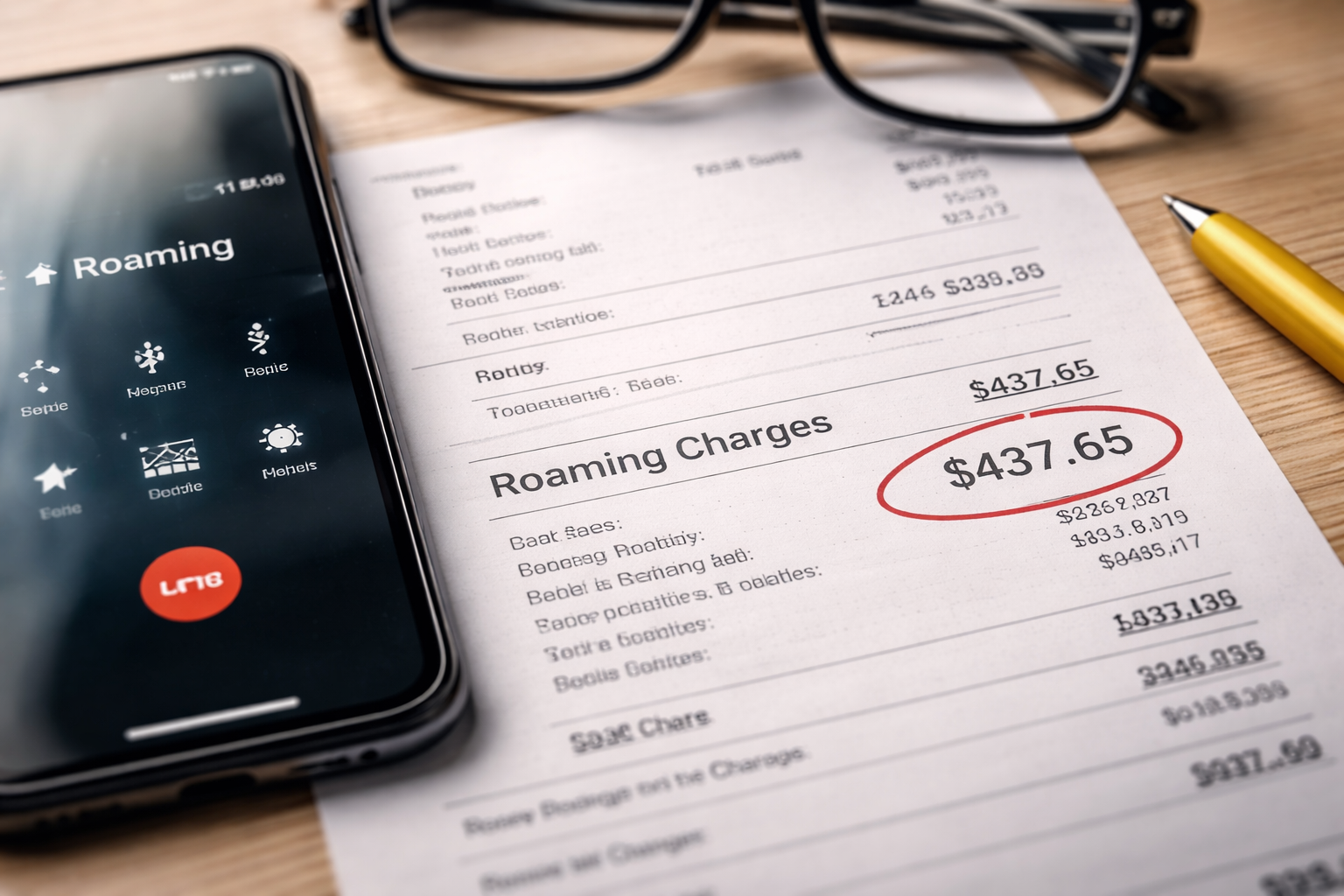
Mobile bill roaming charges dispute — I typed that phrase with my thumb hovering over the screen because I didn’t want a lecture about roaming. I wanted to know if people actually get these charges reversed. The moment I saw the bill total, I felt that quiet, practical kind of panic: not dramatic, not emotional, just a heavy “this is going to cost me time and money” realization.
I wasn’t even in a good “fight” mood. I was in that tired mood where you start doubting yourself first. Did I forget to turn something off? Did my phone sneak onto a network while I was in the airport? That self-doubt is exactly how people end up paying charges they shouldn’t have to. If you’re here, you’re probably trying to decide whether to accept it or push back.
Fast self-check
Answer these quickly. You’re not building a case yet. You’re choosing your posture.
- Do you see a “daily pass,” “international day pass,” “roaming bundle,” or “roaming session” you don’t remember activating?
- Is the usage time listed when you were on a flight, asleep, in a meeting, or already back in the U.S.?
- Is the data amount tiny (KB/MB) but billed as a full day?
- Did the roaming charges appear only after you returned home?
- Are there multiple days billed even though your trip was short?
If two or more answers are “yes,” treat this like a dispute, not a question. That difference changes how you’re handled on the phone and in the billing system.
Why this happens
Roaming charges often come from small, invisible triggers rather than obvious “usage.” A phone can connect briefly after landing before airplane mode engages. Background app refresh can check in for seconds. A carrier travel feature enabled long ago can still be attached to your line. Partner networks can also report usage in batches, which is why you might not see the charges until later.
None of that automatically makes the bill “correct.” It just explains why the charge exists in their system. Your goal is to separate “it can happen” from “it should be charged this way.”
Most successful disputes focus on one of these angles:
- Consent: Was a roaming plan or pass activated without a clear opt-in?
- Classification: Was your activity incorrectly labeled as roaming?
- Timestamps: Are dates/time zones being applied in a confusing or inaccurate way?
- Proportionality: Did minimal data trigger a full-day fee that can be adjusted?
How providers see it
When you call support, the first rep is usually looking at a summary screen: foreign network reported usage, system applied a product (like a pass), charges posted. They are trained to explain. They are not trained to “assume error.”
That’s why you want to use language that forces the call into the right track. If you say “my bill is high,” you’ll get explanations. If you say “I’m opening a dispute,” you start a process.
Use this opening script, calm and direct:
“I’m opening a billing dispute for roaming charges. I need the roaming session logs with timestamps, the basis for the charge, and a case number. I also need a written summary of the next steps.”
This matters because a mobile bill roaming charges dispute is not won by sounding angry. It’s won by sounding organized.
Consumer rights
You are allowed to dispute billing errors and request supporting details. You are also allowed to escalate when you cannot get a clear explanation or when the provider refuses to provide basic documentation (like logs and timestamps). The key is to keep everything factual and to request confirmation in writing.
If you need an official U.S. escalation path, the FCC provides a consumer complaint portal for communications billing issues. Use the official link below as an escalation option when internal support stalls or refuses to document:
Use external escalation strategically: after you have a carrier case number and a written summary that is vague, contradictory, or non-responsive.
What to gather
Keep your evidence packet small. You’re trying to make it easy for someone to approve an adjustment without a long back-and-forth.
- Bill screenshot: the page showing each roaming charge line item and date.
- Travel timeline: departure/return dates (email itinerary is fine).
- Phone settings: screenshot of “Data Roaming” toggle and any travel plan settings.
- Device context: dual SIM/eSIM screenshots if relevant.
Then write one clean sentence that summarizes your situation. Example: “I traveled from X to Y, data roaming was off, and I’m disputing charges on these specific dates.” That sentence is your anchor.
Actual fix steps
Here is the resolution sequence that works most often because it is simple and repeatable.
- Open the dispute: Ask for a case number and confirm which line items are disputed.
- Request logs: Ask for roaming session logs with timestamps and the reason the charge was triggered.
- Request written summary: Ask for a written note summarizing what they reviewed and what happens next.
- Ask for the right team: If the rep stalls, request “billing corrections” or “billing adjustment review.”
- Follow up on timeline: Ask “When will I receive the determination?” and request that date in writing.
Do not accept “just wait until next cycle” as the only answer. Waiting without documentation is how disputes die quietly.
One more note: in a mobile bill roaming charges dispute, your strongest tool is not volume of words. It’s clarity: dates, triggers, and consent.
Case branching long block
Read the cases below and pick the one that matches your reality. Use the exact “ask” lines. This is where your results shift from random to predictable.
Case A: “Data roaming was OFF, but I still got charged.”
This typically becomes a consent and trigger question. You are not arguing about how roaming works; you are asking why it was charged to you given your settings and behavior.
- Say: “My data roaming setting was off. Please provide the roaming session logs and the specific trigger that generated these charges.”
- Ask: “Was a daily pass or travel add-on activated? If yes, where is the record of my consent?”
- Push (politely): “I’m requesting an adjustment review based on lack of authorization for activation.”
What wins here: getting them to acknowledge that a product/pass was applied rather than pure usage billing.
Case B: “Tiny data triggered a full-day pass.”
This is one of the most common patterns. It happens when a brief handshake or background refresh triggers a daily product.
- Say: “The usage appears to be incidental background data. I’m requesting proration or reversal of the daily pass charge.”
- Ask: “What opt-in mechanism activated this pass on my line?”
- Escalate: “Please escalate for billing adjustment review; the billed amount is disproportionate to the session size.”
What wins here: keeping the focus on proportionality and activation method, not on emotion.
Case C: “Charges posted after I returned to the U.S.”
Delayed partner reporting is real, but it can still be disputed when timestamps are unclear, time zones are mishandled, or the charges exceed your travel window.
- Say: “I returned on (date). I’m disputing any roaming charges shown after that date unless the session logs and timezone basis are verified.”
- Ask: “Are these timestamps displayed in my billing timezone or the foreign network’s local time?”
- Request: “Please provide raw roaming session logs and confirm the timezone used for billing.”
What wins here: forcing clarity. If they can’t clearly explain the timezone basis, the charge becomes easier to challenge.
Case D: “Multiple days charged for a short trip.”
Some products bill by calendar day (midnight-to-midnight), not by 24-hour window. That can create extra days billed when you travel late at night or return early in the morning.
- Say: “My travel window was (start date/time) to (end date/time). Please explain why multiple days were billed and whether charges are per calendar day or per 24-hour period.”
- Ask: “If billing is per calendar day, is an adjustment available when travel overlapped only briefly?”
- Request: “Please submit for adjustment to align charges with my actual travel window.”
What wins here: making them state the billing rule and then requesting a reasonable adjustment review.
Case E: “I never traveled internationally.”
This can occur near borders, through routing errors, or misclassification. Your stance is straightforward: you are disputing the classification and requesting evidence.
- Say: “I did not travel internationally. I’m disputing these charges as incorrectly classified as roaming.”
- Ask: “Which partner network reported roaming and what evidence supports the roaming classification?”
- Request: “Please escalate to billing corrections and provide the documentation used to classify this as roaming.”
What wins here: shifting the burden of proof back to the provider to justify the classification.
Case F: “Dual SIM/eSIM confusion or wrong line billed.”
If you used dual SIM or an eSIM for travel, a mismatch can happen. You want them to tie charges to the correct profile.
- Say: “I used dual SIM/eSIM. I’m disputing that roaming was billed to the incorrect line or profile.”
- Ask: “Which SIM profile identifier is associated with these roaming sessions?”
- Request: “Please correct the billing association and reverse charges tied to the wrong profile.”
What wins here: keeping it profile-specific and refusing to let it stay generic.
If you’re unsure which case fits, use this fallback line: “I’m disputing the activation basis and requesting the session logs and timestamps.” That still moves the process forward.
At this stage, many people notice the pattern: a mobile bill roaming charges dispute is usually not about proving you are careful. It is about forcing documentation and clarity where the system assumes acceptance.
Don’t do this
- Don’t wait: time makes charges “settle” and makes adjustments harder.
- Don’t keep it verbal: request written summaries and keep them.
- Don’t accept vague credits: “maybe next cycle” is not a resolution.
- Don’t stop at the first denial: ask what evidence they used and who can review it.
The most expensive mistake is hesitation.
Recommended reading
These are not duplicates of roaming disputes, but the dispute posture overlaps: documentation, timelines, and written confirmation. If this situation feels familiar, these help you stay consistent.
When billing continues after you cancel, the “prove the timeline” approach is similar.
If your roaming issue includes repeated line items or duplicate-looking charges, this framing helps.
When a dispute becomes a timing and confirmation battle, this teaches the same evidence mindset.
FAQ
Should I pay the bill first to avoid late fees?
If you can avoid it, open the dispute first. If you must pay, ask the provider how they record “paid under dispute” and request written confirmation of that notation.
What if support keeps explaining roaming instead of fixing it?
Repeat: “I’m opening a dispute. I need session logs, activation basis, and a case number.” Explanations are not resolutions.
What if they say “the foreign network reported it, so it’s valid”?
Ask for session logs, timestamps, and timezone basis. Then ask where consent is recorded for any pass activation. You are disputing how the charge was applied.
How long should I wait before escalating?
Ask for a specific timeline. If they cannot provide one in writing, escalate to billing corrections or a supervisor review.
Key takeaways
- Use the word “dispute” early. It changes how your case is processed.
- Logs and timestamps beat explanations. Always request them.
- Consent matters. Especially for daily passes and add-ons.
- Written summaries create leverage. Verbal promises fade.
Once I stopped trying to prove I was a “responsible customer,” the whole situation got simpler. I started treating it like a correction process: log requests, timestamps, case number, written summary. That’s what made the call productive instead of draining. A mobile bill roaming charges dispute becomes manageable when you stop debating and start documenting.
If your bill is open right now, do this today: call billing support, open the dispute, request logs and the activation basis, and get the case number in writing. Don’t wait for the next cycle. You’re not asking for sympathy—you’re asking for clarity and correction, and that’s reasonable.