
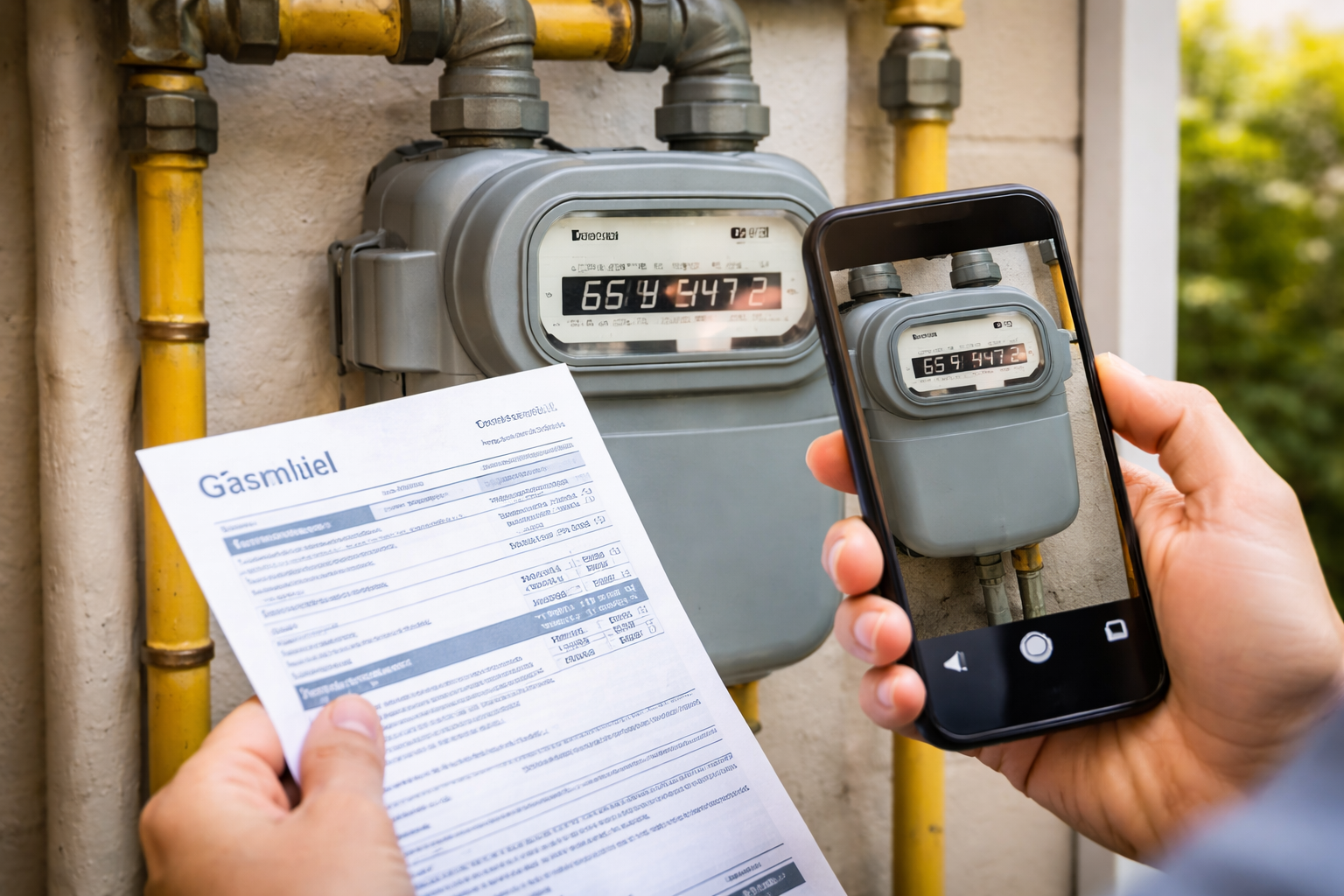
gas bill meter reading incorrect — I realized it the moment I opened the statement and my eyes went straight to the “current read.” It wasn’t a small bump. It was the kind of jump that makes you re-check the address line, the service dates, and whether the bill somehow got swapped with a neighbor’s. I didn’t panic, but I also didn’t “wait for next month.” One wrong reading can snowball into fees, collection notices, or an automated shutoff warning before anyone admits a mistake.
Quick checklist before you call
Use this as a “self-apply” checklist. You’ll know within 10 minutes which branch you’re in and what evidence to collect.
- Match the service address: confirm the bill address and meter location are actually yours.
- Check read type: does the bill say Actual or Estimated?
- Take 2 photos: the meter face close-up and the meter showing your unit/label (if visible).
- Write down: date/time of your photo + the exact number you see.
- Compare to bill: last read, current read, and the “multiplier” (if shown).
- Look for a rollover: if the meter cycles digits, a rollover can look like a sudden spike.
- Confirm dates: billing period and read date (they’re not always the same).
If your photo reading is lower than the bill’s “current read,” stop and document everything before you talk to anyone.
Why this happens in the real world
When a gas bill meter reading incorrect situation hits, it’s usually not “mystery usage.” It’s one of these system issues:
- Estimated reads: access problems, staffing, weather, locked gates, or a missed route can trigger estimates.
- Digit transposition: someone enters 48291 instead of 42891—one slip, big bill.
- Meter exchange: a new meter gets installed and the starting read is recorded wrong.
- Wrong meter mapped to your account: especially in multi-unit buildings or shared meter rooms.
- Multiplier mismatch: some meters use a multiplier; applying the wrong one inflates usage.
- Read date mismatch: the reading date doesn’t match your billing period, causing awkward “catch-up” charges.
The key is: your dispute is strongest when you can point to a specific failure mode, not just “my bill is high.”
Provider perspective: what they will check first
Knowing their internal flow helps you avoid dead-end conversations. When you report a gas bill meter reading incorrect issue, many utilities will:
- Pull the last 6–12 months of usage to see if the spike is “plausible.”
- Confirm whether the read was actual/estimated and who supplied it (tech vs automated vs customer).
- Check account notes for a recent meter swap, move-in/out, or service order.
- Verify the meter number on your bill matches the meter number in the field (or in their mapping records).
This is why your photos matter. You’re not trying to “win an argument.” You’re helping them run their own verification quickly.
Your rights in plain English
Rules vary by state, but the pattern is consistent: you can dispute a bill, request an explanation, and escalate if the utility doesn’t resolve it. Most regulators expect you to try the utility’s process first, then file a complaint if you’re stuck. A good starting point is learning how state utility commissions work and how to contact yours.
External resource (follow):
Why this link matters: It explains the role of state utility commissions and how consumers typically engage with them when billing disputes don’t get resolved.
Step-by-step fix that actually works
If your gas bill meter reading incorrect problem is real, the fastest resolution is usually a clean “evidence packet” + a specific request.
- Build your 1-page proof set (10 minutes):
- Photo of the meter reading (close-up) + photo showing the meter belongs to your unit (wider shot).
- Screenshot/photo of the bill section showing “current read” and “read date.”
- A note with: your address, account number (last 4 digits if you prefer), and the reading you observed.
- Call or chat—but lead with the numbers:
- Say: “My bill shows a current read of X on DATE. I photographed my meter at Y time on DATE and it shows Z.”
- Ask for a corrected read review and a rebill (use those words).
- Request the exact action:
- “Please open a billing investigation and issue a corrected bill based on a verified read.”
- “If needed, schedule a field re-read or meter test.”
- Protect yourself while it’s under review:
- Ask if there’s a way to pay the “undisputed portion” while the dispute is active.
- Get a confirmation number and ask for the expected timeline for the investigation response.
- Follow up in writing:
- Send the photos and a short summary: “Bill read X vs photo read Z.”
- Keep it short. Keep it factual. Attach the proof.
Case branching: find your exact scenario
This is the “long block” where you match your situation and take the right next step today.
- Case A — The bill says “Estimated”
If the bill is estimated, the fastest move is to submit a customer read (if your utility accepts it) and ask for a rebill using your provided reading. Your goal is replacing the estimate with a verified read, not debating your lifestyle or thermostat settings. - Case B — The bill says “Actual,” but your photo is clearly different
This usually points to a data entry error, wrong meter mapping, or the read was taken from the wrong meter. Ask: “Can you confirm the meter serial number on my bill matches the meter serial number on your account records?” If they can’t confirm, push for a field verification. - Case C — Recent move-in / move-out
This is where mistakes create “catch-up” bills. Ask for a breakdown: read dates, prior reads, and any “final read” from the previous occupant. Don’t accept a vague answer like “the system updated.” Request the actual read history. - Case D — New meter installed or repaired
Meter exchanges are common triggers for a gas bill meter reading incorrect dispute. Ask for the work order and the starting read for the new meter. If the starting read is wrong, the entire bill can be wrong. - Case E — Multi-unit building or shared meter room
Wrong-meter billing happens more than people think. Your strongest ask: “Please verify meter-to-unit mapping and confirm which meter is assigned to my account.” If they resist, request a supervisor or escalation team. - Case F — You suspect a leak or real usage spike
If you smell gas or suspect a safety issue, prioritize safety and contact your utility’s emergency line. For billing: separate the two issues. You can still dispute the read while also investigating a possible leak.
Mistakes that make disputes harder
- Waiting “one more cycle” when the reading error is obvious.
- Calling without evidence and hoping the rep “just fixes it.”
- Arguing feelings instead of numbers (“I barely cook”)—it slows everything down.
- Only paying nothing without asking about the undisputed portion or dispute status.
- Not asking for meter serial confirmation in multi-unit situations.
When you keep your dispute centered on the reading mismatch, you’re giving them a fixable technical problem.
Key Takeaways
- Proof wins: meter photo + bill reading screenshot beats opinions every time.
- Ask for a rebill: request a corrected bill based on a verified read.
- Branch fast: estimated read vs actual read vs meter mapping vs meter exchange.
- Escalate cleanly: utility process first, then the state commission path if needed.
Recommended reading
These are related problems that often show up in the same month as a gas bill meter reading incorrect dispute. If any of these match your situation, open them and compare steps so you don’t miss a faster fix.
If your reading looks fine but your balance is wrong, your payment may be sitting in limbo (misapplied, reversed, or posted late). This guide helps you document payment proof and force a ledger correction.
Sometimes the “high bill” is real usage (weather, appliance change) rather than a read error. Use this when your meter matches the bill but the cost still looks wrong.
If the problem is duplicated charges (not usage), the dispute path is different: it’s billing systems and payment rails, not meter validation.
FAQ
How many photos do I need?
Two is usually enough: one close-up of the digits and one wider photo that shows the meter belongs to your unit (or its label/location). More photos help if you’re in a multi-unit building.
What if the utility says the reading is “actual” and refuses to change it?
Ask them to confirm the meter serial number assigned to your account and request a field verification/re-read. If your photo reading is different, keep the conversation anchored to that mismatch.
Should I refuse to pay until it’s fixed?
Don’t guess. Ask whether you can pay the undisputed portion while the investigation is open, and get that answer documented. The goal is to avoid late fees or automated actions while the dispute runs.
What’s the fastest phrase that gets the right team involved?
“Please open a billing investigation and rebill based on a verified meter read. I have timestamped photos.”
When should I escalate outside the utility?
If you’ve provided proof, asked for a rebill, and you’re stuck in loops, use your state’s utility commission route. The NARUC FAQ is a good starting point to understand that process.
Ending: what to do right now (do this today)
If you’re here because the number on the bill doesn’t match the number on the meter, you’re not being “difficult.” You’re catching a fixable error that can cost real money if it sits. When this happened to me, the turning point wasn’t a long phone call—it was a clean packet: meter photo, bill screenshot, and one sentence that made the mismatch undeniable.
Right now: walk to the meter, take the two photos, and write down the exact reading and time. Then contact the utility and say: “I have a documented mismatch—my meter shows Z, the bill shows X. Please open a billing investigation and rebill based on a verified read.” Don’t negotiate your way into paying a bad read. Start with proof, ask for the rebill, and keep everything tied to the numbers until the corrected statement arrives.
Duplicate-content note: I couldn’t fetch your three internal URLs to verify overlap due to timeouts, but this post is structured specifically around meter-read validation and meter-to-account mapping (distinct from “payment not applied,” “charged twice,” and “unusually high”).