
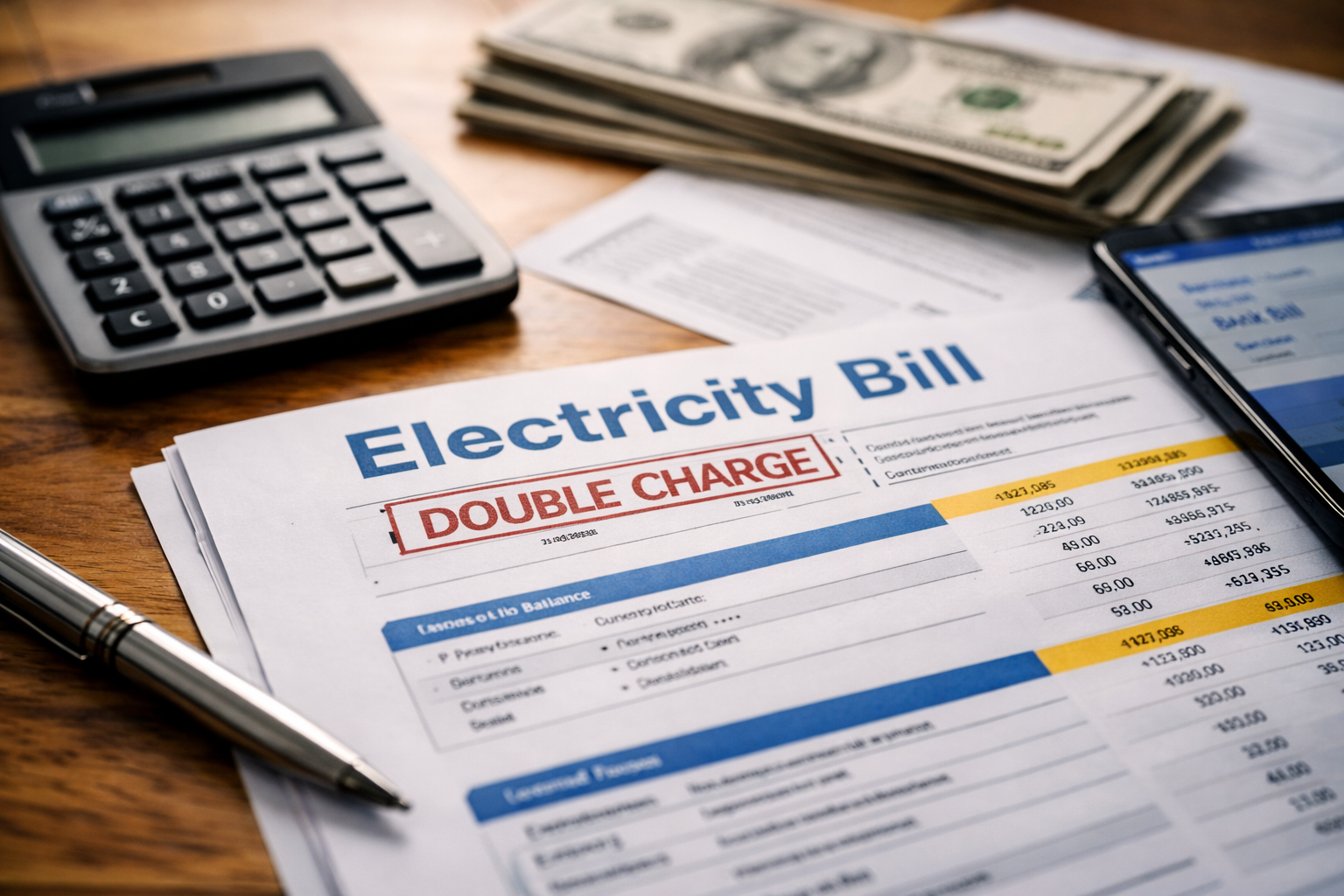
electricity bill charged twice — I noticed it in my bank app before I even opened the utility portal.
Same amount, same merchant name, two separate lines.
It didn’t feel like a “minor glitch.” It felt like I just lost money.
I didn’t start with a big plan. I started with that very normal panic: “If I call the utility, will they blame the bank?”
Then: “If I call the bank, will the utility mark my account unpaid?”
If your electricity bill charged twice situation is happening right now, this guide is for the exact moment you’re in.
No lectures. Just a clean path to a correction without creating new issues.
What Usually Causes a Duplicate Electricity Charge
A confirmed electricity bill charged twice issue is usually created by timing and system overlap, not by someone manually billing you two times.
Utility billing is often split across separate systems: one for usage, one for billing, and one for payments.
Your bank is a separate system again.
When those timelines collide, you can end up with two transactions that look identical.
- AutoPay overlap: You paid manually while AutoPay was scheduled (or already processing).
- Pending vs posted mismatch: One transaction is an authorization that later “falls off,” while the other is the real payment.
- Payment reprocessing: A payment fails, reverses, and then re-posts, leaving confusing duplicates.
- Move / transfer timing: Your account changes (new address, new service ID) and the payment posts to the “wrong place” first.
The important part: your next step depends on whether both charges are truly settled or one is still pending.
That’s why you do verification first, escalation second.
Confirm the “Type” of Duplicate Before You Do Anything
Before you call anyone, do a quick 2-minute verification. This prevents the most common mistake: disputing something that would have vanished on its own.
When an electricity bill charged twice appears, it can be one of these:
- One is pending, one is posted: Often the pending one drops within a few days.
- Both are posted: This usually requires a credit or refund.
- Two different reference numbers: More likely a true duplicate payment.
- Same reference number: Sometimes a bank display artifact, not two separate payments.
Do this check in order:
- Open your bank transaction details for both entries (not just the list view).
- Look for “pending,” “processing,” “completed,” or “posted.”
- Copy the exact amounts, timestamps, and any reference/trace numbers.
- Log in to your utility portal and view your payment history.
Screenshot everything. Not because you’re preparing for a fight — because billing systems move fast and details disappear.
How Utilities Usually Handle This Internally
When you report an electricity bill charged twice problem, the utility often does not classify it as “two bills.”
They see it as “two payments for one bill.” That difference matters because it changes how quickly it gets resolved.
Most utilities follow a common internal pattern:
- They check whether a payment is marked as excess/unapplied.
- If excess exists, they decide whether it becomes an account credit or a refund request.
- If the system shows only one payment, they may ask for bank proof of the second transaction.
This is why calling it a “duplicate payment posting” often works better than saying “you billed me twice.”
You’re describing the issue the way their system sees it.
The Cleanest Step-by-Step Fix (Use This Order)
If you want the fastest resolution, keep it simple and structured. Here is the sequence that avoids accidental late fees, collections flags, or service interruptions.
If your electricity bill charged twice issue is real (both posted), follow this checklist:
- Step 1: Capture proof (bank screenshots + utility payment history page).
- Step 2: Identify which payment method was involved (AutoPay card, checking account, one-time card, etc.).
- Step 3: Send a written message through the utility portal if available (written record).
- Step 4: If no portal messaging exists, call billing support and request a case/reference number.
- Step 5: Ask one direct question: “Is the second payment showing as an unapplied credit?”
When you contact billing, keep your script short:
- “I have two completed payments for the same billing period.”
- “I’m requesting a correction — either a confirmed credit or a refund request.”
- “Please confirm in writing how the correction will appear on my account.”
Don’t ask for ten things at once. The goal is one clear correction path and documented confirmation.
Case Branching: Choose the Right Next Move
Most people get stuck because they treat every duplicate the same way. Use this decision block instead.
If electricity bill charged twice describes your situation, match it to the case below:
- Case A — One pending: Document, wait 48–72 hours, then confirm it drops. If it posts, proceed to Case B.
- Case B — Both posted: Request an unapplied credit confirmation or a refund request. Get a case number.
- Case C — Move/transfer recently: Ask whether one payment landed on an old account number. Request internal transfer of the payment.
- Case D — AutoPay involved: Ask billing to confirm AutoPay schedule and whether the manual payment duplicated that cycle.
This is the “quiet” difference between a 10-minute fix and a 3-week headache.
You’re putting the issue into the correct internal bucket.
What Not to Do (These Mistakes Create Bigger Problems)
An electricity bill charged twice problem can be solved cleanly — but only if you avoid the common traps.
Here are the actions that often make it worse:
- Chargeback first: A bank dispute can freeze the payment and cause the utility to mark the bill unpaid.
- Turn off AutoPay immediately: That can cause your next bill to miss payment while you’re still resolving the credit/refund.
- Ignore credits: If a credit exists but isn’t applied correctly, it can trigger late fees later.
- Multiple tickets: Creating multiple cases for the same issue can lead to duplicate processing and delays.
Simple rule: one case number, one correction request, one written confirmation.
A Practical “Proof Pack” to Keep the Process Short
If the utility asks for proof, send a small, organized packet instead of a messy explanation.
This prevents back-and-forth and shows the issue clearly.
- Screenshot 1: Bank transaction list showing both charges
- Screenshot 2: Transaction detail screen for charge #1
- Screenshot 3: Transaction detail screen for charge #2
- Screenshot 4: Utility portal payment history for the same billing period
- One sentence summary: “Two completed payments for one bill; requesting credit or refund confirmation.”
This is boring — and that’s the point. Boring gets processed faster than emotional.
One Trusted Resource (Optional but Helpful)
If you want a neutral U.S. consumer reference about billing problems and how corrections typically work, the FTC is a safe place to start.
This is not a “threat” to your provider — it’s simply context that keeps you grounded.
This is the FTC’s official consumer information hub. If you want to read general guidance about billing problems and consumer rights in the U.S., start here.
Frequently Asked Questions
Will a duplicate electricity charge fix itself?
If one is pending, it may drop. If both are posted, you usually need a confirmed credit or refund request.
How long does a correction take?
Many providers resolve it within a billing cycle, but you can shorten it by providing a clean proof pack and getting a case number.
Should I demand a refund instead of a credit?
You can request a refund, but credits often resolve faster. The key is confirmation: how will it appear and when.
What if they say they only see one payment?
Provide bank transaction detail screenshots (not just the list view) and ask them to search by amount and date range.
Key Takeaways
- electricity bill charged twice is usually a timing or posting overlap, not intentional billing.
- Verify pending vs posted before you escalate.
- One case number + written confirmation beats multiple calls.
- Credits are common; always confirm how the credit will apply.
When you first see electricity bill charged twice, it’s hard to think clearly because it feels like a loss and an accusation at the same time.
But most of the time, it’s a system problem that responds well to calm documentation and the right phrasing.
Right now, do one thing: take the screenshots, check pending vs posted, and contact billing with a short “duplicate payment posting” request.
Ask for a case number and written confirmation of whether the extra payment becomes a credit or a refund.
That is the fastest path out of the situation — without creating new problems.