
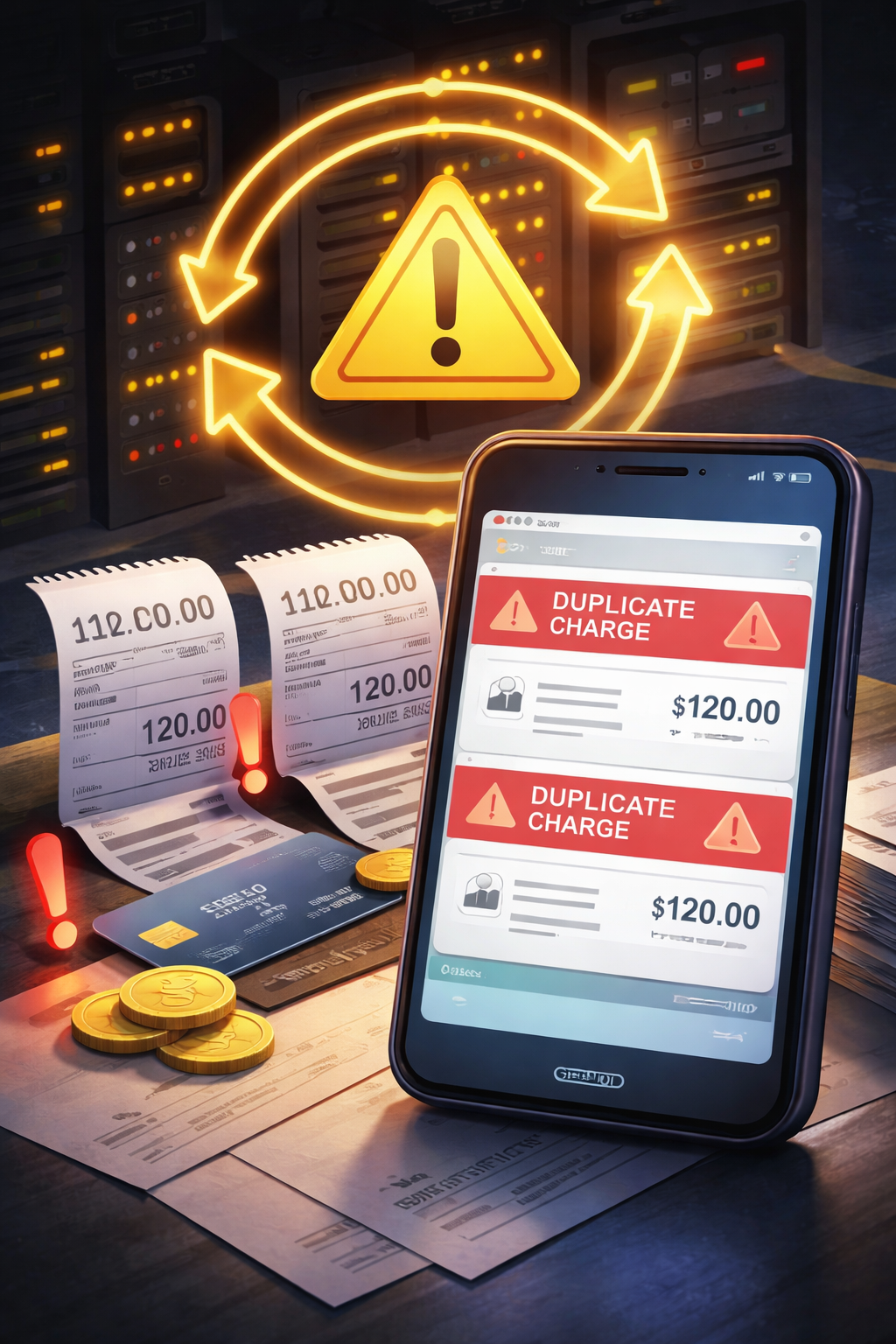
Payment Processed Twice Due to System Retry Error was the exact phrase I started typing into search after I saw the same charge hit my account twice. The first charge looked ordinary. The second one looked like a mistake I hoped would disappear on its own. I refreshed the page, logged out, logged back in, and kept staring at the merchant name because I was sure I had missed something obvious.
I had not. The amount was identical. The payment time was close enough to feel connected. There was no second order, no second service, no second approval on my side. What made it worse was how normal the transaction history looked. Nothing in the account said “system error.” Nothing warned me that a retry process might have turned one payment attempt into two settled charges. That is why this problem catches people off guard. It does not look dramatic at first. It looks administrative. Then the money actually leaves.
If you want the broadest overview first, this hub explains how billing mistakes move through consumer systems and why they often look “valid” before they are corrected:
What this problem feels like in real life
Payment Processed Twice Due to System Retry Error usually starts with a moment that seems too small to matter. A page spins longer than expected. A receipt takes a while to arrive. A pending payment appears, disappears, and then comes back. Sometimes the screen freezes and the customer taps once more because the system did not clearly confirm anything. Sometimes the customer does nothing at all, and the billing platform still runs another attempt because its first request did not get a timely response.
That is the part many companies do not explain clearly: the second charge can happen even when the customer did not intentionally submit a second payment. A retry loop can be triggered by network delay, processor timeout, gateway communication lag, bank authorization slowness, or internal reconciliation logic that assumes the first request failed when it really did not. The customer sees one purchase. The billing system may temporarily see an incomplete message exchange and behave as if recovery is needed.
Payment Processed Twice Due to System Retry Error becomes especially stressful when the duplicate charge settles instead of remaining pending. Once both charges post, the issue no longer feels like a harmless display glitch. It becomes a cash flow problem, a budgeting problem, and sometimes a credit risk problem if the account balance gets tight or another payment bounces because of it.
Why systems do this behind the scenes
Payment systems are built to avoid failed collections. That sounds reasonable until recovery logic creates a second successful charge. In many billing environments, the merchant platform sends an authorization or payment capture request and waits for confirmation. If confirmation does not return fast enough, the system may flag the transaction as uncertain. Some platforms queue another attempt automatically. Others pass the request through multiple layers such as a merchant site, billing engine, gateway, processor, and bank. Delay at any point can make one side believe the payment failed while another side already approved it.
Payment Processed Twice Due to System Retry Error often comes from one of these patterns:
Common retry patterns
- The first authorization succeeds, but the merchant does not receive confirmation quickly enough.
- The checkout page stalls, so a second request is sent by the platform or by the customer.
- The processor marks the first attempt as unresolved, then a retry is triggered before reconciliation completes.
- The bank shows one pending item first, then both charges settle after delayed message matching.
- An autopay or scheduled payment engine re-submits after a timeout window closes.
From the business side, this can look like two technically valid transactions. From your side, it is still one intended payment. That gap is why frontline support sometimes gives weak answers at first. They are looking at successful transaction records, not at the sequence error that created them.
How to tell whether this is really a retry error
Not every duplicate charge comes from the same cause. Payment Processed Twice Due to System Retry Error has a pattern that is usually more precise than a general overbilling problem. The amount is often identical. The merchant descriptor is the same. The timestamps are close. There is no added product, no plan change, and no service expansion that would justify a second charge. In many situations, one charge may appear first as pending and the other arrives shortly after, or both settle within a narrow timeframe.
Here are the strongest signs that you are dealing with Payment Processed Twice Due to System Retry Error rather than a separate purchase:
Check these details immediately
- Same merchant name and same amount
- Two charges placed minutes apart or within the same billing cycle event
- Only one product, one order number, or one service event
- No deliberate second click from you, or one extra click during a frozen page
- One delayed receipt but two posted charges
If your duplicate happened around a subscription renewal, this related article helps compare whether the issue was a general duplicate charge versus a retry-flow failure:
Detailed case splits that change the outcome
Payment Processed Twice Due to System Retry Error does not resolve the same way every time. The exact path matters because it affects how fast you should act and who needs to fix it.
Case split 1: One pending, one posted
This is the least damaging version, but it still needs attention. If one item is pending and the other is fully posted, the pending one may fall off. Do not assume that will happen. Take screenshots immediately and watch whether the pending item disappears or settles. If it posts, the dispute becomes harder to explain if you waited too long without documenting the timeline.
Case split 2: Both posted, no refund initiated
This is the classic Payment Processed Twice Due to System Retry Error scenario that requires direct action. Once both payments are settled, many merchants stop viewing it as a temporary display issue. You need to contact the merchant with dates, amount, and proof that only one transaction was intended. If support says both are valid, escalate fast rather than repeating the same chat with three different agents.
Case split 3: Merchant promises refund, but nothing returns
This is where people lose time. A verbal refund promise is not the same as a completed reversal. Ask for confirmation in writing or by email. Ask whether the refund was voided, reversed, credited, or merely requested internally. Each of those words can mean something different inside billing systems. The money is not back until you see the credit actually enter your account.
Case split 4: Autopay or scheduled payment triggered the second charge
Scheduled billing systems can create a confusing trail because the duplicate may not come from checkout behavior. A retry job can run after a temporary communication failure, especially near cutoff times. In those situations, merchant support may initially blame your bank while the bank says the merchant submitted both transactions. Keep records from both sides because mismatched explanations are common.
Case split 5: Duplicate charge caused a downstream problem
This is the most serious branch. The second charge can trigger overdraft fees, returned payments, service interruption, or a falsely delinquent account elsewhere. When a retry error creates a second financial consequence, do not frame the problem only as “please refund one payment.” You should also document any additional damage that followed from the duplicate charge.
What the merchant and bank are likely to say
Payment Processed Twice Due to System Retry Error often turns into a blame loop. The merchant may say the bank approved both transactions. The bank may say the merchant submitted both. Both statements can be true at the same time and still fail to solve your issue.
Merchants usually focus on submitted transaction records, settlement status, and order data. Banks focus on authorizations, postings, and dispute procedure. Neither side automatically investigates your intent unless you clearly frame the issue. That is why your wording matters. Do not describe it vaguely as “something looks weird.” State that only one payment was intended, the second charge appears tied to a retry or duplicate processing event, and no second purchase or service was authorized by you.
When the duplicate follows a delayed or cutoff-sensitive payment event, this article can help you connect the timing failure to the billing logic that often causes it:
What to do in the first 24 hours
If Payment Processed Twice Due to System Retry Error just happened, the first day matters more than most people think. You do not need a dramatic legal approach, but you do need organized proof.
- Screenshot both charges, including status, amount, merchant name, and date.
- Save order confirmation, invoice, receipt email, or service record showing only one intended purchase.
- Write down what happened on screen: freezing page, delay, no confirmation, or repeated error message.
- Contact the merchant first and ask them to identify which transaction reflects the intended payment.
- Ask whether the second charge was a retry, reauthorization, resubmission, or duplicate capture.
- If both charges settle and the merchant does not resolve it quickly, notify your bank or card issuer.
The biggest mistake is waiting quietly because the transactions “look close enough that maybe one will disappear.” That delay helps the system normalize the duplicate instead of correcting it.
What not to do while the issue is open
Payment Processed Twice Due to System Retry Error gets harder to clean up when people create extra noise in the record. Avoid making things worse while trying to fix it.
- Do not submit another payment to “cover” the confusion unless the merchant gives a clear written reason.
- Do not cancel the card immediately before preserving evidence if the account history is still updating.
- Do not rely only on phone promises without written confirmation.
- Do not describe the problem inconsistently to the merchant and the bank.
- Do not assume a pending reversal equals a completed refund.
Consistency matters. One clean timeline is more useful than five emotional explanations that all sound slightly different.
Consumer rights and escalation
If a duplicate charge remains unresolved, you may have formal billing dispute rights depending on the payment method and account type. For credit card billing errors, the Consumer Financial Protection Bureau explains that you should send a written billing error notice within 60 days after the charge appears on your statement, and the card company generally must acknowledge your dispute within 30 days unless it resolves the issue sooner. :contentReference[oaicite:1]{index=1}
Official guidance: Consumer Financial Protection Bureau – How do I dispute a charge on my credit card bill?
If the merchant stalls, the issue spills into collections, or the balance starts being treated as valid even while disputed, use a structured escalation path rather than continuing random support chats:
Key Takeaways
- Payment Processed Twice Due to System Retry Error usually comes from delay, timeout, or retry logic rather than intentional double payment.
- The duplicate can still look fully valid inside merchant and bank systems.
- Proof matters most in the first 24 hours: screenshots, timestamps, receipts, and a short written timeline.
- One refund promise is not enough; watch for the actual credit.
- If both charges post and support drags its feet, escalate before the record hardens around the duplicate.
FAQ
Can Payment Processed Twice Due to System Retry Error fix itself?
Sometimes one pending item disappears, but once both charges settle you should not wait passively. Monitor, document, and contact the merchant quickly.
Is this the same as fraud?
Not necessarily. Payment Processed Twice Due to System Retry Error often comes from system recovery behavior, not theft. But the financial harm is still real and should be disputed if unresolved.
Should I call the merchant or the bank first?
Start with the merchant because they can sometimes identify and reverse the duplicate faster. If the merchant delays, denies, or gives unclear answers after both charges post, contact your bank or card issuer promptly.
What if the merchant says both charges are valid?
Ask them to explain which two separate purchases or service events each charge represents. If they cannot match the second charge to a real second transaction, push for escalation.
What if the duplicate caused overdraft fees or other problems?
Document those consequences too. Do not describe the problem only as a duplicate charge if it caused additional financial damage.
Payment Processed Twice Due to System Retry Error is frustrating because it makes a customer look like the confusing part of the story, even when the confusion started inside the billing system. The transaction record looks clean. The money movement does not. That mismatch is exactly why people lose days chasing the wrong explanation.
If this happened to you, do not treat it like a harmless glitch anymore. Save the proof, contact the merchant with a tight timeline, and escalate to your bank or card issuer if both charges have posted and no real correction is underway. The right move is not to wait. The right move is to lock the facts down now and force the record to match what actually happened: one intended payment, not two.