
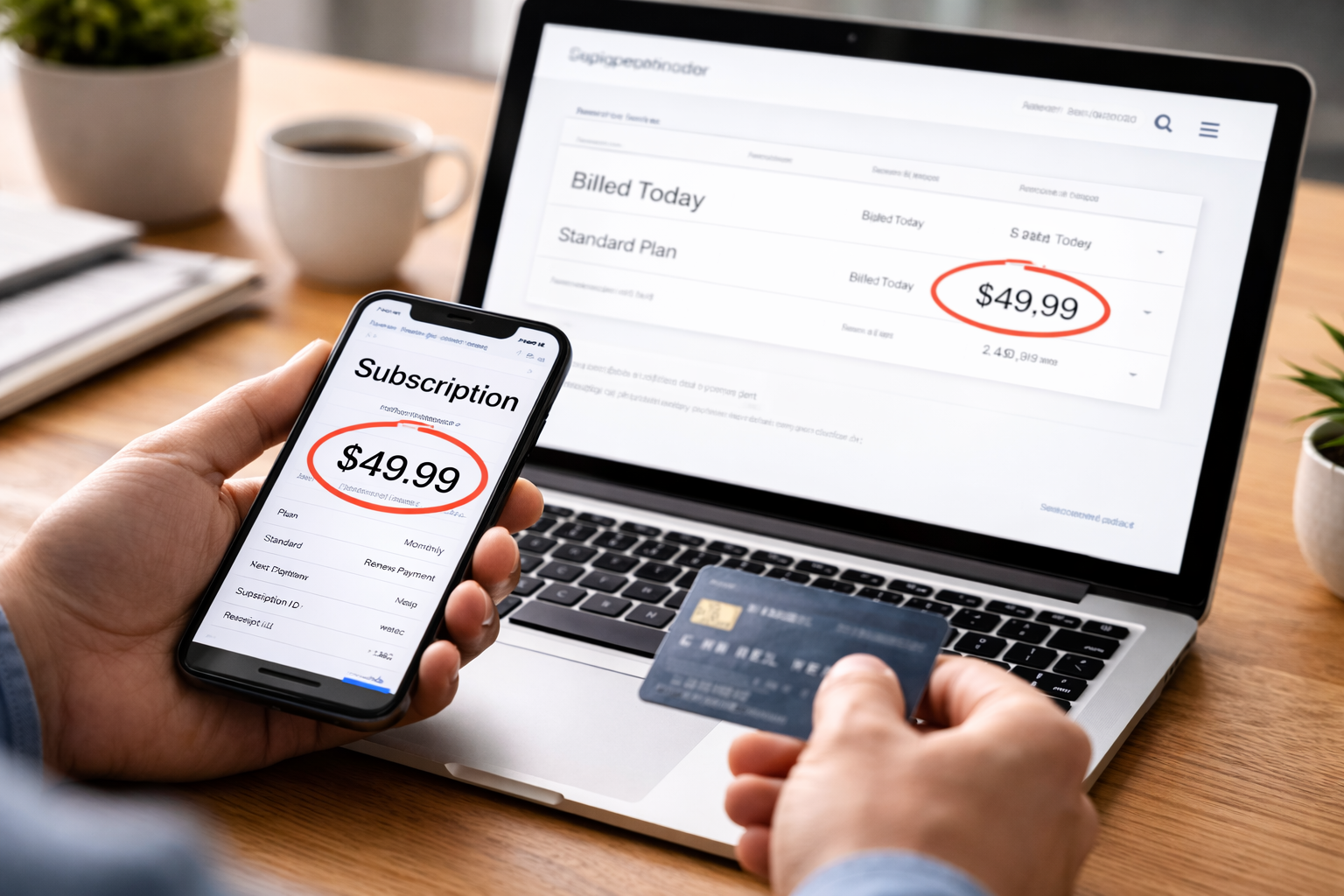
Subscription billing error dispute — it hits you in a quiet moment, not during a big purchase. You’re scrolling your statement, half on autopilot, and a charge interrupts the pattern. Same merchant name you recognize, but the amount is off. Or the date is wrong. Or it shows up twice. You stare at it long enough to feel that familiar doubt: “Did I click something? Did I miss an email?”
Then you do what most people do: you open the app or the subscription dashboard to prove to yourself it’s a mistake. But the plan page doesn’t match the charge. Or the “billing history” looks different than last month. That’s when it stops being a mild annoyance and turns into urgency—because subscription mistakes don’t usually happen once. They repeat until someone forces the system to correct itself.
This is a practical, U.S.-focused guide for a subscription billing error dispute. No definitions. No lecture. You’ll get a decision framework, case splits, and an escalation timeline that protects your refund odds while keeping things YMYL-safe and professional.
Two-Minute Self-Check Before You Do Anything
Most subscription billing error dispute outcomes are decided by what you collect in the first few minutes. This quick checklist helps you avoid the two big traps: (1) disputing the wrong thing and (2) losing proof by clicking around too fast.
- Charge type: pending or posted?
- Amount: higher than expected, lower than expected, or duplicate?
- Frequency: first time, or has it happened before?
- Provider: billed directly by the subscription company, or through Apple/Google/Amazon/PayPal?
- Account access: can you still log in and view plan details?
If the charge is pending, you still act—but you act differently. If it is posted, you move faster on documentation and escalation.
Why Subscription Billing Errors Happen (The System Reality)
A subscription billing error dispute is rarely about someone personally choosing to overcharge you. It’s usually one of these automated system failures:
- Plan migration error: the provider updates pricing tiers and your account maps incorrectly.
- Processor mismatch: the billing processor repeats a charge after a failed confirmation.
- Account duplication: multiple subscriptions exist under one email/payment method.
- Discount expiration misfire: promo pricing ends earlier than promised, or ends without proper notice.
- Add-on activation: an add-on turns on during a trial, a device setup, or a “one-click” flow.
When you understand the system, you stop arguing feelings and start asking for specific records. That’s how refunds happen faster.
Identify Your Subscription Billing Error Dispute Type
Choose ONE case below. Mixing approaches is where people lose time.
CASE 1 — Wrong plan tier billed
You selected Basic/Standard but were billed for Premium/Family/Business.
CASE 2 — Price increased without clear notice
The subscription amount changed and you cannot find a clear authorization or notice.
CASE 3 — Duplicate charge / double billing
The same provider charge appears twice for the same billing cycle.
CASE 4 — Downgrade ignored
You downgraded, but billing remained at the higher tier.
CASE 5 — Add-on or feature activated without intent
An extra fee appears for “protection,” “storage,” “premium support,” or similar.
CASE 6 — Third-party billing (Apple/Google/PayPal) mismatch
The provider says one thing, but your platform billing shows another.
CASE 7 — Refund approved, but the card is not credited
The provider confirms refund, but your statement stays unchanged.
Now follow the matching recovery path below. Each one is designed to resolve faster without burning your escalation options.
Case 1 — Wrong Plan Tier Billed
In this subscription billing error dispute, your goal is to make the provider confirm the plan you were enrolled in at the time of billing. You are not asking for a “favor.” You are requesting a correction.
- Screenshot your current plan page and billing page.
- Find any email/receipt showing the tier you chose (even if it’s months old).
- Request “plan enrollment record for the billing date.”
Ask for verification of the plan tier tied to the billing timestamp. That forces the provider to check internal logs rather than sending a generic reply.
Case 2 — Price Increased Without Clear Notice
This subscription billing error dispute is common after policy updates. The key detail: you don’t need to prove intent—you need to show that notice/authorization is unclear.
- Search your inbox for “price,” “update,” “terms,” and the provider’s name.
- Check your account messages or notification center.
- Request the “notice date and delivery method” used for your account.
If they cannot point to a clear notice path for your account, refunds become more likely.
Case 3 — Duplicate Charge / Double Billing
Duplicate charges are one of the easiest subscription billing error dispute categories to resolve—if you document correctly.
- Take a screenshot showing both charges in the same view.
- Confirm whether one is pending and one is posted.
- Ask the provider to confirm “one active subscription ID” and “one billing event.”
If both charges are posted, request an immediate reversal for the extra transaction.
If double billing is the clear pattern in your case, this related guide goes deeper and helps you avoid common traps:
Case 4 — Downgrade Ignored
For a downgrade dispute, the winning detail is the timestamp. Most providers store the exact moment your plan changed. Your job is to align that timestamp with the billing cycle.
- Locate the downgrade confirmation (email, receipt, account history).
- Screenshot the plan history if available.
- Request a prorated correction if billing crossed the change date.
The cleanest message is: “Here is the plan change timestamp. Please correct billing from that point forward.”
Case 5 — Add-On Activated Without Intent
Many subscription billing error dispute cases are actually add-on issues: storage upgrades, premium support, “protection,” ad-free, device coverage, or similar extras.
- Identify the add-on name exactly as billed.
- Ask for “opt-in record” (how it was enabled).
- Request removal and refund for the add-on portion.
If the provider cannot demonstrate clear opt-in, removal and refund become the logical outcome.
Case 6 — Third-Party Billing (Apple/Google/PayPal)
This subscription billing error dispute is tricky because the provider might not control the transaction. You must identify who “owns” the charge.
- If billed through Apple/Google, check your platform subscription list.
- If billed through PayPal, check automatic payments permissions.
- Match the merchant descriptor to the platform record.
Disputing with the wrong party wastes days and reduces refund odds. Start where the charge is processed.
Case 7 — Refund Approved But Card Not Credited
A subscription billing error dispute can continue even after a refund approval because banks often take time to post credits. Before you escalate, confirm timelines and references.
- Ask the provider for the refund transaction reference.
- Confirm the refund method (original payment method vs store credit).
- Check whether your bank displays refunds in a separate area.
If this is your exact situation, this guide explains the common delay patterns and the next steps:
The Escalation Timeline That Protects Your Refund Odds
For a subscription billing error dispute, escalation works best when it’s procedural. Use this timeline as a default.
- Within 24 hours: document charge + plan details + billing history.
- Day 1: contact provider with evidence and a clear correction request.
- Day 3: if no response, follow up once and request ticket escalation.
- Day 5–7: if ignored or denied without addressing evidence, consider issuer dispute.
Escalate with your card issuer after you’ve created a clean evidence trail with the provider.
A Trusted Official Resource
If you need a neutral official overview for disputing charges, the FTC provides a clear consumer-facing guide. It helps you understand what to keep, what to document, and how disputes typically work.
Mistakes That Quietly Make Disputes Harder
These mistakes show up in almost every slow subscription billing error dispute case:
- Waiting for “next month” to see if it repeats
- Canceling first and losing plan history evidence
- Starting a chargeback immediately without contacting the provider
- Sending long emotional messages instead of evidence
- Arguing about fairness instead of authorization records
The fastest outcomes come from short messages with attached proof.
Key Takeaways
- A subscription billing error dispute should be handled quickly because subscription errors repeat.
- Correct case diagnosis saves time and improves refund odds.
- Evidence (screenshots + timestamps) beats explanations.
- Escalation is strongest after documented provider contact.
- Don’t cancel or chargeback before documenting.
FAQ
How fast should I start a subscription billing error dispute?
Immediately. Even if the amount is small, quick action prevents repeat billing and preserves evidence.
Should I contact the subscription provider or my bank first?
In most cases, contact the provider first with evidence. If they ignore you or deny without addressing evidence, then you escalate to your issuer.
What if the charge is pending?
Document it and contact the provider, but also watch for posting. Some pending charges drop off, while posted charges require correction or refund.
Can I still dispute if I used the service?
If the dispute is about the wrong price, wrong plan, duplicate billing, or unauthorized add-ons, you can still request correction. Keep the request focused on the billing mismatch.
Final Decision Point
A subscription billing error dispute is not about winning an argument—it’s about interrupting an automated money leak before it becomes a pattern.
Do not wait for the next billing cycle to “confirm” it. Document the charge today, identify your case type, and send a correction request with proof attached.
Then follow the escalation timeline calmly. Not because you want conflict—because you want a clean outcome.
If you act today, this can be a one-cycle problem. If you wait, it can become a months-long drain.