
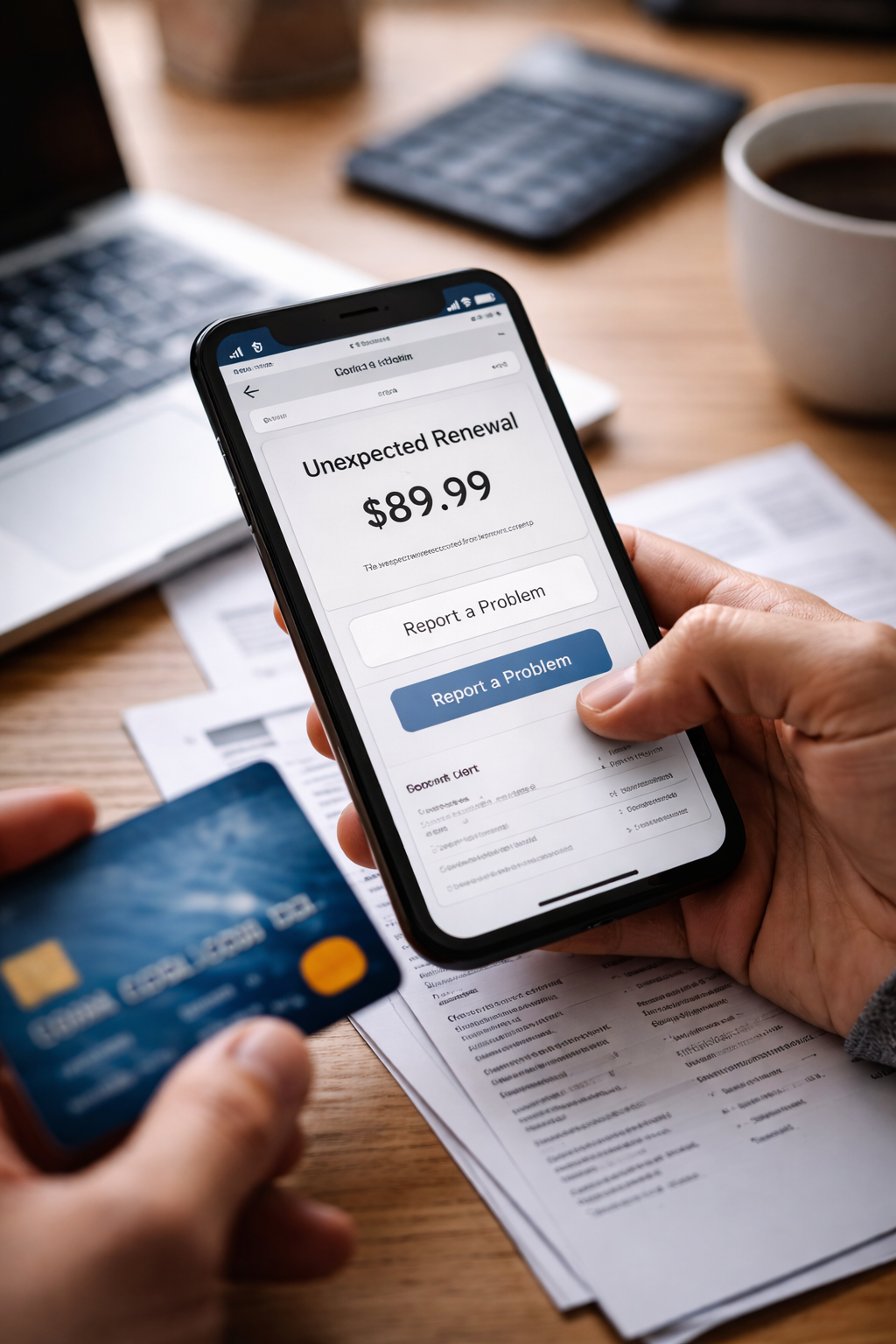
Subscription auto renewal dispute is the kind of search you make with your bank app open and your thumb hovering over the “Report a problem” button. You weren’t shopping. You weren’t signing up for anything new. You were just checking your balance—then you saw it: a familiar company name, a clean charge amount, and a date that feels wrong.
You tap into the details hoping it’s a pending hold or a mistake that will disappear. It doesn’t. You scroll through your email for a renewal notice. Nothing obvious. You open the service and find the status: “Active.” That’s when it hits you: the charge isn’t pending—your money already moved. A subscription auto renewal dispute becomes urgent because every hour you wait makes it easier for a company to say, “You didn’t contact us in time.”
This guide is U.S.-focused and written for consumers dealing with an unexpected renewal right now. It’s general information, not legal advice. The goal is practical: help you win a subscription auto renewal dispute with a clean timeline, the right screenshots, and the right escalation sequence—without wasting days arguing in circles.
If your situation is actually “I canceled but they billed me anyway,” that’s a slightly different path and you should follow this first (it often resolves faster).
The Real Reason Auto Renewals Feel “Unauthorized”
Most people don’t track renewal dates like rent or utilities. Subscriptions are designed to disappear into the background until they charge again. A subscription auto renewal dispute usually happens when the “system” works exactly as designed—just not the way you experienced it.
Common setups that trigger disputes:
• Annual renewals after a long quiet period
• Renewal notices sent to the wrong email (old address, typo, or promotions tab)
• In-app notices you never saw because you weren’t using the app that week
• Cancellation flows that look complete but aren’t actually final
The most important shift you can make: stop arguing feelings and start building proof.
Case Split Box: Identify Your Exact Dispute Type
Pick the one that matches your situation. Your next steps depend on it.
Type A — “No Reminder, No Warning”
You never saw a renewal notice and you weren’t actively using the service.
Type B — “I Tried to Cancel”
You attempted cancellation, but the renewal still processed.
Type C — “I Forgot the Renewal Date”
No cancellation attempt before renewal; you noticed after the charge.
Type D — “Confusing Terms / Tricky Flow”
Cancellation required extra steps, hidden menus, or unexpected confirmation screens.
Type E — “Double Charge or Wrong Amount”
The renewal charged twice, or the price is not what you agreed to.
Most successful outcomes come from matching the type correctly before you contact anyone.
From here, you’re going to run a fast evidence checklist. That’s how you turn a subscription auto renewal dispute into a refund request that’s hard to dismiss.
The Evidence Checklist That Changes the Outcome
Before you send a message, collect these items. It takes 10 minutes, and it prevents the “We can’t find your account / we need more info” stall.
10-Minute Evidence Checklist
✔ Screenshot the charge (merchant, date, amount, last 4 digits).
✔ Screenshot your subscription status page (Active/Next billing date).
✔ Screenshot cancellation screen if it exists (even partial).
✔ Find the order ID / invoice number.
✔ Note whether you used the service after renewal (be honest).
✔ Save any renewal email you can find (even if it arrived late).
In a subscription auto renewal dispute, the timeline matters as much as the complaint.
The 3 Messages That Usually Work Better Than One Long Message
Most people send a single emotional paragraph. That often leads to a scripted refusal. Instead, send short messages that guide the agent to the correct outcome.
Message 1 (Refund request):
“Hi, I was unexpectedly charged due to an automatic renewal. I have canceled the subscription and am requesting a refund for this renewal charge. Please confirm the refund timeline.”
Message 2 (Proof + timeline):
“I noticed the charge on [date/time]. I wasn’t aware of the renewal. I can share the invoice/charge screenshot if needed.”
Message 3 (Escalation without threats):
“If a refund isn’t possible, please escalate to a supervisor review. I want to resolve this directly with you before disputing through my card issuer.”
This keeps the tone professional while making it clear you have a next step.
Used correctly, these messages resolve a large percentage of subscription auto renewal dispute avoids-and-delays cases without you wasting a week.
Provider View: What They Quietly Check Before Refunding
Even when companies don’t say it, refund decisions often follow predictable checks:
• Did you use the service after renewal?
• How fast did you contact support?
• Was this a first-time refund request or a repeat pattern?
• Is the renewal policy strict (annual plans often are)?
Your strongest leverage is early contact plus clean proof.
This is why acting today—not “this weekend”—can decide your subscription auto renewal dispute outcome.
Case Split Box: What to Do Based on Timing
Timing changes everything. Match your case:
Within 24–48 hours
Refund odds are usually highest. Ask for “courtesy refund” and confirm cancellation immediately.
Within 7 days
Still strong. Emphasize you noticed promptly and request supervisor review if denied.
Within 30 days
Refund becomes more policy-dependent. Focus on confusing renewal notice / inability to cancel.
After 30+ days
Provider goodwill drops. Your best path may shift toward card issuer dispute (with documentation).
If your charge is recent, act like it is urgent—because it is.
When to Involve Your Card Issuer
Many people jump straight to a chargeback. Sometimes that works; sometimes it triggers account locks or makes negotiation harder. A smarter approach is usually:
1) Request refund from the provider first (with proof).
2) Escalate internally (supervisor review).
3) If refused or ignored, contact the card issuer with documentation.
For a neutral, high-trust explanation of how credit card charge disputes work in the U.S., this FTC guidance is a safe reference.
A subscription auto renewal dispute is strongest when your story is consistent across provider and bank.
If They Deny the Refund
A denial is common. It doesn’t automatically mean the case is over. Most denials fall into one of these categories:
• “Policy says no refunds.”
• “You used the service.”
• “You didn’t cancel in time.”
• “We sent a notice.”
Your job is to respond with specifics—not arguments:
• Confirm you canceled now and won’t use it again.
• Request proof of the renewal notice (date/time, destination email).
• Ask for a one-time courtesy exception (especially for annual renewals).
• Escalate to supervisor review.
If you’re already at the “refund denied” stage, follow this guide before you escalate—so you don’t accidentally weaken your position.
Many successful subscription auto renewal dispute outcomes happen after the first “no.”
Mistakes That Quietly Kill Refund Chances
These are common and expensive:
• Waiting weeks “to see what happens”
• Continuing to use the service after renewal
• Sending angry messages that invite scripted responses
• Admitting fault too early (“I forgot, so it’s on me”) when the issue is notice/clarity
• Starting a chargeback before collecting screenshots and order IDs
Your best strategy is calm speed: act fast, document, communicate cleanly.
Case Split Box: Special Situations People Miss
These scenarios change how you frame the request:
Annual plan renewal
Ask for a “prorated” or “courtesy” refund and confirm you didn’t knowingly accept renewal.
Price increased
If the renewal amount is higher than expected, request proof of notice for the price change.
Student / family plan confusion
Confirm which account was billed and whether multiple profiles caused duplicate billing.
Two renewals close together
Treat it as a billing error first, not a policy issue.
A precise label (“billing error” vs “policy refund”) often changes the response you get.
When you handle a subscription auto renewal dispute like a clear case file instead of a rant, you usually get a faster, better outcome.
Key Takeaways
• subscription auto renewal dispute results are heavily influenced by timing.
• Collect screenshots first; then request refund with a clean timeline.
• Keep messages short, professional, and escalation-ready.
• If denied, ask for proof of notice and request supervisor review.
• Move to card issuer dispute only after you’ve documented everything.
FAQ
Is an auto renewal always “authorized” if it’s in the terms?
Not always in practice. The terms may allow renewal, but dispute outcomes often depend on notice clarity, cancellation flow, and how quickly you acted.
Should I dispute through my bank immediately?
If the charge is clearly fraudulent, yes. Otherwise, try provider refund first—then escalate with documentation if refused.
What if I used the service after renewal by accident?
Be careful. Usage can reduce refund chances. If possible, stop using the service after you request the refund so your timeline stays consistent.
What if I truly forgot the renewal date?
You can still try. Fast action plus cancellation plus a clean request often wins “courtesy” refunds.
How long should I wait before escalating?
If you don’t get a clear response within a couple business days, escalate to supervisor review. Don’t let the timeline drift.
Conclusion
A subscription auto renewal dispute feels unfair because it hits when you’re not actively choosing anything. But you’re not powerless. The consumers who get refunds aren’t the loudest—they’re the fastest and most organized.
Do this today: cancel the subscription, capture screenshots, request the refund in writing, and escalate if you get a scripted “no.” If the charge looks duplicated or repeated, treat it as a billing error and act immediately. That’s how you stop a single renewal from turning into months of silent losses.