
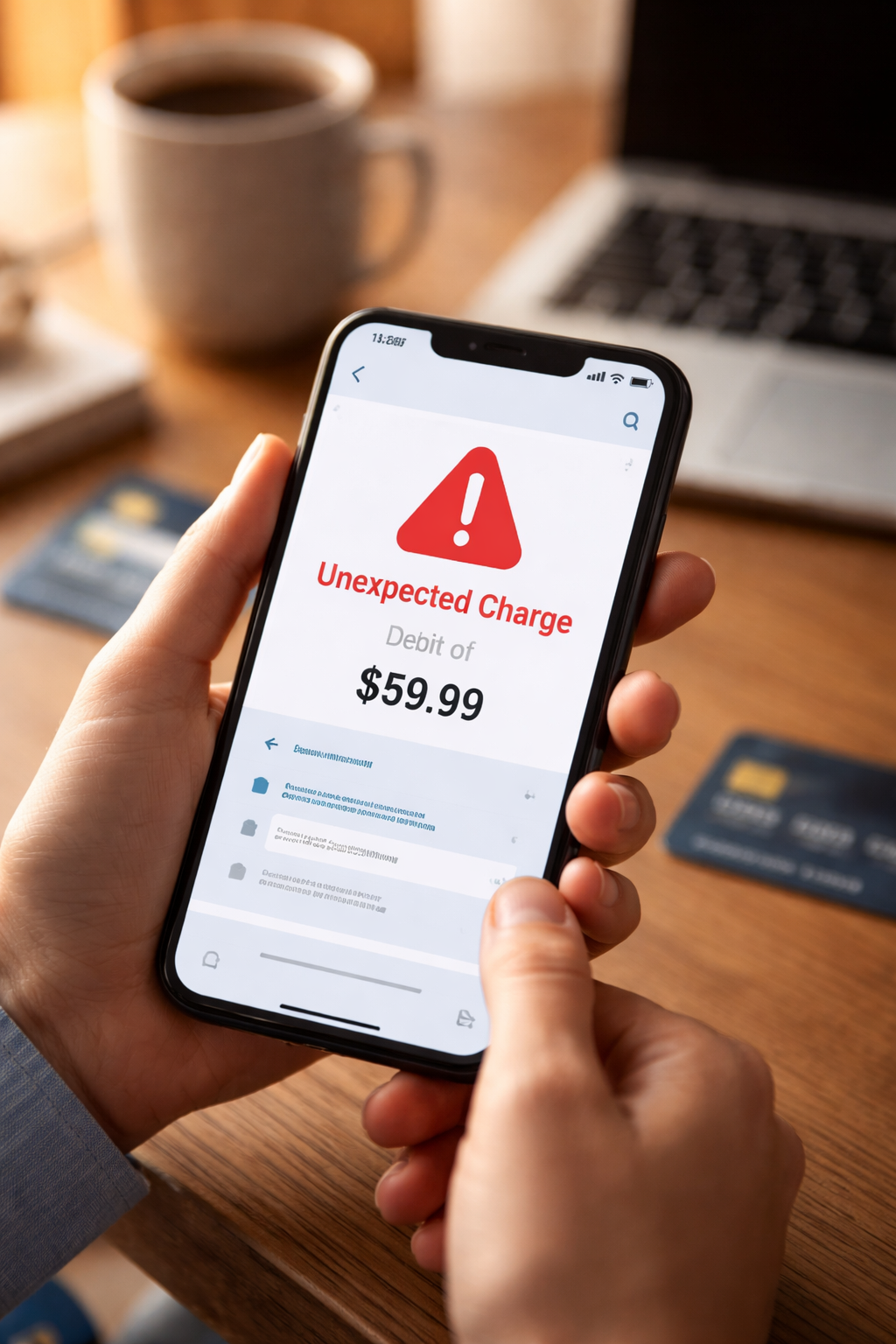
Subscription free trial ended charged without notice — I saw it in my banking app and froze. The amount wasn’t huge, which almost made it worse. Big charges trigger alarms. Small charges slip through. I tapped the transaction, looked for the merchant name, and felt that tight, quiet irritation: I did not remember agreeing to pay today.
I wasn’t trying to “win” a fight. I just wanted the charge to stop, and I wanted a fair refund if this shouldn’t have happened. When a free trial ended charged without notice, the first hour matters because evidence is freshest and cancellation windows are still open. So before I sent any angry message, I treated it like a process.
What this charge usually is (without the textbook talk)
When Subscription free trial ended charged without notice happens, it’s usually one of three realities:
- Automatic conversion: the trial quietly flipped to a paid plan.
- Cancellation didn’t “stick”: you canceled, but the system didn’t record it correctly.
- Confusing disclosure: the terms existed, but the user experience made them easy to miss.
These are not the same problem. If you use the wrong approach, you get the wrong outcome. The goal is to identify which one you’re in, then take the shortest path to resolution.
Fast self-check in 3 minutes
If you’re here because a subscription free trial ended charged without notice, do these checks before contacting anyone:
- Check the charge descriptor: merchant name, app store, or payment processor.
- Open the service account: look for “Billing,” “Plan,” “Invoices,” or “Payments.”
- Find the trial start date: confirm the expected conversion date.
- Screenshot everything: plan status, dates, cancellation page, receipts.
Do not close the tab until you’ve captured proof. Some services update the page the moment you cancel, and you lose the “before” state.
Case branches: match your situation first
Case A: “I forgot to cancel”
You realize the deadline passed. The system is acting “as designed.” The best move is a policy-friendly refund request, not a fight.
Case B: “I canceled, but got charged anyway”
You have a cancel confirmation, email, screenshot, or timestamp. This is strongest for refunds and disputes.
Case C: “I never saw clear trial terms”
The terms were buried, confusing, or the UI implied “free” without emphasizing auto-renewal. This is a disclosure argument.
Case D: “I don’t recognize the merchant”
This might be an app store charge, payment processor, or account compromise. You must identify the source before anything else.
Case E: “It’s a small charge first”
Some services run a small authorization or starter charge. The next charge can be larger. Treat this as an early warning.
Pick one case and follow its path. Jumping between actions (canceling, disputing, replacing cards) can create confusion and slow refunds.
What to do right now (step-by-step playbook)
If a subscription free trial ended charged without notice, this is the cleanest order of actions for most people:
- Step 1: Cancel the subscription immediately (so it doesn’t renew again).
- Step 2: Capture proof (screenshots + confirmation page + email).
- Step 3: Contact the provider in writing (chat/email) with a calm request.
- Step 4: Ask for a refund review, not a demand (you can escalate later).
- Step 5: If denied, escalate with a structured dispute timeline.
Your goal in the first message is to keep them in “help mode,” not “defense mode.”
Exactly what to say to the provider
When subscription free trial ended charged without notice, a strong first message is short and factual:
- State the charge date and amount
- State you did not expect a paid conversion
- Ask them to confirm what triggered it
- Request a one-time refund review
Do not accuse them of fraud in the first message. Many support agents have scripts: accusation triggers denial templates.
If you fall under Case B (canceled but charged), mention the exact timestamp and attach the proof. That often ends the dispute quickly.
Provider logic: why they deny “obvious” refunds
It helps to understand how support teams categorize this. When a subscription free trial ended charged without notice, the agent often checks:
- Was the trial conversion listed in terms at signup?
- Did the user log in or use the service after conversion?
- Is the request inside a refund window (often 7–30 days)?
If you used the service after the charge, refunds get harder. If you didn’t use it, say that clearly. “I did not use the service after the charge posted” is a powerful sentence.
Bank path: when to dispute and when to wait
If subscription free trial ended charged without notice, you can usually involve your bank or card issuer—but timing matters.
- Best: try provider resolution first if you can do it quickly (same day).
- Escalate: if the provider denies, stalls, or repeats the charge.
- Immediate bank action: if you truly don’t recognize the merchant (Case D).
Bank disputes are strongest when you can show you attempted resolution and the merchant refused. Keep copies of chat transcripts or emails.
For official consumer guidance and dispute basics, see the Consumer Financial Protection Bureau resource:
This can help you understand the general complaint and dispute flow without relying on random forums.
Common traps that make refunds fail
When a subscription free trial ended charged without notice, people often do “logical” things that backfire:
- Canceling the card immediately: it may not stop “account updater” recurring charges.
- Disputing while still subscribed: the merchant says “service available,” dispute weakens.
- Waiting for the next statement: you lose refund windows and evidence freshness.
- Only calling by phone: no written record, harder to prove.
Cancel first, document second, message third. That sequence prevents most headaches.
Deep case handling: do this if your case is tricky
If you signed up through an app store:
Your “merchant” may be the store, not the service. Check your Apple/Google subscriptions page and request a refund through the store flow. Provider support may not be able to refund store-billed charges.
If the charge is pending:
Pending doesn’t always mean final. Cancel now and take screenshots. If it posts, you already have proof.
If you see multiple charges:
Treat it as urgent. One is a conversion; multiples can be duplication or plan stacking. Document each transaction.
If you used a virtual card or privacy card:
Locking the merchant can stop repeats. Do it after you capture evidence and confirm the merchant identity.
If you’re worried about identity misuse:
Change your account password and enable 2FA. Then contact the provider and your card issuer with “unrecognized charge” framing.
Even in tricky scenarios, the same principle holds: identify the billing source before you escalate.
Prevention: make sure this never happens again
After subscription free trial ended charged without notice, prevention is part of “solving.” Here’s the simplest future-proof system:
- Set a calendar reminder for 2 days before trial ends
- Use a dedicated email label or folder for “Trials”
- Take a screenshot of the cancellation confirmation every time
- Consider using a virtual card for trials (merchant-locked if possible)
Most people don’t lose money because they’re careless. They lose money because trial systems are quiet by design.
Related issues that often show up next
If you’re dealing with a free trial ended charged without notice, these three internal guides can prevent the “second wave” problem (continuing charges, denied refunds, duplicates):
This is for when you canceled but charges keep coming—different tactics apply.
If support says “no” instantly, this shows how to escalate without making your case weaker.
For duplicate billing scenarios that require item-by-item proof and careful wording.
FAQ
1) Is “free trial ended charged without notice” automatically illegal?
Not automatically. It depends on disclosure clarity and whether you had a reasonable way to cancel. But you can still request refunds and dispute if the experience was misleading.
2) Should I file a dispute with my bank right away?
If you recognize the service, try the provider first quickly, then escalate if denied. If you don’t recognize the merchant, involve the bank immediately.
3) Will canceling my card stop the subscription?
Not always. Some merchants can keep billing through card account updater systems. Canceling the subscription itself is usually necessary.
4) What if I accidentally used the service after the charge?
Refunds can still happen, but it’s harder. Be honest, focus on unclear disclosure, and ask for a one-time courtesy refund if within the refund window.
5) What’s the safest framing to avoid policy trouble?
Stick to facts, timestamps, and what you expected. Avoid exaggerations. Clear documentation is stronger than strong emotion.
Key Takeaways
- When free trial ended charged without notice, act fast: cancel, document, message.
- Pick the right case branch first (forgot to cancel vs canceled but charged vs unclear terms).
- Provider-first is often fastest, but bank escalation is there if denial happens.
- Prevention is part of resolution: reminders + screenshots + safer payment methods.
If you’re reading this because subscription free trial ended charged without notice, you’re not being dramatic. This is a real, common billing trap. The good news is that you can still fix it—especially if you move in the right order and keep records.
Today’s goal is simple: stop future charges and put yourself in the strongest position to reverse the current one. Cancel now, capture proof, send the calm message, and escalate only when you have a clean timeline. You shouldn’t have to “accept” a charge just because a system was quiet.
Note: This article provides general information and is not legal advice. For advice specific to your situation, consider contacting your card issuer or a qualified professional.