
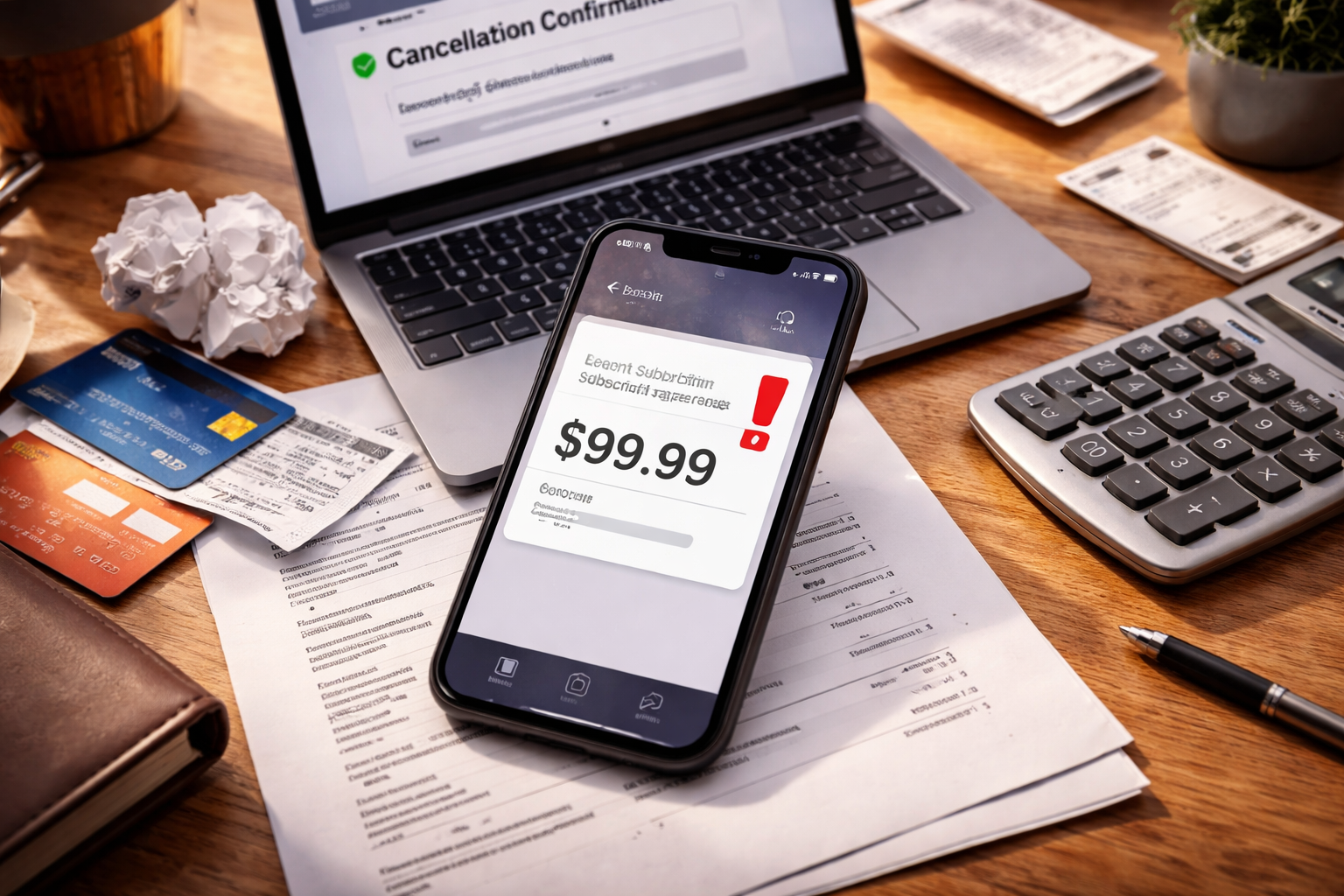
Subscription canceled but still billed. That’s the exact phrase I typed into Google the moment I saw the charge. I was standing in the kitchen, half-looking at my phone, half-thinking about something else, and then my bank app updated. The merchant name was familiar. The amount was familiar. And that’s what made it worse: this wasn’t a mysterious scam. This was the service I had canceled on purpose.
I didn’t panic immediately. I went straight to my inbox and searched “cancellation.” The confirmation email was there. The timestamp was there. I even remembered the little sense of relief I’d felt when the screen said, “You’re all set.” Yet the charge was on my statement anyway. The emotional whiplash of “I did everything right” and “I’m still being billed” is the hallmark of this dispute.
Fast self-check: which version of subscription canceled but still billed are you in?
Before you write any emails or open a dispute, identify which bucket your situation falls into. When subscription canceled but still billed happens, outcomes depend heavily on the exact timing and the “type” of subscription.
- Pending charge: You see it as pending/authorized but not posted.
- Posted charge: The money has already left (debit) or posted (credit card).
- Renewal mismatch: You canceled, but the provider claims the “next renewal” was already locked.
- Trial conversion: You canceled a trial but were billed anyway.
- Bundle subscription: You canceled one part, but billing was tied to another product.
- App store / platform billing: You canceled inside the app, but the platform is the merchant of record.
If you choose the wrong path (provider vs platform vs bank) you can lose days—and days matter.
Why subscription canceled but still billed happens (without “textbook” explanations)
Most people assume cancellation is a clean switch: ON to OFF. In reality, subscription canceled but still billed often happens because billing systems treat cancellation as a “status change” that may not propagate everywhere. You cancel in one place, but billing is running somewhere else.
Here are the most common “real-world” causes I see repeated in these disputes:
- Cutoff-time cancellation: You canceled on the renewal date, but the system processed billing earlier that day (or the day before).
- End-of-cycle language: The UI says “cancel,” but the terms mean “cancel at end of billing period,” so you still get charged for the current cycle.
- Multiple accounts: You canceled one login, but billing is tied to a different email, Apple ID, Google account, or legacy account.
- Payment processor delays: The cancellation record exists, but the payment processor already generated the invoice/authorization.
- Bundle entanglement: You canceled “Add-on A,” but the charge is for “Bundle B,” and you didn’t actually cancel the billing source.
None of that makes the charge fair. It only explains why it happened.
What the provider sees (and why they often refuse at first)
When you contact support, the first agent is often reading from a dashboard that was designed for billing success, not consumer fairness. In many subscription canceled but still billed cases, their screen shows something like:
- Payment succeeded
- Subscription was active at time of invoice
- Cancellation effective at end of period
- No refund eligibility flag
So you get a scripted response: “We can’t refund because the subscription was active.” That doesn’t mean you’re wrong. It means the default support path protects their revenue unless you show the mismatch clearly and calmly.
Your job is not to argue emotion. Your job is to prove timeline and authorization.
Your rights when subscription canceled but still billed (U.S. safe framing)
In the U.S., you generally have the right to dispute charges you did not authorize or that were billed in error. When subscription canceled but still billed occurs, the key question is: did you give valid permission for that specific billing period?
- If you canceled before the renewal window and have proof, the provider must justify why the charge was valid.
- If you canceled during a trial, the provider must justify why it converted anyway.
- If the platform is the merchant (Apple/Google), you may need to dispute through the platform first.
Cancellation is you withdrawing future authorization. A charge after that is not automatically “allowed.”
Do this first: evidence pack you can build in 5 minutes
When subscription canceled but still billed hits, you want a simple, clean set of proof. Not a long story. Not a rant. Proof.
- Screenshot of cancellation confirmation page (if accessible)
- Screenshot or saved copy of the cancellation email with timestamp
- Account page showing “Canceled” or “Inactive” status
- Statement line item showing merchant, amount, date
- If trial-based: screenshot of trial end date vs cancellation date
Think of this like a mini “case file.” You’re making it easy for someone to refund you.
Case split : pick your situation and follow the matching steps
This section is designed so you can immediately match your reality. Read only the case that fits you and act today.
Case A: You see a pending charge (not posted yet)
If subscription canceled but still billed appears as pending, you’re in a strong position because the charge may be stoppable before it finalizes.
- Contact the provider immediately (chat/email). Provide cancellation timestamp and ask them to “void the authorization.”
- Ask for a confirmation number or written acknowledgment.
- If it’s a debit card and you’re worried about overdraft, call your bank and ask if they can place a stop on the merchant authorization (policies vary).
Do not wait for it to post. A pending charge is the easiest to reverse—if the provider acts quickly.
Case B: Charge posted after you canceled before renewal
This is the “classic” subscription canceled but still billed scenario: you canceled in time, and the system billed anyway.
- Send a short message: “Canceled on [date/time]. Charged on [date]. Request refund to original payment method.”
- Attach proof: cancellation email + account status screenshot.
- If they refuse, ask for escalation: “Please review the cancellation timestamp and billing cutoff.”
Keep it timeline-based. The more precise you are, the harder it is for them to dismiss you.
Case C: Free trial canceled, still charged
Trial conversion disputes are a high-volume category. The provider often claims you canceled “too late,” even if the UI was unclear.
- Check whether you canceled inside the app or on a website. If billed by Apple/Google, you may need the platform’s refund flow.
- Provide the exact trial end date shown at signup (if you have it).
- Request a “one-time courtesy refund” if they hide behind policy, but still include proof.
Many providers will refund trial conversions if your request is fast and clean.
Case D: Annual plan auto-renewed
Annual renewals are where subscription canceled but still billed gets expensive. Providers often cite policy, but you can still win if there’s a mismatch or unclear consent.
- Look for renewal notification emails. If they failed to notify, mention it.
- Argue authorization: you canceled access/intent and should not be billed for a new year.
- If you didn’t use the service after renewal, say so. “No usage since renewal date” helps.
Annual disputes are harder, but not hopeless—especially when usage is zero and cancellation evidence is strong.
Case E: You canceled but the provider says “effective end of billing period”
This is where wording matters. Sometimes subscription canceled but still billed is not “after” cancellation, but “for the current cycle.” If you canceled mid-cycle, they may claim you still owe the current month.
- Check the billing period dates: are you being charged for time already used?
- If the charge is for the next period (future service), push back hard.
- If the charge is for current period, your best path may be to prevent future renewals rather than refund.
Ask one question: “Is this charge for past/current service, or future service?” The answer guides your next move.
Case F: App store / platform is the merchant (Apple/Google)
If your statement shows Apple/Google (or the platform), the provider may not be able to refund you directly. This is a major reason subscription canceled but still billed drags on.
- Verify the “merchant of record” on your statement.
- Request refund through the platform first if they are the merchant.
- Still cancel inside the platform subscription settings (not only in the app UI).
When the platform bills you, the platform’s rules often control the refund path.
Case G: You canceled, but charges keep coming monthly
Recurring post-cancellation charges are the most exhausting form of subscription canceled but still billed. It often indicates you canceled the “account” but not the “billing agreement.”
- Look for a separate billing portal, PayPal billing agreement, or “active payment authorization.”
- Change your password and remove saved payment methods (where possible).
- Escalate: “Charges continue after documented cancellation. Please terminate billing authorization immediately.”
If it happened once, it can happen again next month. Stop the authorization, not just the account.
A simple escalation ladder that actually works
When subscription canceled but still billed is met with a refusal, most people either give up or explode. Neither helps. Use an escalation ladder that stays calm and keeps pressure on the timeline problem.
- Step 1: Provider support (written) with your evidence pack
- Step 2: Supervisor/escalation team review (ask explicitly)
- Step 3: Bank/credit card dispute if unresolved
- Step 4: Formal complaint route if needed (see resource below)
Escalation is not aggression. It’s structure.
What NOT to do (these mistakes reduce refunds)
- Don’t accept store credit if you want cash back (unless you truly prefer it)
- Don’t cancel again and lose your original timestamp trail
- Don’t send long paragraphs—keep it “proof + request”
- Don’t wait beyond dispute windows (especially for credit cards)
- Don’t threaten legal action as your opening line (it slows support)
Your strongest weapon is clarity, not intensity.
Internal reads that match this problem (follow)
If you’re dealing with subscription canceled but still billed, these three posts are the closest matches in your existing cluster. They won’t duplicate this page, but they expand related dispute tactics.
Read this if the provider acknowledges cancellation but refuses a refund anyway.
Helpful when the provider claims “one charge,” but your statement shows duplicates or repeated authorizations.
Same pattern, different industry. Good for escalation language and documenting service termination.
One authoritative escalation option (follow)
If the charge involves a financial institution or you need a formal escalation route, the Consumer Financial Protection Bureau complaint process is a credible U.S. option. Use it only after you’ve documented provider contact attempts.
FAQ
Is subscription canceled but still billed an “unauthorized charge”?
Sometimes. If you canceled before the renewal and have proof, it can be treated as a billing error or unauthorized renewal, depending on the details.
Should I dispute with the provider or the bank first?
Start with the provider to create a record, but don’t stall. If they refuse or delay, move to your bank/issuer dispute path promptly.
What if I used the service after canceling?
If you continued using it, the provider may argue you accepted the service. If usage was accidental or minimal, explain it factually and focus on the cancellation proof and billing dates.
What if the merchant name looks different on my statement?
That’s common. Take a screenshot of the charge and match it to the subscription billing receipt or invoice email if available.
What if I canceled through an app but still got billed?
Confirm whether Apple/Google (or another platform) is the merchant of record. If they are, refund and cancellation steps often must be done through the platform’s subscription settings.
Key Takeaways
- subscription canceled but still billed is usually a system mismatch, not “you forgetting”
- Evidence + timeline beats long explanations
- Pick the correct path: provider vs platform vs bank
- Recurring post-cancellation charges mean you must stop the billing authorization
- Act within 24–72 hours for the best outcome
If you’re dealing with subscription canceled but still billed right now, here’s the simplest next move: build your evidence pack, send a short refund request in writing, and set a deadline for yourself (not them). If you don’t get a clear resolution quickly, escalate—calmly—to the dispute route.
You did the responsible thing when you canceled. The goal now is to make the billing system match reality. Start today, while the timestamps are still fresh and the charge is still easy to reverse.